Food & Drink
Kobe Beef: Japan's Most Revered Dining Experience
Only 3,000 cattle per year earn the right to be called Kobe beef. Behind that exclusivity lies centuries of Japanese tradition, exacting husbandry, and a marbling so extraordinary it melts at body temperature.
Of all the world's great luxury foods, few carry the mystique — and the strict gatekeeping — of authentic Kobe beef. Produced exclusively from Tajima-strain Japanese Black cattle raised in Hyogo Prefecture, around the city of Kobe, true Kobe beef is among the rarest meats on earth. Fewer than 3,000 head of Kobe-certified cattle are slaughtered each year, and only a handful of restaurants outside Japan are licensed to serve it.
The history of Wagyu cattle in Japan stretches back over two millennia, but the breed was largely isolated from foreign genetics until the Meiji Era (1868–1912), when crossbreeding with Western cattle briefly occurred before being banned to preserve the bloodline's purity. The result is a uniquely Japanese genetic heritage that produces extraordinary intramuscular fat — the hallmark marbling (shimofuri) that has made Kobe beef legendary.
To qualify as Kobe beef, an animal must meet an extraordinary set of criteria established by the Kobe Beef Marketing and Distribution Promotion Association (https://www.kobe-niku.jp/en/). It must be a Tajima-strain Japanese Black born, raised, and slaughtered within Hyogo Prefecture. It must achieve a Beef Marbling Score (BMS) of 6 or higher (out of 12), an overall quality grade of A4 or A5, and a meat quality score of 4 or 5. Less than one in four Tajima cattle qualifies.
The cattle themselves are treated with meticulous care. They graze on natural grass and are fed a diet of high-quality grains, including rice straw, and given clean spring water. Contrary to popular myth, the practice of massaging cattle or feeding them beer is not a standard certified practice — it is more legend than rule. What is real is the exceptional level of attention paid to stress reduction, as stress hormones negatively impact marbling quality.
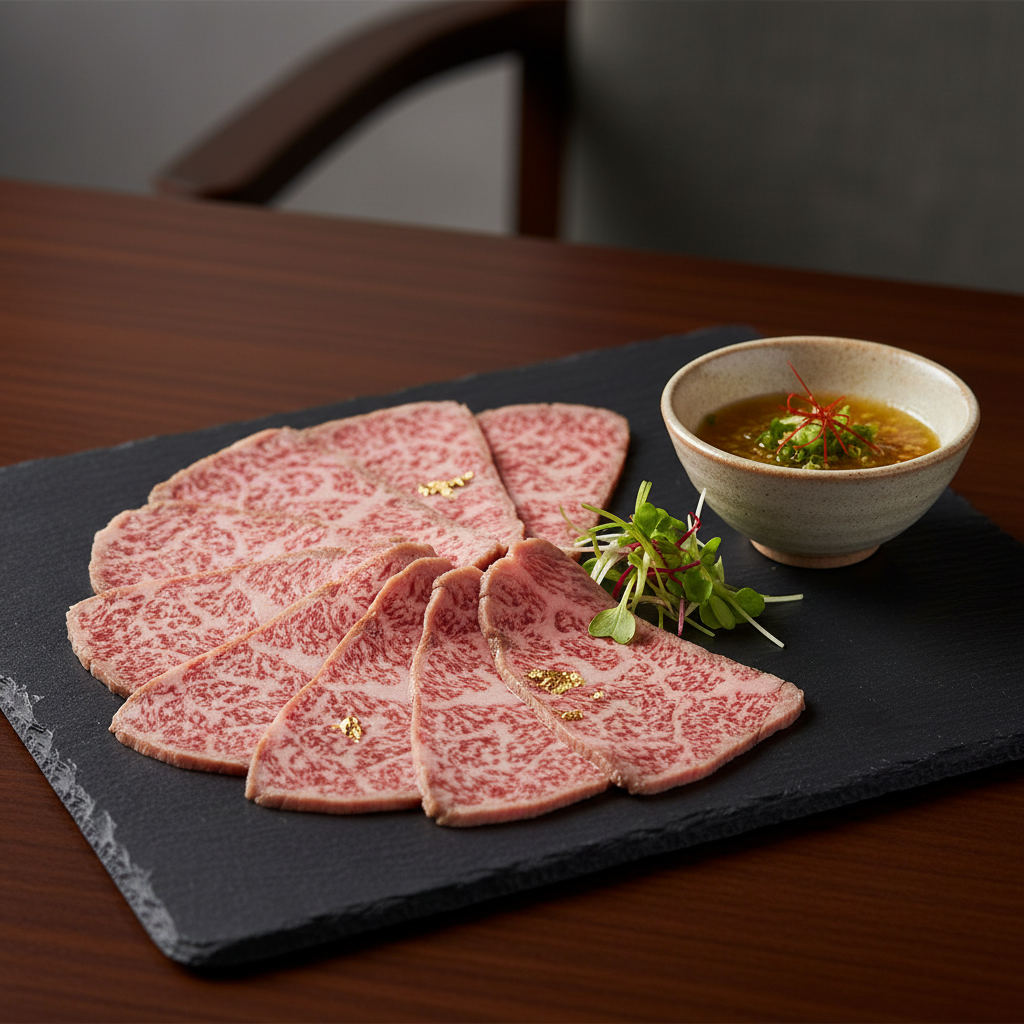
The marbling of A5 Kobe is not simply aesthetic. The fat in true Kobe beef is unusually high in oleic acid (the same healthy monounsaturated fat found in olive oil), which lowers its melting point to below body temperature — meaning it literally dissolves on the palate. The flavour is intensely beefy, with a clean buttery richness and a long, sweet finish that cannot be replicated by any other cattle breed or region.
In Kobe city itself, the finest way to experience the meat is at a certified teppanyaki restaurant, where a skilled chef grills thin-sliced Kobe on an iron plate before you. A few elite establishments, like Mouriya Honten (www.mouriya.co.jp) — established in 1885 — have been serving Kobe beef for over a century. Steakhouses in the Kitano and Sannomiya districts offer everything from multi-course kaiseki-style presentations to simple, reverently grilled cuts served with ponzu or wasabi.
For visitors to Kobe, the Kobe Beef Official Guide (https://www.kobe-niku.jp/en/) lists all certified retailers and restaurants. Outside Japan, only a small number of internationally certified importers are permitted to sell authentic Kobe beef — look for the official Kobe beef logo and traceability certificate when purchasing.
When dining on Kobe, less is more. The finest cuts — the ribeye (rib roast), sirloin, and tenderloin — are best served rare to medium-rare to allow the marbling to melt but not render away. Accompaniments should be minimal: a touch of fleur de sel, a sliver of sudachi citrus, or a clean ponzu. The meat carries the experience entirely on its own.
For those who cannot make it to Japan, A5 Wagyu from other prefectures — Miyazaki, Kagoshima, Ohmi — offers a similarly extraordinary experience. But for the purist, there is only one Kobe.

Continue Reading