Fashion
Italian Shoes: The Art of Goodyear Welted Footwear
The Goodyear welt — patented in 1869 by Charles Goodyear Jr. — is the gold standard of shoe construction. From the factories of Northampton to the workshops of Italy, here is the art of welted footwear.
The Goodyear welt is the gold standard of shoe construction — a method of assembling a shoe that has remained essentially unchanged for over 150 years, and that produces footwear of extraordinary durability, repairability, and quality. A Goodyear welted shoe can be resoled dozens of times, meaning that a single pair, with proper care, can last a lifetime.
The Invention
The Goodyear welt was patented in 1869 by Charles Goodyear Jr. — the son of Charles Goodyear Sr., the inventor of vulcanised rubber. The younger Goodyear's invention was a method of stitching the upper (the visible part of the shoe), the insole, and a strip of leather called the welt together, before attaching the sole to the welt. This construction allows the sole to be removed and replaced without disturbing the upper, making the shoe fully resoleable.
The key innovation was the use of a rib (a canvas or leather rib attached to the underside of the insole) that allowed the upper and the welt to be stitched to the insole by machine — a process previously done entirely by hand (the hand-welted method). The Goodyear welt machine, which Goodyear Jr. developed, made this construction commercially viable and revolutionised the shoemaking industry.
The Northampton Tradition
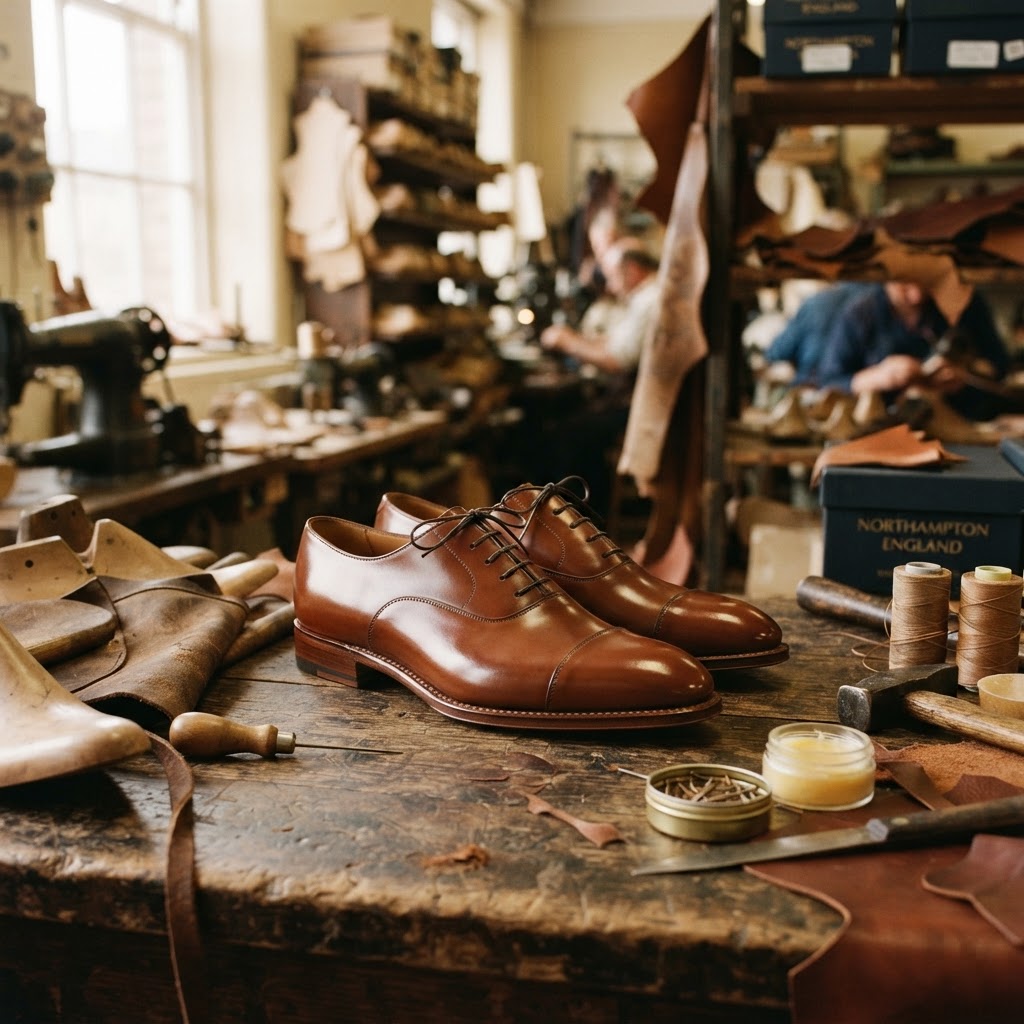
The spiritual home of Goodyear welted shoemaking is Northampton, England — a market town in the East Midlands that has been the centre of English shoemaking since the 15th century. The town's tradition of leather working was established by the abundance of local oak forests (whose bark was used for tanning) and the local cattle trade.
**Crockett & Jones**, founded in 1879 by James Crockett and Charles Jones (two brothers-in-law), is one of the most respected names in Northampton shoemaking. The company has been manufacturing shoes in its Northampton factory since its founding, and in 1910 became the first English shoemaker to install the Goodyear welt machine — transitioning from the slower, more labour-intensive hand-welted method. Crockett & Jones remains family-owned (now in its fifth generation) and produces all its shoes in Northampton using Goodyear welted construction.
A single pair of Crockett & Jones shoes takes 8 to 10 weeks to make and passes through over 200 separate operations. The company's most iconic models — the Audley (a plain cap-toe oxford), the Hallam (a plain cap-toe oxford on a sleeker last), and the Coniston (a country boot) — are benchmarks of English shoemaking.
The Great Houses
Beyond Crockett & Jones, the Northampton tradition is represented by several other historic houses:
**Edward Green** (founded 1890) — considered by many to be the finest English shoemaker, producing approximately 350 pairs per week (by contrast, Crockett & Jones produces several thousand). Edward Green is known for its proprietary last shapes, its exceptional leather (sourced from the best tanneries), and its meticulous hand-finishing.
**John Lobb** (founded 1866) — the Paris-based English bootmaker (not to be confused with the Northampton-based ready-to-wear brand of the same name), John Lobb Paris is a bespoke house that also produces a ready-to-wear line. The bespoke waiting list can extend over a year, with shoes priced in the thousands.
**Church's** (founded 1873) — acquired by Prada in 1999, Church's is one of the largest and most internationally recognised Northampton brands.
The Italian Tradition
While the English tradition of Northampton is the heart of Goodyear welted shoemaking, Italy has developed its own tradition of fine shoemaking, centred in the Marche region. Italian shoemakers such as **Santoni** (founded 1975) and **Silvano Lattanzi** (founded 1971) combine Goodyear welted and Blake-stitched construction with the aesthetic sensibility of Italian design. Silvano Lattanzi, in particular, is renowned for its hand-welted, hand-coloured shoes, which are collected by enthusiasts worldwide.
Practical Guidance
When investing in Goodyear welted shoes, the key considerations are the leather quality (full-grain calfskin for dress shoes, pebble grain or suede for country shoes), the last shape (choose a last that fits your foot — the shoe should be comfortable from the first wearing, as Goodyear welted shoes do not stretch significantly), and the construction (a genuine Goodyear welt can be identified by the visible stitching around the perimeter of the sole). With proper care — regular polishing, shoe trees, and resoling when needed — a quality pair of Goodyear welted shoes will last for decades.
Reference Links:
- Crockett & Jones — Goodyear Welted Construction: us.crockettandjones.com/blogs/the-article/goodyear-welted-construction
- Crockett & Jones — In the Making: us.crockettandjones.com/pages/in-the-making
- Wikipedia — Crockett & Jones: en.wikipedia.org/wiki/Crockett_%26_Jones
- Edward Green: edwardgreen.com
- John Lobb Paris: johnlobb.com
- Church's: church-footwear.com
- Santoni: santonishoes.com
- Silvano Lattanzi: silvanolattanzi.com



Continue Reading