Food & Drink
The Italian Aperitivo: Spritz Culture and the Milanese Golden Hour
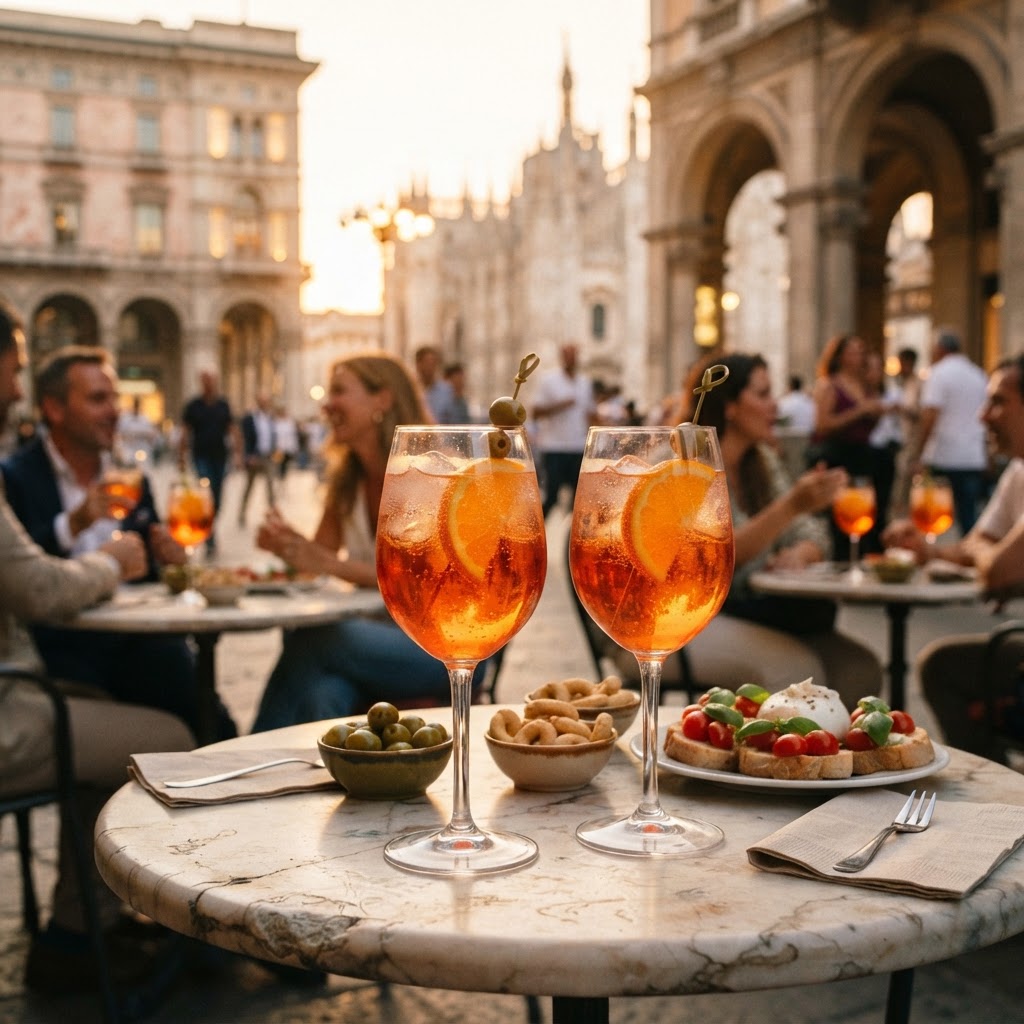
In Italy, the hour before dinner is not empty time. It is the aperitivo — a daily ritual of a bitter, sparkling drink and a small plate of something salty, taken standing at a bar or settled at a café table as the city turns gold.
In Italy, the hour before dinner is not empty time. It is the aperitivo — a daily ritual of a bitter, sparkling drink and a small plate of something salty, taken standing at a bar or settled at a café table as the city turns gold. To understand the aperitivo is to understand how Italians separate the work of the day from the pleasure of the evening, and how a single glass can hold an entire philosophy of time.
**What an Aperitivo Is**
An aperitivo is, strictly, a drink taken before a meal to stimulate the appetite — the word shares its root with "appetite" and "aperire," to open. But in practice it is more than a drink. It is a social institution: from roughly six in the evening until nine, Italians gather in bars and cafés, order a bitter or sparkling beverage, and are brought, often without extra charge, a small plate of olives, nuts, crisps, sliced meats, or crostini. The point is not to dine. The point is to mark the transition from labor to leisure in the company of others.
**The Origins of the Spritz**
The signature drink of the modern aperitivo is the spritz, and its origins are a collision of empires. During the nineteenth century, the Veneto region of northern Italy was under the rule of the Austrian Habsburgs, and the occupying Austrian soldiers found the local Italian wines too strong for their taste. They took to diluting them with a splash of water — the German verb "spritzen," to spray or splash, giving the drink its name. Over time, the splash of water became a splash of sparkling water, then a measure of a bitter aperitif such as Aperol or Campari, and finally the addition of Prosecco that defines the modern drink.
The contemporary recipe, codified when the spritz was added to the International Bartenders Association's official cocktail list in 2011, is simple: three parts Prosecco, two parts Aperol (or Campari, or Cynar), and a splash of soda, served over ice in a large wine glass with a slice of orange. The Aperol Spritz, in particular, became one of the most popular cocktails in the world in the 2010s, its vivid orange color as recognizable as its bittersweet taste.
**The Milanese Golden Hour**
While the spritz was born in the Veneto, Milan made the aperitivo an art. The Milanese aperitivo, particularly in the canal-side Navigli district and the grand bars around the Duomo, is famous for its abundance — a single drink buying access to a buffet of hot and cold small plates that can amount to a light dinner. The ritual is so embedded in Milanese life that the city's offices effectively empty toward six in the evening as workers migrate, in groups, to their preferred bar. The golden hour, that low slant of evening light for which Italy is famous, is the natural backdrop; the aperitivo is its ceremony.
**Bitterness and the Italian Palate**
What distinguishes the Italian aperitivo from a simple happy hour is the bitterness. Aperol, Campari, Cynar, and the Negroni — that other great Italian aperitif cocktail of gin, Campari, and sweet vermouth — share a family of flavors rooted in bitter herbs, citrus peel, and roots. These are acquired tastes that Italians acquire early, and they serve a function: bitterness triggers the digestive system, preparing the body for the meal to come. Where the American palate reaches for sweetness before dinner, the Italian palate reaches for the opposite, and the spritz is its brightest expression.
**The Brunch Connection**
The aperitivo and the brunch are, in a sense, mirror rituals — both exist to slow the day, both pair a sparkling drink with small, savory food, and both reward the social hour over the meal itself. A brunch built on aperitivo principles — an Aperol Spritz or a Paloma Spritz, a board of olives and cured meats and crostini — borrows the best of Italy for the American morning. The Italian Aperitivo Hour is, in spirit, the cousin of the mimosa bar.
**References**
- Wikipedia: Spritz (cocktail) — https://en.wikipedia.org/wiki/Spritz_(cocktail)
- Wikipedia: Aperitivo — https://en.wikipedia.org/wiki/Aperitivo
- Wikipedia: Negroni — https://en.wikipedia.org/wiki/Negroni
- Wikipedia: Aperol — https://en.wikipedia.org/wiki/Aperol

Continue Reading