Travel
Iceland: The Northern Lights, the Blue Lagoon & the Land of Fire and Ice
Iceland — a volcanic island of extraordinary geological youth on the Mid-Atlantic Ridge — offers the most dramatic natural spectacle in the Northern Hemisphere: the aurora borealis over a landscape of glaciers, geysers, black sand beaches, and geothermal pools.
Iceland is one of the world's youngest landmasses in geological terms — a volcanic island sitting directly on the Mid-Atlantic Ridge, where the Eurasian and North American tectonic plates are pulling apart at 1 in per year, creating a landscape of extraordinary geological dynamism: active volcanoes, geysers, hot springs, glaciers, black sand beaches, and lava fields in every stage of ecological succession from bare rock to ancient moss. The result is a country of dramatic, alien beauty unlike anywhere else in Europe — and, for 2–3 months of winter, the finest place on earth to witness the aurora borealis.
The Northern Lights
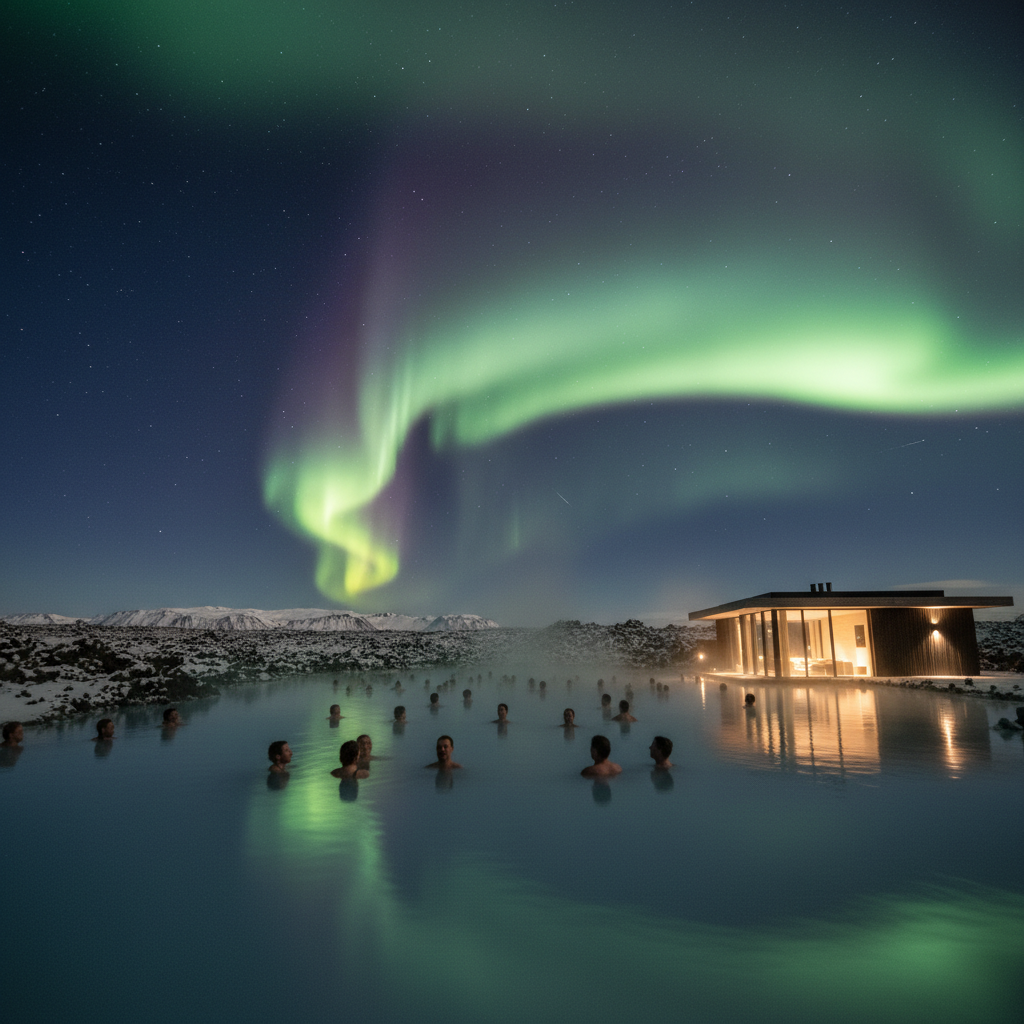
The aurora borealis — caused by charged solar particles interacting with Earth's magnetosphere — appears in Iceland between September and March, with October–February offering the longest and darkest nights. Iceland's low light pollution outside Reykjavík, combined with its position just south of the Arctic Circle, makes it one of the most reliable viewing destinations in the Northern Hemisphere. Solar activity (measured by the Kp index; spaceweather.com provides real-time forecasts) is the primary determinant of display intensity. The Icelandic Met Office's aurora forecast (vedur.is/english/aurora-forecast) provides a cloud-cover and activity prediction essential for trip planning. The Snæfellsnes Peninsula (2 hours from Reykjavík), Jökulsárlón Glacier Lagoon (5 hours), and the Westfjords offer the finest dark-sky viewing locations.
The Blue Lagoon
The Blue Lagoon (bluelagoon.com) — Iceland's most famous attraction — is a geothermal seawater pool of milky-blue, silica-rich water at 37–102°F, located in a dramatic lava field 40km from Reykjavík on the Reykjanes Peninsula. Created as a secondary effect of the Svartsengi geothermal power station in 1976, the lagoon's unique water chemistry — rich in silica, algae, and minerals — creates the characteristic white-blue opacity and the therapeutic skin properties for which it is celebrated worldwide. The Retreat at Blue Lagoon Iceland (bluelagoon.com/the-retreat) — a 62-room luxury hotel within the lagoon itself, opened 2018 — is the definitive accommodation: guests access a private section of the lagoon at any hour, including midnight aurora viewing from the water. Rooms from $1,000/night.
Reykjavík: The World's Most Northerly Capital
Reykjavík — population 130,000 — is the world's most northerly capital city, and one of the most concentrated in Europe for cultural activity per capita. Hallgrímskirkja (hallgrimskirkja.is) — the 73-metre concrete church modelled on the basalt column formations of Svartifoss waterfall — is the city's defining landmark. The Harpa Concert Hall (harpa.is), designed by Henning Larsen Architects with a glass facade by Olafur Eliasson, is one of the most beautiful concert halls in Europe. The restaurant scene — small, locally-sourced, New Nordic in philosophy — is the finest in the North Atlantic: Dill Restaurant (dillrestaurant.is), the first Michelin-starred restaurant in Iceland (awarded 2017), serves a tasting menu of extraordinary ingredients (langoustine, Arctic char, lamb, skyr) in a deeply Icelandic culinary vernacular.
The Ring Road and Natural Wonders
Route 1 — the Ring Road — circles Iceland's entire perimeter in 1,332km, passing all of the country's principal natural attractions: the geysers of Geysir and Strokkur (geysircenter.com) in the Golden Circle; the Gullfoss waterfall; the black sand beaches and basalt sea stacks of the South Coast; Vatnajökull National Park (vatnajokull.is) — Europe's largest national park, covering 14% of Iceland, encompassing Europe's largest glacier — and the extraordinary Jökulsárlón glacier lagoon, where icebergs calve from the Breiðamerkurjökull glacier into a lagoon of extraordinary sculptural beauty.
Where to Stay
Ion Adventure Hotel (ioniceland.is) at the Nesjavellir geothermal area, 60km from Reykjavík, is the finest design hotel outside the capital: a dramatic structure of concrete and glass embedded in a lava landscape, with an outdoor geothermal pool, superb northern lights viewing, and direct access to hiking trails. Rooms from $400/night.
Fosshotel Glacier Lagoon (islandshotel.is) at Jökulsárlón is the best located property in South Iceland — glacier views from every room, with the aurora visible across the iceberg lagoon on clear nights. Rooms from $350/night.
Getting There
Reykjavík Keflavík International Airport (KEF) — 50km from the city — is served by Icelandair (icelandair.com) from 28 US cities, and by multiple European carriers from London, Paris, Amsterdam, Frankfurt, and Copenhagen. Icelandair's Stopover programme allows free multi-day stopovers in Iceland on transatlantic flights at no additional airfare.
Reference Links:
- Visit Iceland: visiticeland.com
- Blue Lagoon & The Retreat: bluelagoon.com
- Aurora forecast (Icelandic Met Office): vedur.is/english/aurora-forecast
- Vatnajökull National Park: vatnajokull.is
- Dill Restaurant Reykjavík: dillrestaurant.is
- Ion Adventure Hotel: ioniceland.is
- Icelandair Stopover: icelandair.com/stopover
- Geysir Center: geysircenter.com



Continue Reading