Home
The Home Cinema: Designing a Private Screening Room Worth the Investment
A home cinema is the most indulgent room in the house — and when designed properly, one of the most used. Here is how to create one that rivals the best boutique cinemas in the world.
The home cinema is, at its core, a very simple room: a dark space with excellent picture, excellent sound, and excellent seating. But within that simplicity lie hundreds of decisions — technical, aesthetic, acoustic — each of which materially affects the quality of the experience.
A well-designed home cinema rivals the best boutique cinema experiences anywhere in the world. A poorly designed one is simply a living room with a big television and inadequate seating. The distance between the two is not primarily one of budget; it is one of knowledge and careful specification.
**The technical brief: start here**
Any home cinema project should begin with an honest assessment of how the room will be used. Is this a dedicated cinema room, used exclusively for film and television? Or is it a multi-use media room that also functions as a family sitting room? The answer determines everything: screen size, seating configuration, acoustic treatment, and the degree to which the room can be optimised for cinematic performance at the expense of other uses.
A dedicated cinema room can be taken much further — blackout conditions, full acoustic treatment, tiered seating, a projector and 4K laser projector screen rather than a television — than a multi-use space. ISE (iseurope.org), the Integrated Systems Europe conference, publishes excellent resources on the state of the art in residential AV installation.
**The image: projector versus screen**
For serious home cinema enthusiasts, a large-format 4K laser projector with a acoustically transparent motorised screen is the gold standard. At its peak, this combination delivers an image quality and scale that no flat-panel television can approach.
Sony's VPL-VW890ES (sony.com) and JVC's DLA-NZ900 (jvc.com) are among the finest 4K projectors currently available for residential installation. They project onto screens of 120 to 180 inches with colour accuracy that satisfies Hollywood colourists.
For those who prefer the simplicity of a flat panel, Samsung's 98-inch Neo QLED (samsung.com) and LG's OLED evo range (lg.com) deliver reference-quality images in rooms where total light control is not achievable.
Screen innovations (screeninnovations.com) and Stewart Filmscreen (stewartfilmscreen.com) manufacture some of the finest projection screens available, including ambient light-rejecting options that maintain contrast in rooms with some residual light.
**The sound: where most home cinemas fail**
Home cinema audio is a field of considerable complexity, and it is where the majority of home cinema installations fall short. A great audio system in a poorly treated room will always sound worse than a good audio system in a well-treated room. Acoustic treatment is not optional; it is foundational.
The objective of acoustic treatment in a cinema room is to control three things: early reflections (the first bounce of sound off walls, ceiling, and floor), bass resonance (low frequencies that build up at room boundaries), and reverberation time (the length of time sound takes to die away after its source stops).
For premium home cinema audio, Dolby Atmos (dolby.com) is the current benchmark — a three-dimensional sound format that places individual sounds at precise positions in three-dimensional space, including above the listener. An Atmos system requires ceiling-mounted speakers in addition to the traditional surround array, but the experiential upgrade is dramatic.
Bowers & Wilkins (bowers-wilkins.com), Focal (focal.com), and Steinway Lyngdorf (steinwaylyngdorf.com) produce speakers of reference quality suitable for demanding home cinema installations.
**Seating: the experience is only as good as the chair**
Cinema seating has evolved enormously. The best contemporary home cinema chairs — from manufacturers such as Cineak (cineak.com), Fortress Seating (fortressseating.com), and Moovia (moovia.eu) — combine the reclining, power-adjusting comfort of business-class aircraft seats with the aesthetic quality of proper furniture.
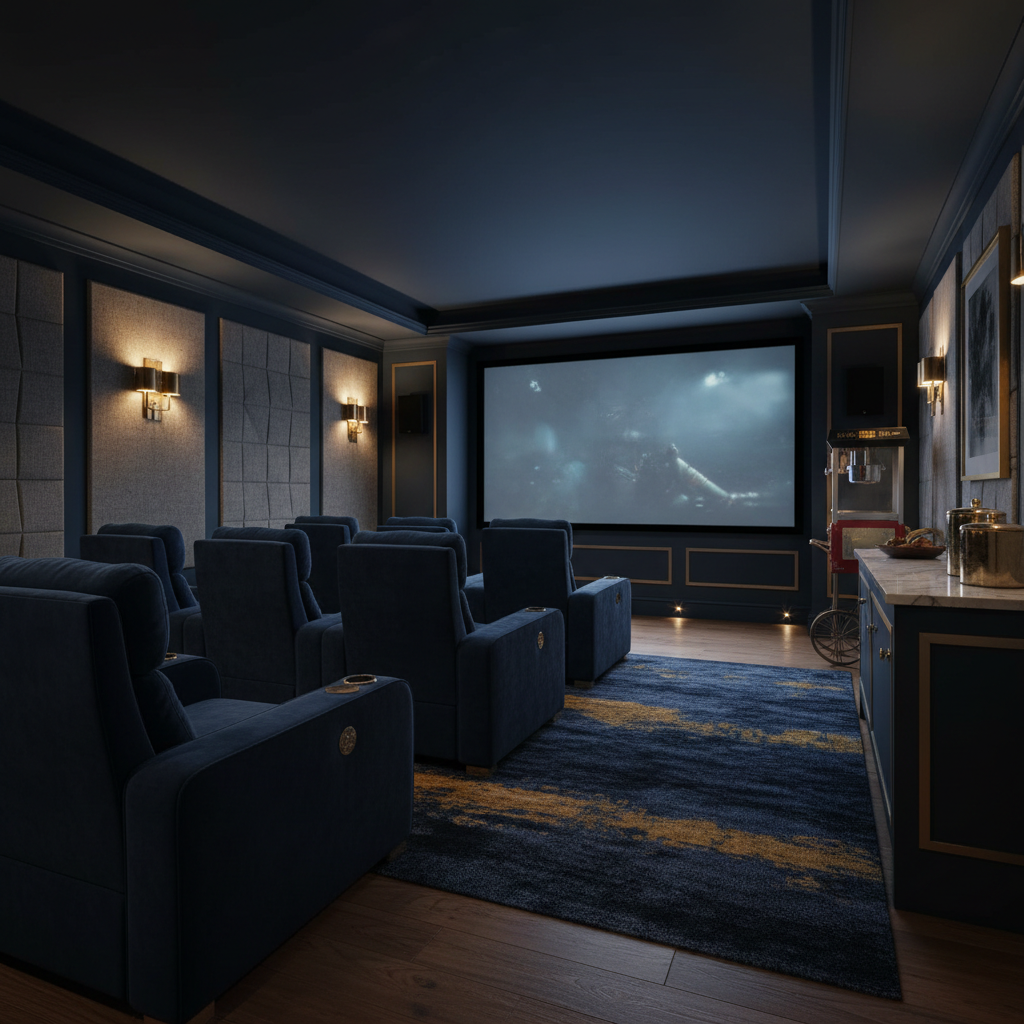
Key considerations: seat width (wider than a standard chair — 22 to 26 inches minimum), recline range (fully flat for feature films), legroom (nothing interrupts a film like an uncomfortable position), and the material (leather is the most durable; performance velvet feels the most luxurious).
For tiered seating — front and rear rows at different heights — the rear platform should raise by 12 to 15 inches to ensure clear sightlines over the front row heads.
**Décor: the room should disappear into the dark**
A cinema room is one of the few domestic spaces where the décor's primary function is to become invisible. Dark walls, dark ceiling, dark floor — all these elements reduce light scatter and allow the projected image to dominate the visual field.
Deep navy, charcoal, and black are the classic cinema room colours. Wall-to-wall carpet or felt-backed carpet tiles absorb sound and eliminate floor reflections. Fabric-wrapped acoustic panels, available through GIK Acoustics (gikacoustics.com), serve the dual purpose of decoration and acoustic management.
Concealed LED lighting at low level — under seats, at the base of walls — provides sufficient ambient light for safe movement without compromising the cinematic atmosphere. Lutron (lutron.com) produces the most sophisticated residential dimming systems, offering scene control that adjusts automatically between movies, intermission, and room entry.
**The popcorn station: the finishing detail**
A home cinema without a popcorn station is a home cinema that is missing its most pleasurable finishing touch. A dedicated counter with a proper popcorn maker, a small refrigerator for drinks, a shelf for glassware — these details transform a well-equipped media room into a destination.
For further inspiration on home cinema design and specification, CEDIA (cedia.net) — the Custom Electronic Design and Installation Association — publishes extensive resources for homeowners navigating the technical complexity of high-performance AV installation.



Continue Reading