Travel
Georgia: Tbilisi, the Caucasus Mountains & the World's Oldest Wine Country
Georgia — the small Caucasian nation at the crossroads of Europe and Asia — is one of travel's most compelling current discoveries: a country of extraordinary natural beauty, ancient Christian architecture, a capital of creative energy, and the most interesting wine culture in the world.
Georgia occupies one of the most geographically dramatic positions in the world — a small country of 3.7 million people wedged between the Greater Caucasus Mountains (including Mt. Shkhara, 5,201m, the highest peak entirely within the country), the Black Sea coast, and the ancient civilisations of Turkey, Armenia, and Azerbaijan. It is simultaneously one of the oldest Christian nations (baptised in 327 AD), one of the oldest wine cultures (8,000-year-old qvevri winemaking discovered at archaeological sites in the Alazani Valley in 2017), and one of the most rapidly developing travel destinations in Europe. CNN Travel, Condé Nast Traveler, and Lonely Planet have all identified Georgia as among the most compelling emerging destinations in recent years.
Tbilisi: The Capital
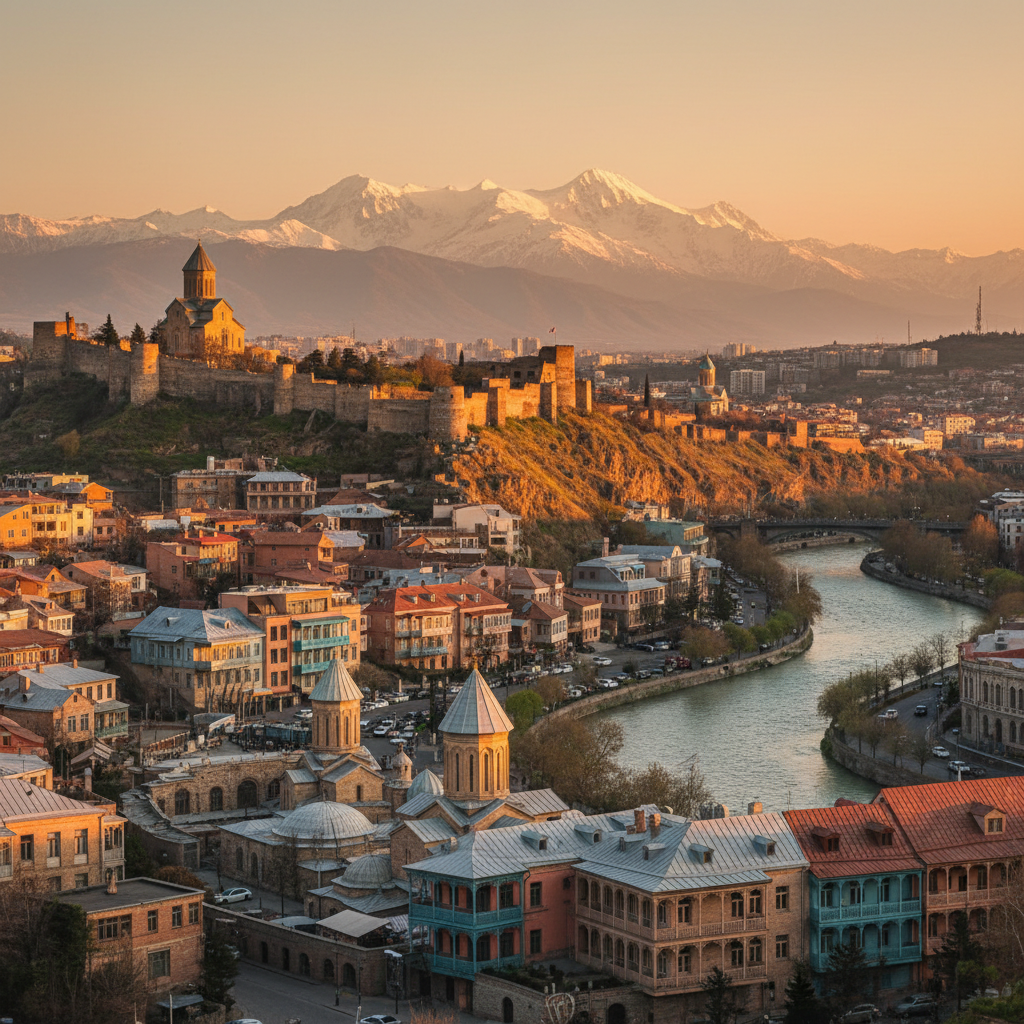
Tbilisi — founded in the 5th century AD by King Vakhtang I Gorgasali, who, legend says, discovered the city's sulphur hot springs while hunting — is one of the most visually distinctive capitals in Europe: a cityscape of multi-coloured, intricately carved wooden balconies (darbazi) overhanging narrow streets, Orthodox domes rising from cliff edges above the Mtkvari (Kura) River, and the ruins of the 4th-century Narikala Fortress visible from almost every angle. The Abanotubani district — a neighbourhood of ancient sulphur bath domes in the city's southern quarter — is the historic heart of old Tbilisi; the baths, fed by natural sulphur springs at 99°F, have been in continuous operation since the medieval period. Chreli-Abano (chreliabano.ge) is the finest of the traditional bathhouses, offering private sulphur pools, massage, and exfoliation scrubs in beautiful tilework rooms.
The art and creative scene concentrated in the Fabrika (fabrika.ge) creative hub, Marjanishvili, and the Vera district reflects a generation of Georgian creatives responding to rapid social change with energy and originality — Tbilisi's design hotels, natural wine bars, and art galleries represent some of the most interesting creative developments in European city tourism.
Where to Stay
The Stamba Hotel (stambahotel.com) — converted from a Soviet-era publishing house in the Vera district — is the finest hotel in Tbilisi: a 186-room design hotel of extraordinary character, with soaring atrium spaces, a spectacular swimming pool enclosed in the original printing-hall structure, the best bar programme in the city, and a rooftop terrace with views across Tbilisi's historic roofscape. Rooms from $250/night.
Rooms Hotel Tbilisi (roomshotels.com/tbilisi) — occupying a 19th-century neoclassical building in the Vera district — is the city's second-best design property and an excellent alternative: excellent natural wine programme, and a rooftop pool. Rooms from $180/night.
Georgian Wine: The Qvevri Tradition
Georgia claims 8,000 years of continuous winemaking — the world's longest documented wine culture — and practices winemaking traditions found nowhere else on earth. The qvevri (clay amphora buried underground for temperature stability) is used for both fermentation and ageing; the traditional skin-contact (orange wine) method — leaving grape skins and seeds in contact with juice during fermentation — produces wines of extraordinary tannin structure, amber colour, and flavour complexity. The Kakheti region (2 hours east of Tbilisi) contains over 500 indigenous Georgian grape varieties and the country's most celebrated wineries: Alaverdi Monastery Winery (alaverdi.ge, founded 6th century), Teliani Valley (telianivalley.com), and Pheasant's Tears (pheasantstears.com), led by American painter John Wurdeman, who was instrumental in reviving the traditional qvevri method. Wine tourism in Kakheti, centred on the towns of Telavi and Sighnaghi (known as the City of Love for its 18th-century fortification walls and panoramic Alazani Valley views), is the most rewarding introduction to Georgian wine culture.
The Greater Caucasus: Kazbegi and Mestia
The Kazbegi region (Military Georgian Road north of Tbilisi, 3 hours) is Georgia's most dramatic mountain landscape: the Gergeti Trinity Church (14th century) on a 2,170m spur above the Terek River, with the 5,047m Mount Kazbek behind, is the single most iconic image in Georgian travel photography. Rooms Hotel Kazbegi (roomshotels.com/kazbegi) — a dramatic mountain lodge with panoramic glacier views — is the finest property in the Georgian Caucasus. Rooms from $250/night.
Getting There
Tbilisi International Airport (TBS) is served by direct flights from Amsterdam (KLM), Paris (Air France), Vienna (Austrian), Frankfurt (Lufthansa), London (Wizz Air, British Airways seasonal), Dubai, Istanbul, and Tel Aviv. The Georgian national carrier Georgian Airways (georgian-airways.com) connects Tbilisi to Batumi (Black Sea coast), Kutaisi, and international destinations.
Reference Links:
- Georgia Tourism: georgia.travel
- Stamba Hotel Tbilisi: stambahotel.com
- Chreli-Abano Sulphur Baths: chreliabano.ge
- Pheasant's Tears winery: pheasantstears.com
- Rooms Hotel Kazbegi: roomshotels.com/kazbegi
- Fabrika creative hub: fabrika.ge
- UNESCO Intangible Heritage — Georgian Qvevri Winemaking: ich.unesco.org



Continue Reading