Home
The Garden Room: Designing a Year-Round Indoor-Outdoor Living Space
The garden room or greenhouse extension is one of the most transformative additions to a home. Here is how to design one that works in every season.
The garden room is perhaps the most aspirational of all home extensions — a room that is both inside and outside, that brings the garden into the house and the house into the garden. When properly designed, it becomes the most used room in the home: a morning coffee room in spring, a cool green retreat in summer, a candlelit gathering space in autumn, and a warm botanical sanctuary in winter.
Yet the garden room is also one of the most technically demanding spaces to get right. Without careful consideration of glazing, orientation, thermal performance, and planting, a garden room can become a scorching greenhouse in summer and an unheatable glass box in winter — neither of which serves any purpose.
**Orientation and solar gain**
The first question for any garden room is orientation. A south-facing garden room in the northern hemisphere will receive the most year-round light but will require sophisticated solar shading to prevent overheating in summer. An east-facing room captures morning light and is ideal for breakfast and morning use. A north-facing room receives no direct sun but maintains even, gentle light throughout the day — ideal for plants that prefer indirect light and for those who want to use the space for working or reading.
A quantity surveyor or architect specialising in glazed extensions — such as the Garden Room Company (thegardenroomco.co.uk) or Ultraframe (ultraframe.com) — will model solar gain as part of the design process. This calculation is not optional; it is the foundation on which all other decisions rest.
**Glazing: the most important technical decision**
Glazing in a garden room must perform across a spectrum of competing demands: it must transmit maximum light, minimise heat loss in winter, control solar gain in summer, and provide acoustic insulation from rain noise.
The current benchmark for performance glass in residential applications is triple-glazed units with a low-emissivity coating and argon gas fill. For roof glazing, self-cleaning glass — which uses UV light to break down organic matter and rain to wash it away — dramatically reduces the maintenance burden.
Saint-Gobain (saint-gobain.com) and Guardian Glass (guardianglass.com) are among the leading manufacturers in this field. For architectural glazing of genuine quality, the Schüco system (schueco.com) — German-engineered aluminium framing — is widely regarded as the finest available.
**Heating and ventilation: the systems that make it work**
A garden room without proper heating and ventilation is a seasonal room at best. Underfloor heating — specified for the thermal mass of stone or tile flooring — provides the most even, comfortable heat distribution. Electric underfloor heating is the simplest to install in a glazed extension; water-fed systems connected to the main boiler are more efficient for larger spaces.
Natural ventilation through roof vents and opening sections of glazing is essential in summer. For a garden room that will be used throughout the warmer months, mechanically assisted ventilation — or a discreetly installed air-source heat pump for cooling — may be worth the investment.
**Flooring: the connection between inside and out**
The floor of a garden room should create a visual and physical connection with the garden beyond. Large-format stone tiles that continue the same material outside — or a similar material in a slightly different format — blur the boundary between interior and exterior space.
Reclaimed terracotta tiles, natural limestone, and smooth-ground concrete all read beautifully in garden room settings, developing character over time and connecting the room with the natural world it sits adjacent to. Mandarin Stone (mandarinstone.com) carries a particularly strong range of suitable materials.
**Planting: the living architecture**
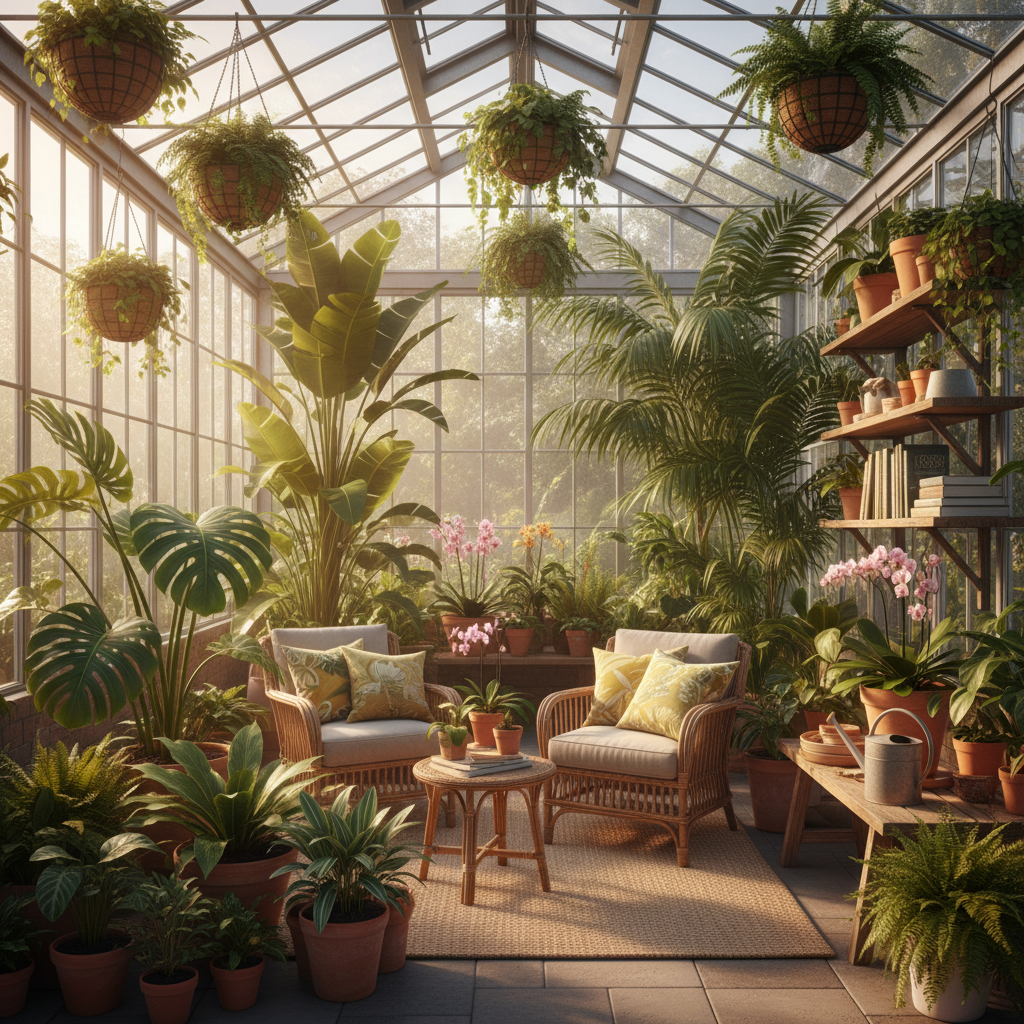
The planting in a garden room is not decoration; it is the room's primary architectural element. Large-leaved tropical plants — Monstera deliciosa, Ficus lyrata, Strelitzia reginae — bring scale and drama. Hanging plants trail from rafter-level hooks. Trained climbers — jasmine, wisteria, stephanotis — climb structural supports and release fragrance.
The key to successful planting in a garden room is understanding the micro-climate you've created. Light levels, temperature variation, and humidity will determine which plants thrive and which suffer. The RHS (rhs.org.uk) provides excellent genus-specific guidance, while specialist retailers including Patch Plants (patchplants.com) can advise on plants suited to your specific space conditions.
**Furniture: designed for this specific room**
Garden room furniture occupies a hybrid category: it must be beautiful enough for an interior space and resilient enough to handle the variable conditions of a semi-outdoor room. Teak, eucalyptus, and powder-coated aluminium all meet this brief. Wicker and rattan — from quality manufacturers such as Sika Design (sika-design.com) or Gloster (gloster.com) — provide the comfort and warmth of upholstered pieces with significantly greater resilience to moisture and temperature variation.
The overall effect should feel like a proper room rather than a garden annexed to the house. A rug (outdoor-rated, naturally), a proper lamp on a side table, a shallow shelf of books — these details complete the transition from conservatory to room.
**The garden room in winter**
The finest garden rooms earn their place in winter. With the garden dormant beyond the glass, the room becomes a kind of vivarium — a warm, green, living space at odds with the cold and dark outside. Well-heated, properly planted, and lit with warm light and candles, a winter garden room is one of the most deeply pleasurable rooms in any home.
This is the room for a pot of tea in the morning and a glass of something excellent in the evening. It is the room that, once built, you will wonder how you ever lived without.


Continue Reading