Travel
The Galápagos Islands: Darwin's Living Laboratory & the World's Greatest Wildlife Encounter
The Galápagos Islands — 13 major volcanic islands in the Pacific Ocean 1,000km off the Ecuadorian coast — contain the most extraordinary concentration of endemic, fearless wildlife on earth: the living laboratory that gave Charles Darwin the evidence for his theory of evolution by natural selection.
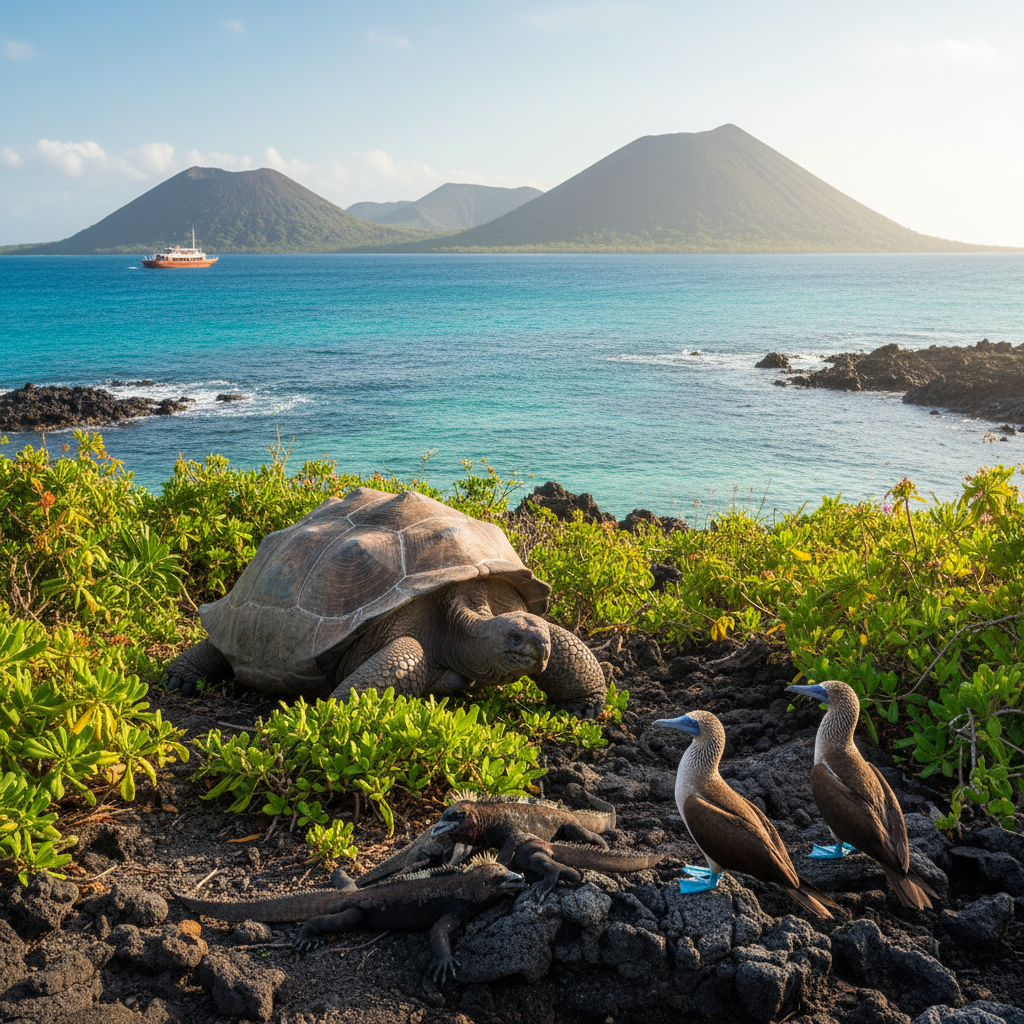
The Galápagos Islands are unique in the history of science and in the history of travel — a volcanic archipelago so remote, and so recently connected to the South American mainland by human navigation, that the animals evolved in almost total isolation from predators. The result is a wildlife experience unlike anything else on earth: giant tortoises that regard approaching humans with indifference; marine iguanas swimming through turquoise water around snorkellers' fins; blue-footed boobies performing their mating dance 11 ¾ in from a seated observer; Galápagos sea lions using tourist pier benches as communal sleeping platforms. The animals have no instinctive fear of humans and no reason to develop it — the National Park Service has maintained visitor protocols limiting disturbance since 1959, with remarkable success.
Charles Darwin visited the Galápagos in September–October 1835 aboard HMS Beagle (age 26). The variation in beak shapes between finches adapted to different food sources on different islands — together with the tortoises' differentiated shell shapes — provided key observational evidence for the concept of adaptation by natural selection that he would develop over the following 24 years into On the Origin of Species (1859). The Charles Darwin Research Station (darwinfoundation.org) on Santa Cruz Island continues its work in tortoise breeding and conservation, and is open to visitors.
The Wildlife by Island
Santa Cruz (Indefatigable Island) — home to Puerto Ayora, the largest town in the archipelago — is the hub of Galápagos tourism and the location of the Darwin Research Station. The tortoise reserve at El Chato (accessible by taxi from Puerto Ayora) allows walking freely among giant tortoises in their natural highland habitat — an experience of almost surreal intimacy with Pleistocene megafauna. The Los Gemelos pit craters, the lava tubes, and the beaches of Tortuga Bay (a 2.5km walk from Puerto Ayora) add to Santa Cruz's remarkable variety.
Isabela Island — the largest in the archipelago by area — is the most volcanically active and contains the greatest diversity of microhabitats. The Sierra Negra volcano (1,124m, with a 10km-diameter crater, the second-largest in the world) is reached by a 16km round-trip hike offering views of extraordinary drama. Marine iguanas, flamingos in saline lagoons, and Galápagos penguins (the only penguins in the Northern Hemisphere) are all found on Isabela.
Fernandina Island — the youngest and most pristine in the archipelago, accessible only by live-aboard cruise — hosts the world's largest marine iguana colony: thousands of the black iguanas basking on lava fields in formations of prehistoric density. Flightless cormorants, Galápagos hawks, and the rare Mangrove finch are also found here.
The Live-Aboard Experience
The definitive Galápagos travel format is the live-aboard expedition cruise: a small ship of 16–100 guests navigating between islands, with daily Zodiac landings and snorkelling sessions guided by certified naturalists. The Galápagos National Park requires all cruise vessels to follow designated itineraries and visitor site protocols; the naturalist guides hold Galápagos-specific licences awarded by the park authority.
Silversea Expeditions (silversea.com/galapagos) operates the Silver Origin — a 100-guest ship purpose-built for the Galápagos, with the largest guide-to-guest ratio (1:10) in the archipelago and the finest onboard dining. From $10,000/person/week.
UnCruise Adventures (uncruise.com) operates the 66-guest Safari Voyager — a smaller, more intimate vessel with an extraordinary naturalist team and closer access to smaller visitor sites. From $6,500/person/week.
National Geographic Expeditions (nationalgeographic.com/expeditions) operates with Lindblad Expeditions on the Sea Bird — the partnership that pioneered natural history expedition cruising in the Galápagos and maintains the deepest scientific relationships with the Darwin Research Station. From $8,000/person/week.
Santa Cruz and Land-Based Visits
For those unable or unwilling to commit to a live-aboard schedule, land-based visits from Puerto Ayora (Santa Cruz) or Puerto Baquerizo Moreno (San Cristóbal) provide access to a remarkable number of visitor sites by day-boat. Royal Palm Galápagos (royalpalmgalapagos.com) — a 15-villa eco-lodge in the Santa Cruz highlands — is the finest land-based accommodation in the archipelago: extraordinary tortoise-spotting from the garden and superb food. Rooms from $600/night.
Getting There
Flights to the Galápagos operate from Quito (UIO) and Guayaquil (GYE) in mainland Ecuador to Seymour Airport on Baltra Island (GPS) or San Cristóbal Airport (SCY). LATAM (latam.com) and Avianca (avianca.com) operate the primary routes. All passengers must pay the Galápagos National Park entrance fee ($200 for most nationalities since 2024, reduced from the previous $100) on arrival. Transit control cards, issued at mainland airports, must be retained throughout the visit.
Reference Links:
- Galápagos National Park: galapagos.gob.ec
- Charles Darwin Foundation: darwinfoundation.org
- Silversea Galápagos Expeditions: silversea.com/galapagos
- Lindblad/National Geographic Expeditions: expeditions.com
- UnCruise Adventures: uncruise.com
- Royal Palm Galápagos Hotel: royalpalmgalapagos.com
- Ecuador Tourism: ecuador.travel
- UNESCO Galápagos World Heritage: whc.unesco.org/en/list/1



Continue Reading