Food & Drink
Foie Gras: Gascony's Most Controversial & Celebrated Delicacy
French law declares foie gras part of the protected cultural and gastronomic heritage of France. For the committed gourmand, it remains one of the most extraordinary ingredients in the world — silky, rich, and unlike anything else on the table.
French law is explicit on the matter: 'Foie gras belongs to the protected cultural and gastronomic heritage of France.' Few ingredients in the world carry such unambiguous official status, and fewer still have inspired the centuries of devotion — and controversy — that surround the fattened liver of a duck or goose.
The history of foie gras is ancient. Egyptian wall paintings from approximately 2,500 BC depict workers hand-feeding figs to geese, prompting the same natural liver fattening that wild migratory birds undergo before long flights. The Romans adopted and refined the practice, and it was the medieval Jewish communities of Alsace and the Gascony region of southwest France who kept the tradition alive through the Middle Ages, using goose fat (in lieu of butter and lard, which their dietary laws restricted) as the primary cooking fat of the region.
Today, the Gascony region — broadly the departments of Gers, Landes, Dordogne, and the Pyrenees-Atlantiques — produces the vast majority of France's foie gras. The region's villages, particularly around Auch, Tarbes, and Auch, celebrate the product with a calendar of markets and festivals. The famous Marché au Gras markets in Samatan and Mirande (https://www.tourisme-gers.com) run from October through March and are among the most atmospheric food markets in France, where whole foie gras livers are sold alongside confited duck legs, rillettes, and magrets on cold winter mornings.
There are two categories of foie gras: that from ducks (foie gras de canard) and from geese (foie gras d'oie). Goose foie gras is considered the more refined — paler, more delicate, with a gentler flavour — and commands a significant premium. Duck foie gras is more widely produced, more robustly flavoured, with deeper iron and mineral notes, and is what most restaurants serve.
Quality is classified by grade. Grade A (Foie Gras Entier) is a whole lobe, ideally weighing between 15 ⅞ oz-1 lb 5 oz for duck and 1 lb 9 oz-2 lb for goose, with minimal blemishes, a consistent ivory-beige colour, and a smooth, firm texture. This is what the great chefs of France use for their finest preparations. Grade B includes two-lobe livers and smaller specimens suitable for pâtés and terrines. Grade C covers the trimmed portions and fat used for block production.
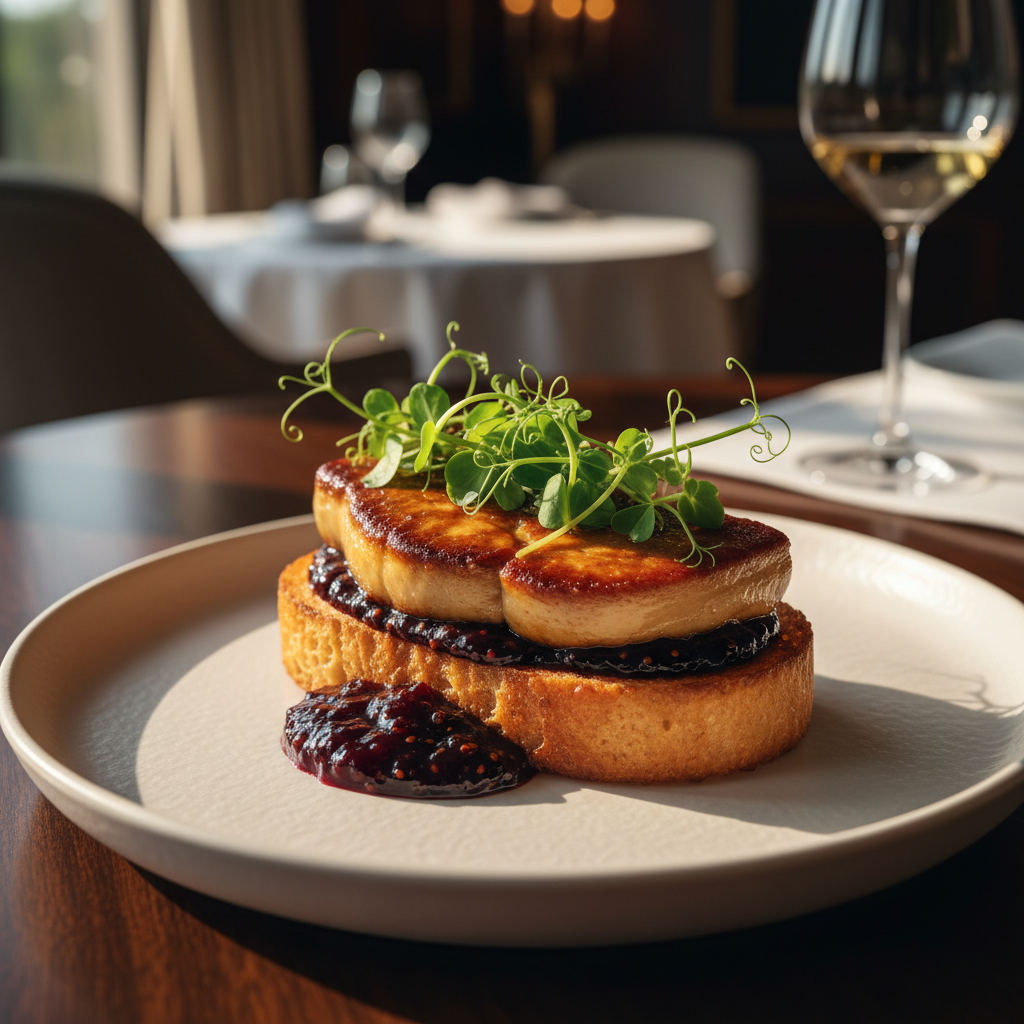
The classical preparations are all worth knowing. Foie gras au torchon (wrapped in cloth and poached gently) is the great charcuterie preparation — dense, silky, served cold in slices with Sauternes jelly and brioche. Seared foie gras (escalope de foie gras poëlé) is the hot preparation — a thick slice seasoned simply, seared in a very hot, dry pan for 45 seconds per side until caramelised outside and barely warm within. It is invariably served with something sweet and acidic to cut the richness: fig jam, caramelised apple, Sauternes reduction, or quince paste.
The pairing question for foie gras is settled in Gascony: a glass of Sauternes — Bordeaux's great sweet wine, particularly Château d'Yquem (https://www.yquem.fr) or Château Rieussec — is the classic companion, the botrytis-enriched sweetness and acidity cutting the fat perfectly. In Alsace, the local Gewurztraminer or Pinot Gris Vendanges Tardives (late harvest) plays the same role. For a more contemporary match, a glass of demi-sec Champagne or a Jura Vin Jaune can be extraordinary.
For sourcing outside France, D'Artagnan (https://www.dartagnan.com) is widely considered the gold standard of foie gras purveyors in the United States, sourcing from Hudson Valley Duck in upstate New York. Their Grade A Hudson Valley Moulard duck foie gras is the benchmark against which all American production is measured.
Foie gras is, and will remain, one of the most debated ingredients in gastronomy. For those who eat it, the experience — particularly a perfectly seared escalope with a cold glass of Sauternes on a winter evening in Gascony — is entirely its own argument.



Continue Reading