Fashion
Filson and the Seattle Tradition: How the 1897 Klondike Gold Rush Forged America's Heritage Workwear
On July 27, 1897, the steamship Portland docked in Seattle carrying two tons of Klondike gold. Among the outfitters who rushed to supply the stampeders was Clinton C. Filson, who opened a store on First Avenue and built a brand that still clothes loggers, hunters, and the U.S. Forest Service.
On July 17, 1897, the steamship Portland docked in Elliott Bay in Seattle, carrying more than a ton of gold from the Klondike region of the Canadian Yukon. The news triggered one of the great stampedes of the nineteenth century: tens of thousands of prospectors flooded into Seattle to buy supplies before boarding steamships north to the gold fields. Among the outfitters who rushed to supply them was a man named Clinton C. Filson, who, ten days after the Portland docked, opened a store on First Avenue in Seattle to sell clothing and gear built to survive the subarctic cold of the Yukon. The brand he founded that year, Filson, is now one of the oldest continuously operating heritage clothing companies in the United States.
The Gold Rush and the Founding
Clinton C. Filson had come to Washington State in 1890, seeking new frontiers. When the Klondike gold rush arrived in 1897, he positioned his store to outfit the prospectors who passed through Seattle on their way to Alaska. The Yukon was one of the harshest environments on earth, and Filson's clothing was a matter of survival, not style. He manufactured Mackinaw wool coats and blankets, and he sold boots, gloves, and supplies chosen for function, durability, and warmth. His reputation was built on a refusal to compromise on quality, summarized in his own words: "Your satisfaction is the sole purpose of our transaction."
The Cruiser: A Jacket Built for the Forest
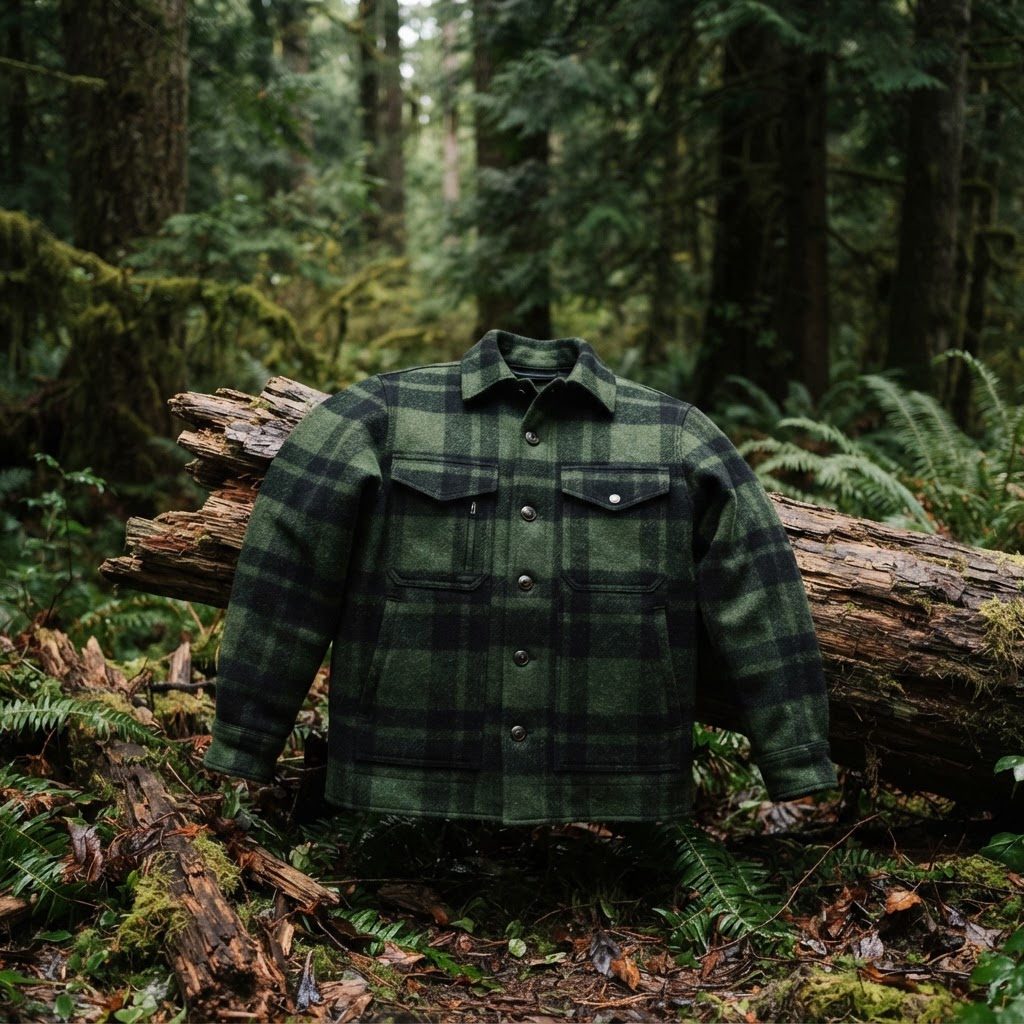
As the gold rush ebbed, many who had failed to strike it rich in the Klondike returned to Seattle and found work in the booming timber industry of the Pacific Northwest. Filson, who had already learned the needs of loggers during the earlier Monte Cristo gold rush, turned his attention to the forests. The result was the Filson Cruising Shirt, patented on March 3, 1914, as U.S. patent number 1088891. The Cruiser was designed for timber cruisers — the foresters who scouted ahead of logging operations to survey and map stands of timber. It was a thick wool garment with a pocket arrangement engineered for the tools of the trade: notepads, charts, a compass, and a full-width reach-through pocket across the back for maps. The U.S. Forest Service adopted a customized version of the Filson jacket as its official uniform attire, and a 1925 letter from a Montana basecamp describes the standard kit as "Filson water repellent pants, jackets and woolen underwear and sox."
The Materials: Mackinaw Wool and Tin Cloth
Filson's identity rests on two materials. Mackinaw wool is a heavy, dense virgin wool, woven tightly enough to be naturally water-resistant, windproof, and warm even when wet. Oil Finish Tin Cloth is a tightly woven cotton fabric saturated with a waxy oil finish that repels rain, wind, and abrasion. Both materials were developed for the wet, brush-choked forests of the American West, and both have changed remarkably little in over a century. The Mackinaw Wool Cruiser, Filson's signature jacket, remains close to the patented 1914 design. During the 1980s and 1990s, the company expanded from workwear into luggage, introducing its Rugged Twill and Bridle Leather bags, which have since become as closely associated with the brand as the wool.
Practical Guidance: Buying Heritage Outerwear That Lasts
A Filson Cruiser or Mackinaw coat is an investment garment, meant to be worn for decades and passed to the next generation. The Mackinaw wool should be dense and slightly stiff when new, softening with wear; it requires occasional dry-cleaning but never machine washing. Tin Cloth should be re-waxed with Filson's wax dressing once a season to maintain its water resistance. The fit should allow layering beneath. These garments are not designed for the runway; they are designed to be worn hard, repaired rather than replaced, and to look better the longer they are owned.
Related Reading
Filson belongs to a family of American heritage brands that turned workwear into enduring fashion — our guides to [American denim](/lifestyle/denim-guide-from-workwear-to-luxury-staple), the [trench coat](/lifestyle/the-trench-coat-fashions-most-enduring-garment), and building an [investment wardrobe](/lifestyle/investment-wardrobe-fashion-that-endures) cover the broader logic of buying fewer, better garments.
Reference Links
- About Us: Filson Since 1897 (Klondike, C.C. Filson, Cruiser patent 1914): [Filson](https://www.filson.com/pages/about-us)
- Original Alaska Outfitter Since 1897 (Klondike Gold Rush, Mackinaw wool): [Filson Journal](https://www.filson.com/blogs/journal/featured-original-alaska-outfitter-since-1897-the-filson-story)
- The Filson Story (1897 Seattle, Cruiser 1914, Forest Service): [Filson](https://www.filson.com/blogs/journal/featured-original-alaska-outfitter-since-1897-the-filson-story)
- Filson heritage and history (Klondike, Mackinaw wool, Tin Cloth): [Filson About Us](https://www.filson.com/pages/about-us)



Continue Reading