Travel
Fès: Morocco's Ancient Imperial City & the Arab World's Greatest Medieval Medina
Fès el-Bali — the medieval old city of Fès — is the largest living medieval city in the world: a UNESCO World Heritage labyrinth of 9,000 streets and alleyways, ancient madersas, tanneries, and mosques where the rhythms of 11th-century urban life continue largely undisturbed into the 21st century.
Fès is older than Marrakech, more culturally significant, and — for the traveller willing to engage with a greater complexity — more rewarding. Founded in 789 AD by Moulay Idriss I, and greatly expanded by his son Idriss II and the Andalusian refugees who arrived after the fall of Córdoba, Fès was the dominant city of the Islamic West for four centuries: the political, intellectual, and commercial capital of a civilisation that produced the University of al-Qarawiyyin (founded 859 AD; the oldest continuously operating university in the world), extraordinary architecture in the Hispano-Moorish tradition, and a tradition of craft production — leather tanning, zellige tilework, brass metalwork, silk weaving — that remains largely intact today.
Fès el-Bali: The Old City
Fès el-Bali — the original walled city — is a UNESCO World Heritage Site and the largest urban area in the world without motor vehicle access. The medina's 9,000+ streets and alleyways, many barely wide enough for two people to pass, contain an estimated 14,000 buildings of historical significance. Navigation is genuinely challenging — even with GPS, the lack of consistent street addressing and the extraordinary density of the urban fabric make orientation difficult. A licensed guide (arranged through Fès Tourism; visitmorocco.com) is essential for a first visit.
The Bou Inania Madrasa (14th century) — built by Marinid Sultan Abu Inan between 1351 and 1356 — is the finest example of Moroccan Gothic architecture in existence: three storeys of carved cedar wood, plaster muqarnas, and zellige tilework of extraordinary intricacy. The Attarine Madrasa (adjacent to the Qarawiyyin mosque) and the Cherratine Madrasa are comparable in quality. Non-Muslims cannot enter the Qarawiyyin mosque, but views from adjacent madrasa rooftops reveal its extraordinary cedar-wood minaret and tiled roofs.
The Chouara Tanneries
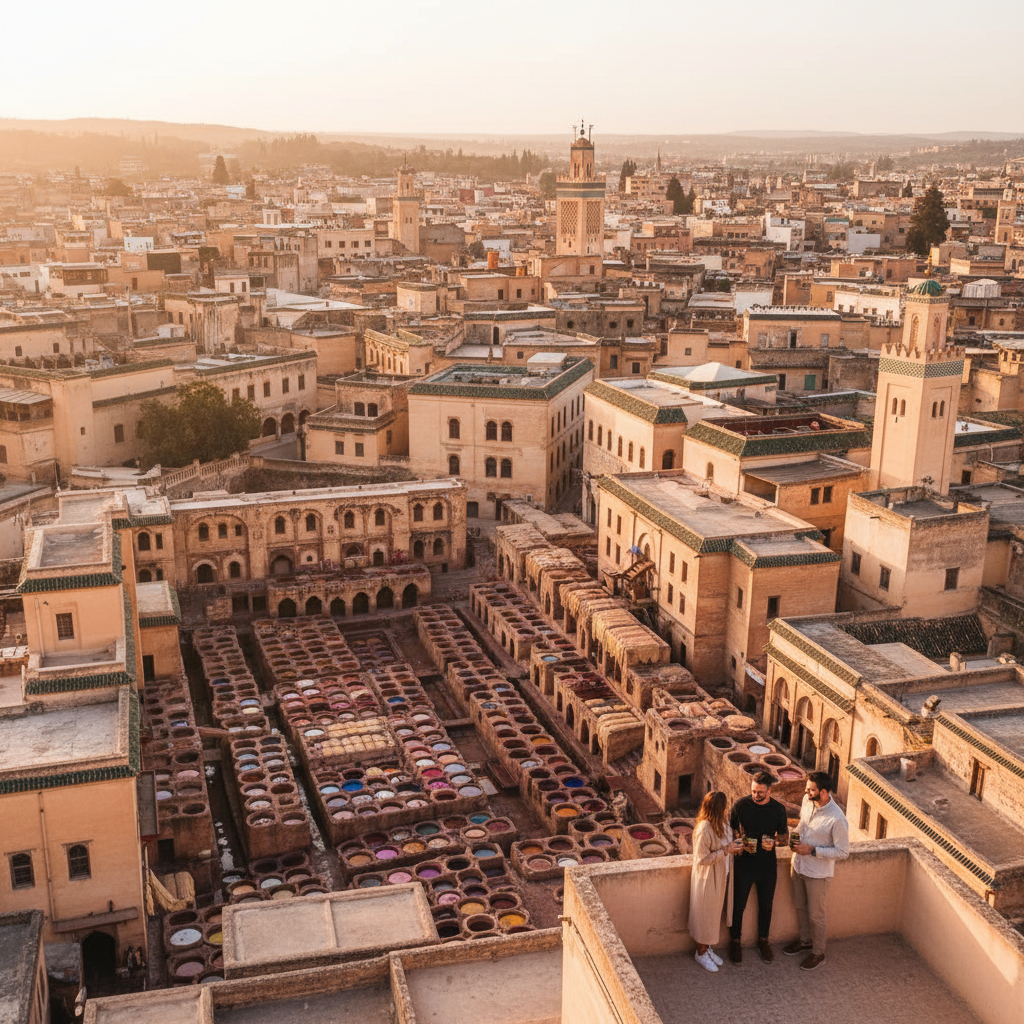
Fès's leather tanneries — visible from the rooftop terraces of shops in the Cherratine leather district — are the city's most iconic image: circular vats of natural dyes (saffron for yellow, indigo for blue, poppy for red, henna for orange) in which hides are cured using ancient methods unchanged since the 10th century. The view from above — a mosaic of coloured circles among white-roofed buildings — is one of the most recognisable images in North African travel photography. The best terraces (belonging to the leather shops ringing the tanneries) are accessible without purchase obligation; a sprig of fresh mint — given by the shops at the entrance — mitigates the powerful smell of pigeon dung and ammonia used in the curing process.
Where to Stay
Riad Fès (riadfes.com) — a 21-room boutique hotel in a beautifully restored 18th-century riad in the heart of Fès el-Bali — is the finest accommodation in the medina: a courtyard garden of jasmine and orange trees, a hammam, an excellent restaurant serving traditional Fassi cuisine, and the combination of extraordinary architecture and attentive service that characterises the best Moroccan riad experience. Rooms from $250/night.
Palais Amani (palaisamani.com) — also within the medina — is the grandest of Fès's luxury riads: a 300-year-old Andalusian palace with a colonnaded central courtyard, a 45-metre swimming pool, and suites of exceptional scale. Rooms from $400/night.
Fassi Cuisine
Fassi cuisine — the cooking of Fès — is considered the finest and most refined of all Moroccan culinary traditions, combining Andalusian sophistication with Berber and Arab techniques. Bastilla (a flaky pastry enclosing pigeon or seafood with almonds, cinnamon, and saffron), harira (slow-cooked lamb and chickpea soup), and m'hanncha (the 'snake pastry' of almond and orange-flower cream) are the defining dishes. Restaurant number 7 (Jnan Sbil, inside the medina) and Riad Fès's own kitchen are the most recommended tables for traditional Fassi cooking.
Getting There
Fès–Saïs Airport (FEZ) is served by direct flights from Paris (Royal Air Maroc, Air France), London Stansted (Ryanair), Madrid (Iberia Express), and Amsterdam (Transavia). Casablanca Mohammed V Airport (CMN) is the primary international gateway; Morocco's excellent ONCF high-speed train (oncf.ma) connects Casablanca to Fès in 2 hours 20 minutes.
Reference Links:
- Morocco Tourism: visitmorocco.com
- Riad Fès: riadfes.com
- Palais Amani: palaisamani.com
- Al-Qarawiyyin University history: qarawiyyin.ac.ma
- ONCF high-speed rail Morocco: oncf.ma
- UNESCO Fès el-Bali: whc.unesco.org/en/list/170



Continue Reading