Home
The Entryway Edit: How to Design a First Impression Worth Having
The entryway is the first and last thing you experience of a home. Here's how to design one that sets the tone for everything that follows.
The entryway is the prologue to your home — the first sentence of a story your guests will be reading for the rest of the evening. Get it right, and everything that follows is read through a lens of confidence and welcome. Get it wrong, and no amount of beautiful rooms beyond will fully rescue the first impression.
Yet the entryway is consistently underinvested in. Homeowners lavish attention on living rooms and kitchens, treating the hallway as a functional corridor rather than a design destination. The most considered homes understand that the entrance is where the magic begins.
**Start with the floor**
Nothing anchors an entryway like the floor. Stone, marble, or high-quality porcelain tile in a classic format — herringbone, Versailles, large-format marble-effect — signals quality before a single piece of furniture is in sight. If you have original parquet or hardwood floors, restore them to their best.
If budget is a consideration, a statement rug over a neutral floor achieves much of the same effect. The Rug Company (therugcompany.com) offers heritage-quality pieces in compact sizes suited to smaller hallways, while Aelfie (aelfie.com) provides more playful, artisan-crafted options.
**The console table: your anchor piece**
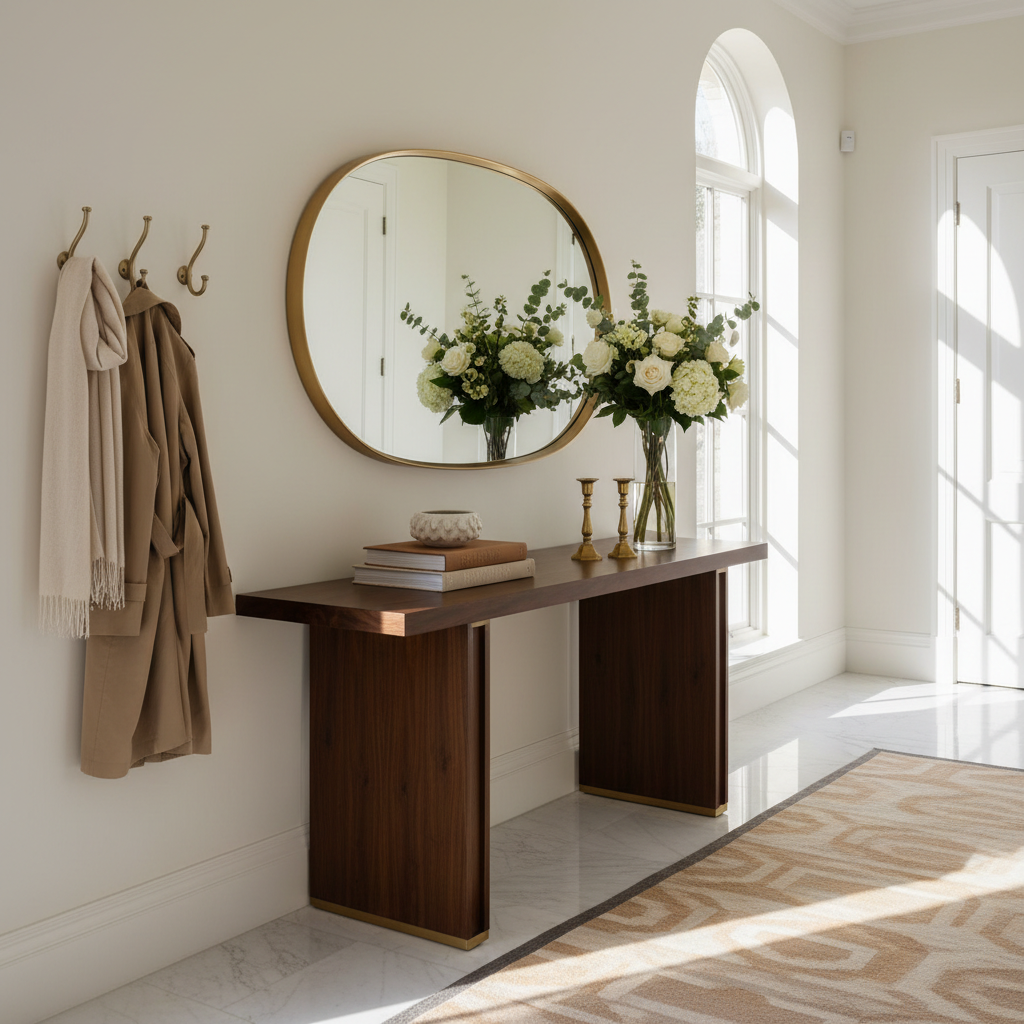
A console table is the backbone of any entryway. It provides practical surface space for keys, mail, and objects while offering a canvas for seasonal styling. Choose something with presence — a marble top on burnished brass legs, a rustic oak slab with sculptural supports, or a mirrored Art Deco piece for maximum drama.
Designers including Bunny Williams and Thomas O'Brien consistently recommend a console that is roughly two-thirds the width of the wall it occupies — enough to make a statement without feeling cramped.
Pair it with a lamp for warmth (your entryway should never rely solely on overhead lighting), a small vessel for seasonal flowers or sculptural branches, and a decorative object with personal meaning.
**Mirrors: the essential companion**
A well-placed mirror above a console table is one of the most hardworking combinations in interior design. It amplifies light, creates the illusion of depth, and serves the entirely practical purpose of a last-look before leaving the house.
For maximum impact, choose a mirror that is no more than three-quarters the width of the console table below it. Lean it or hang it — both approaches work, though leaning tends to read as more casual and contemporary.
Antique and vintage mirrors — available through dealers such as 1stDibs (1stdibs.com) and Chairish (chairish.com) — bring patina and irreplaceable character that no new piece can replicate.
**Storage solutions that don't read as storage**
The entryway carries much of a home's everyday detritus: coats, bags, shoes, umbrellas, dog leads, children's items. The secret is to provide generous storage that doesn't announce itself as such.
Built-in joinery with concealed doors is the gold standard. A run of floor-to-ceiling cabinetry, painted in the same colour as the walls, virtually disappears while housing enormous capacity. For homes where built-ins aren't possible, choose freestanding furniture with closed doors — a painted armoire, a deep-seated ottoman with internal storage, a stack of beautiful boxes.
Visible hooks and open shelving should be limited to those items you actively want on display: a favourite hat, a woven basket, a length of interesting rope.
**Lighting: the most important detail**
The lighting in an entryway tells your guests everything about your relationship with your home. A bare bulb or a standard pendant fixture says the space was an afterthought. A thoughtfully chosen statement fixture — a sculptural lantern, a cluster of blown-glass pendants, a genuine antique chandelier — says you considered every room.
Designer Christopher Spitzmiller's advice is to always choose a fixture that is slightly too large for the space, rather than one that is slightly too small. Scale reads as confidence. The Visual Comfort & Co. range (visualcomfort.com) offers some of the finest residential lighting available, with pieces that span Georgian, mid-century, and contemporary vocabularies.
Layering is also important: add a table lamp on the console table, and consider low-level lighting — sconces or concealed strip lighting — for warmth.
**Scent: the invisible layer**
The most memorable entryways are ones you smell before you see them. A beautifully chosen candle or room diffuser burning as guests arrive creates an olfactory first impression that lodges itself in the memory long after the evening is over.
Diptyque's Baies (diptyque.com) has been a hallmark of considered European homes for decades. Cire Trudon (ciretrudon.com) — the world's oldest candle manufacturer, established in 1643 — offers even more distinctive options for those who want something truly unexpected.
**The final consideration: art**
Art in the entryway is the most personal signal of all. Unlike the carefully curated gallery walls of a living room, entryway art should be something that moves you — a single powerful work that your guests encounter before anything else.
It doesn't need to be expensive. A beautifully framed vintage botanical print, an oversized photograph, a piece of textile art — what matters is that it is considered, properly framed, and hung at exactly the right height (eye level, which is generally 57 to 60 inches to the centre of the work).
The Entryway Edit is ultimately about this: treating the entrance to your home with the same care and intention you bring to its most important rooms. Because the first impression is, in every sense, the only one you get.

Continue Reading