Home
The Dressing Room: Designing Your Own Private World
The dressing room is the ultimate domestic luxury — a room devoted entirely to you. Here is how to design one that makes every morning a pleasure.
Of all the rooms in a well-designed home, the dressing room is the most personal. It is a space created entirely around a single individual — their possessions, their rituals, their daily relationship with how they present themselves to the world. Designing it properly is not a luxury reserved for large homes or large budgets. It is an act of self-knowledge and considered intention.
A dressing room begins with a question: what does the act of dressing mean to you? For some, it is purely functional — a private space to store and access clothes efficiently. For others, it is a ritual: a slow, pleasurable morning performance of assembling oneself for the day. How you answer that question should govern every subsequent decision.
**The space: carved from what already exists**
A dressing room does not require a dedicated room — though one is, naturally, the ideal. A generous landing, a walk-in cupboard, a partitioned section of a large bedroom, even an alcove fitted with open shelving and a proper mirror can function as a dressing area of genuine quality.
The interior designers at Smallbone of Devizes (smallbone.co.uk) and Neatsmith (neatsmith.com) are specialists in transforming awkward spaces into bespoke dressing rooms of remarkable sophistication. For American interiors, California Closets (californiaclosets.com) offers more accessible custom solutions, while Elfa (elfa.com) provides a flexible, modular system for those who prefer to configure storage themselves.
**Open versus closed storage**
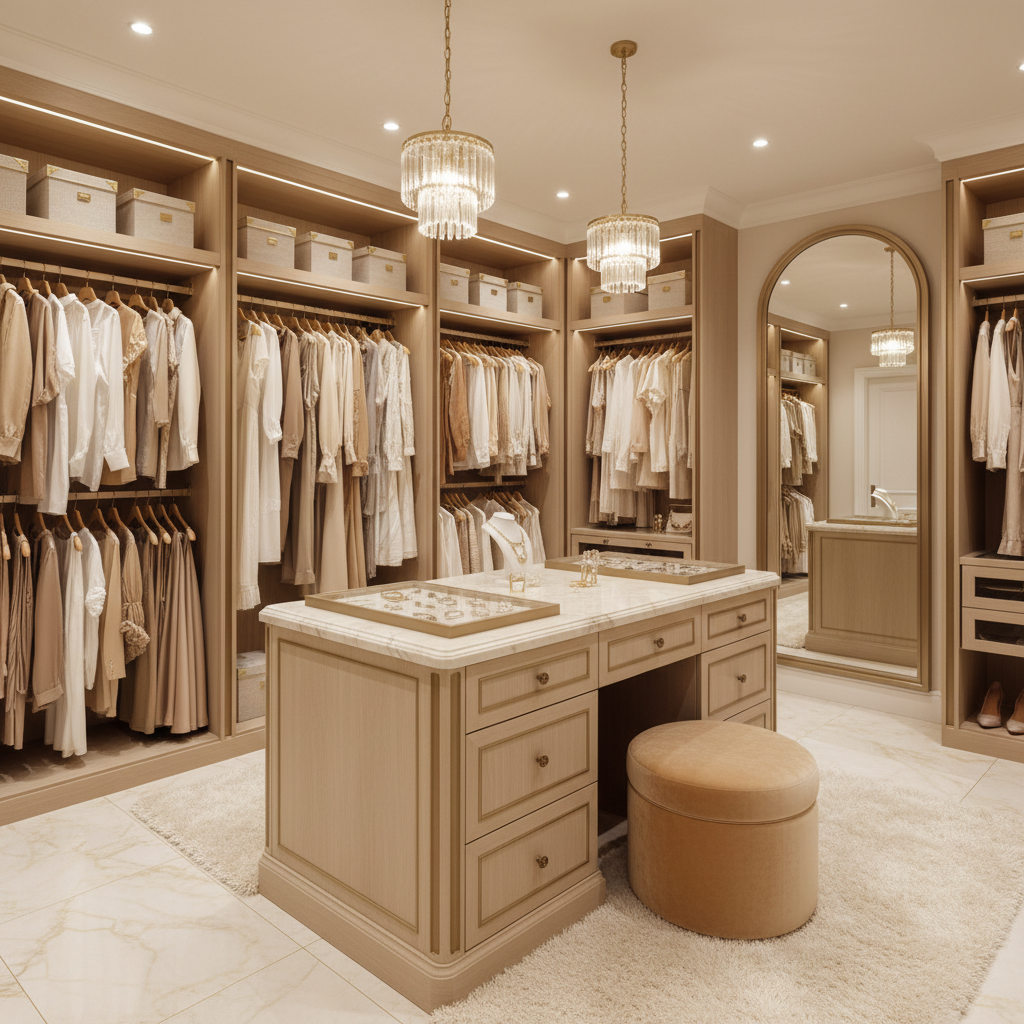
The great debate in dressing room design is open versus closed storage. Open wardrobe systems — rails of neatly hung clothing arranged by colour, shelves of folded items visible at a glance — are visually dramatic and practically efficient. You can see everything you own at once; the morning decision is made easier by visibility.
Closed cabinetry — drawers, doors, concealed rails — creates a tidier visual field and protects garments from light, dust, and the slow accumulation of everything that ends up in any open space. The most considered dressing rooms combine both: open hanging for frequently worn items, closed storage for everything else.
If your wardrobe is something you're proud of, there is an argument for displaying it. A properly edited wardrobe, arranged by colour and hung on matching velvet hangers, is a genuinely beautiful sight. The Container Store (containerstore.com) carries an exceptional range of matching hangers and organisational accessories.
**The island dresser: the defining feature**
In a large enough dressing room, the island dresser is the defining element — a central freestanding unit with deep drawers for folded items, a top surface for daily objects (jewellery, watches, keys), and the spatial quality of something that belongs to a room rather than merely filling a wall.
A bespoke island dresser in painted timber or dark-stained oak, topped with marble or leather, brings a quality of furniture-making to the dressing room that elevates it from storage space to considered room.
**Lighting: a science unto itself**
Lighting in a dressing room serves two entirely different purposes: ambient illumination and accurate colour rendering. The ceiling fixture provides overall light; the lighting around the mirror provides the specific, even, shadow-free quality needed for applying makeup and assessing how you look.
The ideal dressing room mirror light comes from both sides and from above — not from overhead alone, which creates unflattering downward shadows. Hollywood-style bulb mirrors (large, lit all around the perimeter) are supremely functional if a little theatrical; well-placed wall sconces flanking a large mirror are more architectural in character.
All lighting should render colour accurately — specified with a Colour Rendering Index (CRI) of 90 or above. LED bulbs in the 2700K to 3000K range provide the warm, accurate light most suited to dressing decisions. Ketra (ketra.com) produces some of the finest residential LED lighting available, with programmable scenes that can shift the room from morning dressing mode to evening preparation in a single tap.
**Organisation: the system that works for you**
The most sophisticated storage system in the world is useless if it doesn't reflect how you actually live. Build your organisation system around your real habits rather than an aspirational version of them.
This means hanging items you hang in life, folding items you fold in life, and being honest about the category of things that currently pile up on chairs and floors — then designing storage specifically for them.
Marie Kondo's method (konmari.com) remains the most rigorous approach to editing a wardrobe before designing storage — because a dressing room built around a well-edited wardrobe will always feel more luxurious than one built around an unedited one, regardless of its size or specification.
**The finishing touches**
A dressing room, like every other considered room, deserves finishing touches. A proper ottoman or bench at the right height for sitting while putting on shoes. A small tray for daily jewellery. A single beautiful candle — Trudon's Cyrnos (ciretrudon.com) is a perennial favourite — for the ritual atmosphere of a proper morning routine.
A small painting or photograph on the wall. A potted plant in a corner. These details do not belong in a storage room. They belong here, in the most personal room in the house, because they signal that this space — and by extension, the ritual it serves — deserves to be treated with care.



Continue Reading