Fashion
The Denim Guide: From Workwear to Luxury Staple
Denim's journey from 1873 workwear patent to luxury fashion staple is one of fashion's most remarkable stories. From Levi Strauss and Jacob Davis to Japanese selvedge, here is the complete denim guide.
Denim — the rugged cotton twill fabric that clothed American labourers, armed soldiers, and clothed the world — has undergone one of the most remarkable transformations in fashion history. From its origins as durable workwear for miners and labourers to its current status as a luxury staple worn with cashmere and leather, denim's journey is the story of how function becomes fashion, and how the humblest of garments can achieve cultural immortality.
The Birth of the Blue Jean
The story of denim as we know it begins on May 20, 1873, when **Levi Strauss** and **Jacob Davis** received US Patent No. 139,121 for 'Improvement in fastening pocket openings' — the use of copper rivets to reinforce the stress points of work trousers. Strauss, a Bavarian immigrant who had opened a dry goods company in San Francisco in 1853 at the height of the California Gold Rush, partnered with Davis, a tailor from Reno, Nevada, who had devised the riveted-reinforcement method to satisfy the demands of a customer's wife for stronger work pants.
The patent gave Strauss and Davis a 17-year monopoly on riveted clothing, and the 'XX Waist Overalls' — the garment that would later become the Levi's 501 — was born. The fabric, originally sourced from the Amoskeag Manufacturing Company in New Hampshire, was a heavy cotton twill dyed with indigo. The term 'denim' itself is widely believed to derive from 'serge de Nîmes' — a sturdy twill fabric produced in Nîmes, France.
After the patent expired in 1890, other manufacturers entered the market, but Levi Strauss & Co. — which had been producing the riveted overalls since 1873 — remained the dominant force. The introduction of the lot number '501' (assigned to the riveted overalls in 1890) created what is now the oldest and most iconic garment in the world: the Levi's 501, still in production today.
The Selvedge Revolution
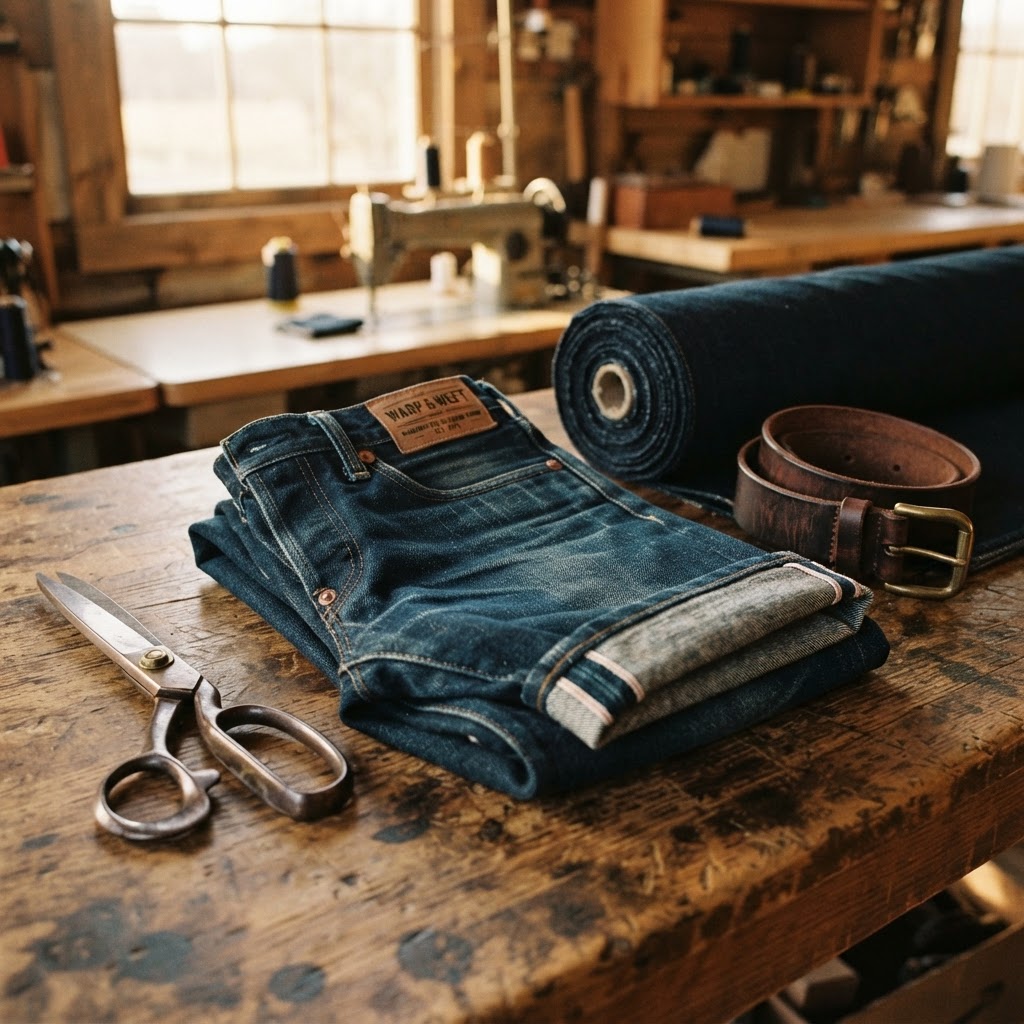
The most significant development in modern denim is the resurgence of **selvedge denim** — fabric woven on traditional shuttle looms, which produce a tight, self-finished edge (the 'self-edge' or 'selvedge') that does not unravel. Shuttle looms, which were the standard before the 1950s, produce a narrower, denser, and more irregular fabric than the modern projectile looms that replaced them. The selvedge edge — typically visible when the jeans are cuffed — has become the hallmark of quality denim.
The centre of the selvedge denim revival is Japan, specifically the Kojima region of Okayama Prefecture, where a cluster of artisanal denim mills — including **Kuroki**, **Collect (Japan Blue Group)**, and **Cone Mills (historically American, but the Japanese mills now lead)** — produce some of the finest denim in the world. Japanese selvedge denim is characterised by its heavy weight (typically 14 to 21 ounces), its use of natural indigo dye, and its distinctive irregular texture (the 'slub') produced by older, slower looms.
Brands such as **Samurai Jeans**, **Iron Heart**, **Pure Blue Japan**, and **Studio D'Artisan** have built cult followings among denim enthusiasts for their obsessive attention to materials and construction. At the luxury level, brands such as **3sixteen**, **Rogue Territory**, and **Baldwin** have brought selvedge denim to a wider audience.
The Denim Guide
For those investing in quality denim, the key considerations are:
**Weight** — Heavier denim (14oz and above) is more durable and develops more characterful fading, but takes longer to break in. Lighter denim (10–13oz) is more comfortable from the first wear but less distinctive in its ageing.
**Indigo** — Natural indigo (dyed from the indigofera plant) produces richer, more complex fading than synthetic indigo. Ring-spun denim (where the yarn is spun on a ring frame, producing a softer, more irregular yarn) fades more beautifully than open-end denim.
**Sanforized vs. unsanforized** — Sanforized denim has been pre-shrunk and will shrink minimally. Unsanforized (or 'shrink-to-fit') denim will shrink significantly on first washing, requiring the buyer to size up and soak before wearing.
**The fit** — The most timeless fit is the straight leg (neither skinny nor bootcut). Buy raw denim snug, as it will stretch approximately one inch in the waist with wear.
Reference Links:
- Levi Strauss & Co. — History: levistrauss.com/2019/07/04/the-history-of-denim
- Levi's — First Blue Jean: levi.com/US/en_US/blog/article/lvc-first-blue-jean
- History.com — Levi Strauss and Jacob Davis: history.com/this-day-in-history/may-20/levi-strauss-and-jacob-davis-receive-patent-for-blue-jeans
- Wikipedia — Denim: en.wikipedia.org/wiki/Denim
- Heddels — Denim Guide: heddels.com
- Raw Denim (community): rawdenim.com
- Self Edge (retailer): selfedge.com



Continue Reading