Travel
Costa Rica: Rainforest Lodges, Volcano Views & Sustainable Luxury at Its Best
Costa Rica has been the world's leading sustainable tourism destination for three decades — a small country (51,000 square kilometres) that protects 26% of its territory in national parks and biological reserves, contains 5% of the world's biodiversity, and has been carbon-neutral since 2021.
Costa Rica has been the world's leading sustainable tourism destination for three decades — a small country (51,000 square kilometres) that protects 26% of its territory in national parks and biological reserves, contains 5% of the world's biodiversity, and has been carbon-neutral since 2021 through a combination of hydropower, geothermal energy, and aggressive reforestation. The country abolished its military in 1948 and has used the savings to fund education and conservation ever since. The result is a stable, educated, conservation-minded society that treats its natural heritage as a national asset rather than a resource to be extracted.
For the traveller, this translates to a country where the wildlife encounter is genuinely extraordinary: scarlet macaws flying over the Osa Peninsula, quetzals in the Monteverde cloud forest, jaguar tracks in Corcovado, and four species of sea turtle nesting on the Caribbean coast. The lodge infrastructure that has grown up around this wildlife is, at its best, the most sophisticated expression of sustainable luxury in the Americas.
Where to Stay: The Great Lodges
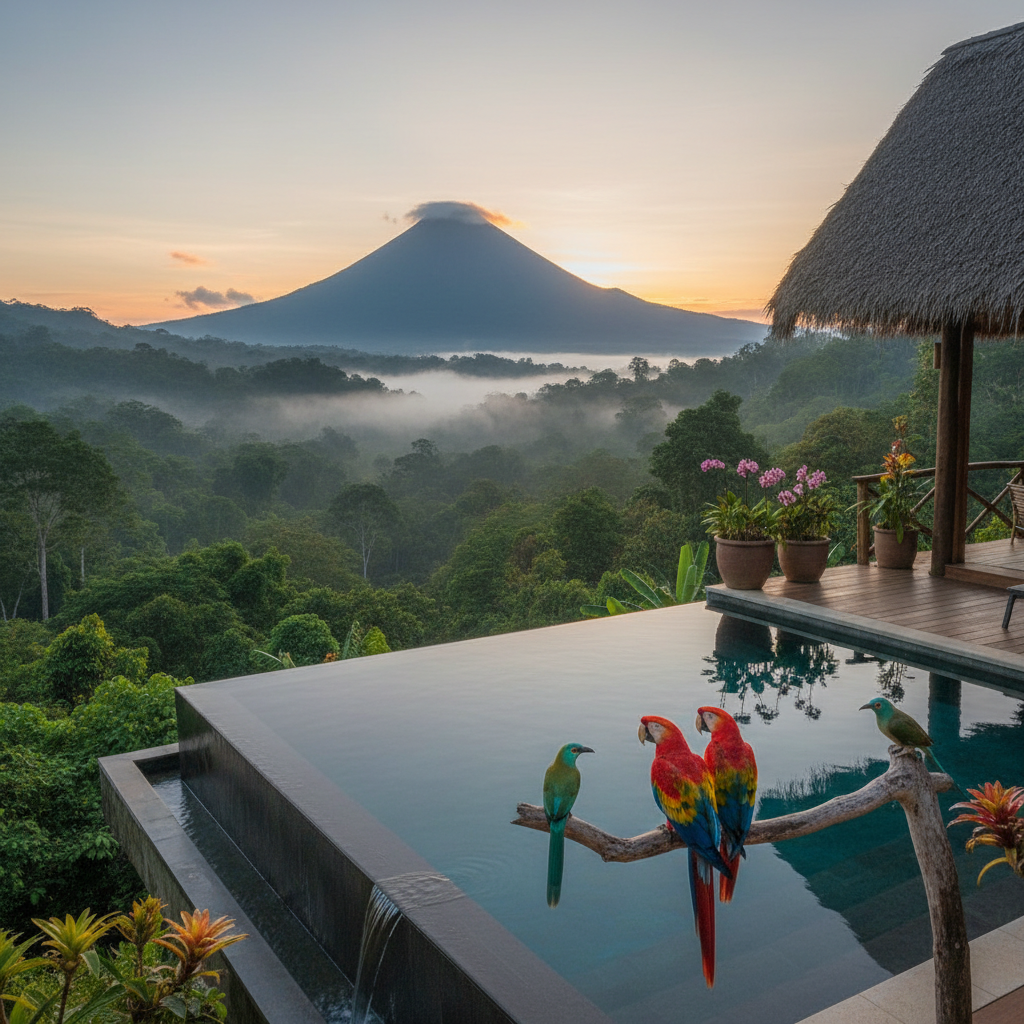
Nayara Springs (nayarasprings.com) at Arenal Volcano in Alajuela Province is consistently ranked the finest luxury resort in Central America and among the top ten in the Western Hemisphere. The 35 pool villas — each with its own private plunge pool fed by natural thermal spring water from the Arenal Volcano geothermal system — are set in rainforest that opens onto views of the active volcano and Arenal Lake. Five restaurants include Altamira (the Costa Rican tasting menu of exceptional quality) and a Japanese kaiseki restaurant of surprising authenticity. The spa uses volcanic thermal water throughout. Villas from $1,200/night.
Lapa Rios Lodge (laparios.com) on the Osa Peninsula — the most biologically intense rainforest in the Americas, according to National Geographic — is a carbon-neutral eco lodge that operates its own 1,000-acre private wildlife reserve adjacent to the Corcovado National Park. The 17 thatched bungalows on stilts above the rainforest canopy provide accommodation that is genuinely in (rather than beside) the natural world; howler monkeys wake guests at dawn, scarlet macaws fly at eye level from the breakfast terrace, and peccaries and tapirs are regularly seen on guided night walks. From $600/night all-inclusive.
Treehouse Lodge (treehouse.cr) in Tortuguero — accessible only by boat or small plane through the Caribbean lowland canal system — offers accommodation literally in the forest canopy, surrounded by the freshwater canal system through which green sea turtles migrate to their nesting beaches from July to October in the largest sea turtle nesting event in the Atlantic Ocean.
Corcovado: The World's Most Biologically Intense Rainforest
Corcovado National Park (sinac.go.cr) covers 40,000 hectares of primary rainforest on the Osa Peninsula and is described by National Geographic as 'the most biologically intense place on Earth in terms of biodiversity.' Entry is limited by permit (required in advance) and overnight camping inside the park requires advance reservation through the Sistema Nacional de Áreas de Conservación. Guided day hikes depart from Carate (the park's southern entrance) or Drake Bay (northern entrance) — the ranger-guided walks to the scarlet macaw nesting sites and along the Pacific coast sections are the primary draw.
Arenal Volcano & Hot Springs
Arenal was one of the world's most active stratovolcanoes from its eruption on July 29, 1968 (which destroyed the village of Tabacón and killed 87 people) until it entered a period of relative quiescence in 2010. The symmetrical cone rising 1,670 metres above the surrounding rainforest and lake is one of the most photogenic volcanoes in the Americas. The Tabacón Grand Spa Thermal Resort (tabacon.com) offers natural hot springs fed directly by geothermal activity from the volcano — a sequence of pools at varying temperatures through a tropical garden.
Getting There
Juan Santamaría International Airport (SJO) in San José is served by direct flights from New York (American, United, JetBlue), Miami (American), Atlanta (Delta), Los Angeles (United), Toronto (Air Canada), and numerous European hubs. Domestic flights with Nature Air or SANSA connect to regional airports including Quepos, Drake Bay, and Puerto Jiménez.
Reference Links:
- Nayara Springs Arenal: nayarasprings.com
- Lapa Rios Lodge: laparios.com
- Corcovado National Park: sinac.go.cr
- Tabacón Thermal Resort: tabacon.com
- Costa Rica Tourism Board: visitcostarica.com


Continue Reading