Food & Drink
Charleston's Lowcountry Cuisine: Shrimp, Grits, and the Flavors of the South
Built on West African foundations, shaped by the coastal marshes of South Carolina, and refined in Charleston's extraordinary restaurant renaissance, Lowcountry cuisine is one of America's most complex and compelling food traditions.
Lowcountry cuisine is the traditional cooking of the coastal region of South Carolina and Georgia — a narrow strip of land stretching from roughly Georgetown, South Carolina to the Georgia-Florida border, encompassing the sea islands, tidal marshes, and river deltas that define the South Atlantic coast. The cuisine is named for the Lowcountry itself, the low-lying coastal region whose geography, climate, and history have shaped a food tradition that is distinct from the broader category of Southern cooking. Charleston, South Carolina, founded in 1670, is the cultural and culinary capital of the Lowcountry, and the city's restaurant renaissance over the past two decades has made it one of the most celebrated food destinations in the United States (charlestoncvb.com).
The influences that shaped Lowcountry cuisine are as layered as the region's history. The foundation is West African — brought by enslaved Africans who arrived in Charleston beginning in the late 17th century and who brought with them the agricultural knowledge, cooking techniques, and ingredients that would define the cuisine. Rice cultivation, which became the economic backbone of the Lowcountry, was introduced and maintained by West African enslaved people who brought expertise in growing, harvesting, and cooking rice — expertise that was essential to the establishment of the Carolina rice plantations in the 18th century. The Gullah Geechee people — the descendants of enslaved Africans who settled on the sea islands of the Lowcountry and who maintained a distinct language, culture, and food tradition — are the true custodians of Lowcountry cooking, and their influence is present in every bowl of shrimp and grits, every pot of okra soup, and every batch of benne (sesame) wafers (gullahgeecheecorridor.org).
Other influences blended into this foundation. French Huguenot refugees, who settled in Charleston in significant numbers after the revocation of the Edict of Nantes in 1685, brought French culinary techniques and a tradition of fine cookery. Caribbean influences arrived through trade with the West Indies, bringing spices, peppers, and cooking methods. Native American contributions — including the cultivation of corn, the use of local game and fish, and the knowledge of indigenous plants — were essential to the development of the cuisine. And the coastal geography itself — with its abundance of shrimp, crab, oysters, fish, and other seafood — provided the raw materials that define the Lowcountry table. The result is a cuisine that is simultaneously refined and rustic, deeply connected to its African roots, and unlike any other regional American cooking.
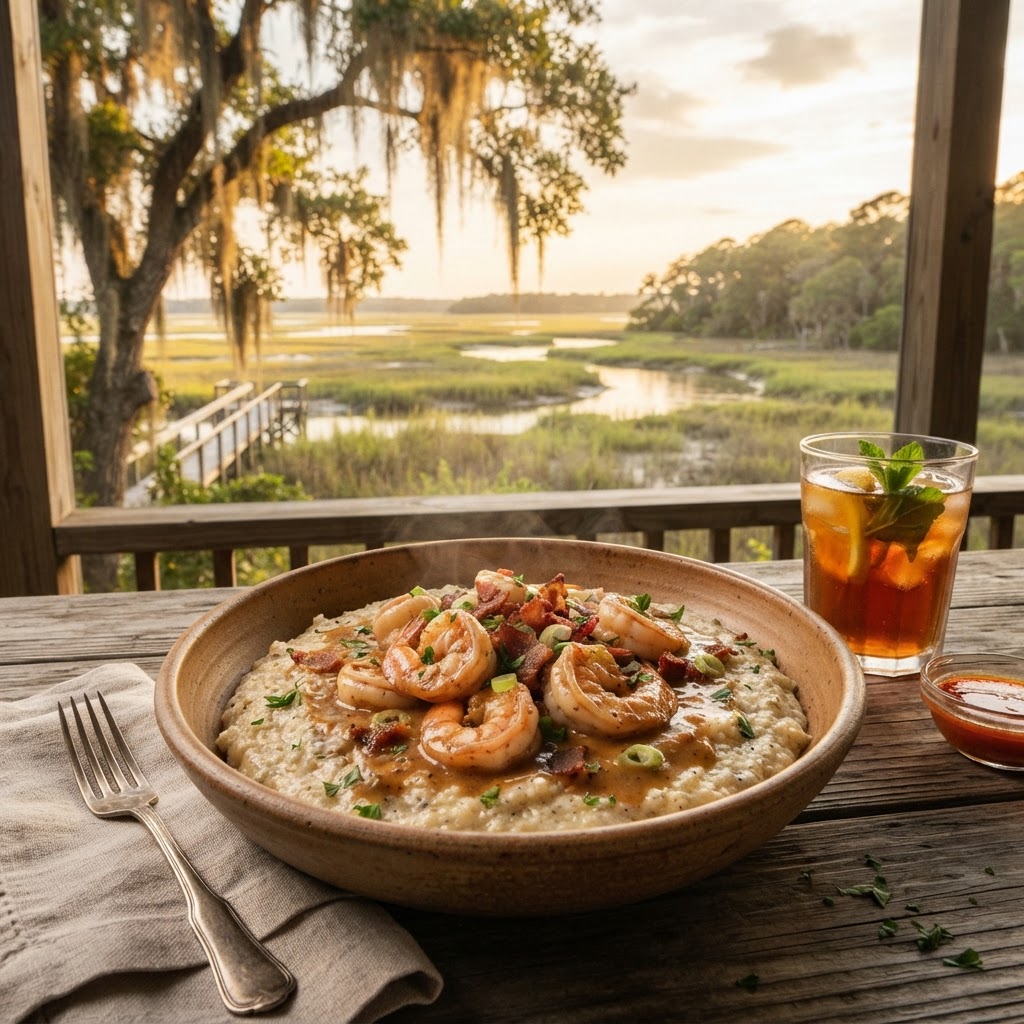
Shrimp and grits — the dish that has become the emblem of Lowcountry cuisine — began as a simple fisherman's breakfast. Originally called 'shrimp and hominy' or 'shrimp and grits,' the dish was a working meal made by shrimp fishermen who would cook their fresh catch with bacon grease and crushed hominy (coarsely ground corn) over an open fire. The grits used in traditional Lowcountry cooking are stone-ground — typically from heirloom corn varieties — and are cooked slowly in water or broth until they achieve a creamy, porridge-like consistency. The shrimp are sautéed with bacon, onion, and sometimes garlic or bell pepper, and the dish is finished with a splash of the bacon fat and pan juices. The modern, more elaborate version of shrimp and grits — with cheese grits, andouille sausage, and a variety of sauces — is a restaurant invention, popularised in the 1980s and 1990s by chefs like Bill Neal of Crook's Corner in Chapel Hill, North Carolina, whose version was praised by Craig Claiborne in The New York Times and helped launch the dish's national popularity (charlestoncvb.com).
Carolina Gold Rice is the grain that defined the Lowcountry. This heirloom long-grain rice, with its golden hue and nutty flavour, was the dominant rice variety of the South Carolina rice plantations from the late 18th century through the early 20th century, when it was nearly lost to extinction. The rice was 'gold' because of the golden colour it developed during the curing process, and it was prized for its flavour, texture, and aroma. After decades of near-extinction, Carolina Gold Rice was revived in the 1980s by Glenn Roberts, founder of Anson Mills in Columbia, South Carolina, who tracked down remaining seed stock and began cultivating the rice for a new generation of chefs and home cooks. Today, Carolina Gold Rice is grown by a small number of farmers and is used by chefs across the Lowcountry and beyond who recognise its superior quality (ansonmills.com).
The Charleston restaurant renaissance of the 21st century has brought Lowcountry cuisine to national and international attention. Husk, opened by chef Sean Brock in 2010 in a restored Victorian house in downtown Charleston, became one of the most celebrated restaurants in America, earning a James Beard Award for Best New Restaurant and helping to define the 'new Southern' cooking movement. Brock's philosophy — that Southern food should be made with Southern ingredients, heritage varieties, and traditional techniques — brought attention to the heirloom ingredients and traditional preparations that define Lowcountry cooking. FIG (Food Is Good), opened by chef Mike Lata in 2003, has been a fixture of the Charleston dining scene, celebrated for its refined, ingredient-driven approach to Lowcountry and French-influenced cuisine. The Ordinary, also from Lata, is set in a restored 1920s bank building and is one of the best seafood restaurants in the South. Leon's Oyster Shop, The Grocery, and Chez Nous are among the many other Charleston restaurants that have contributed to the city's extraordinary culinary reputation (huskrestaurant.com).
Benne — the Gullah word for sesame — is an ingredient that exemplifies the African roots of Lowcountry cooking. Sesame seeds were brought to the Lowcountry by enslaved West Africans, who considered them lucky and grew them in their garden plots. Benne wafers — thin, crisp cookies made from toasted benne seeds — are a classic Charleston treat, and benne seeds are used in a variety of other Lowcountry preparations, from breads to salads. Okra, another West African introduction, is used in gumbo (the word 'gumbo' derives from the Bantu word for okra, ki ngombo), in soups, and in stews throughout the Lowcountry. Field peas — including the famous Sea Island red pea and the crowder pea — are traditional accompaniments to rice, and their cultivation and preparation are deeply rooted in African agricultural tradition. And the rice itself — the growing, harvesting, cooking, and serving of rice — is the thread that connects every plate of Lowcountry food to its West African origins.
For the traveller, Charleston offers one of the most rewarding food experiences in America. The city's restaurant scene is dense, diverse, and constantly evolving, but the best restaurants share a commitment to local ingredients, traditional techniques, and the distinctive flavours of the Lowcountry. The Charleston Wine + Food Festival, held annually in early March, brings together chefs, farmers, and food enthusiasts from around the country for a multi-day celebration of Lowcountry cuisine. The Charleston City Market, operating since the 1790s, offers benne wafers, sweetgrass baskets, and other traditional Lowcountry products. And for those who want to go deeper, the Gullah Geechee Cultural Heritage Corridor, designated by Congress in 2006, encompasses the sea islands from Wilmington, North Carolina to Jacksonville, Florida, and provides information on the people, culture, and food traditions that are the true foundation of Lowcountry cuisine (gullahgeecheecorridor.org).
What makes Lowcountry cuisine so significant in the world of food and drink is the way it embodies the complex, often painful, but ultimately fertile intersection of cultures, geographies, and histories that defines American cooking at its best. The cuisine was built by enslaved Africans on land taken from Native Americans, seasoned by French and Caribbean influences, and shaped by the coastal geography of the South Atlantic. It is a cuisine that cannot be understood without acknowledging the horrors of slavery and the resilience of the people who, despite being stripped of their freedom, maintained and adapted their culinary traditions to create something new, distinctive, and enduringly beautiful. To eat shrimp and grits in Charleston — made with stone-ground heirloom corn, fresh local shrimp, and Carolina Gold Rice on the side — is to taste this history in its most eloquent form: a dish born of necessity, refined by tradition, and now celebrated as one of the great regional cuisines of America.
For those planning a visit, the Charleston Area Convention & Visitors Bureau provides comprehensive dining and travel information (charlestoncvb.com). The Gullah Geechee Cultural Heritage Corridor Commission provides information on the culture, history, and food traditions of the Lowcountry's African heritage (gullahgeecheecorridor.org). Anson Mills, the leading producer of heirloom Carolina Gold Rice and stone-ground grits, provides information on these essential Lowcountry ingredients (ansonmills.com).
Continue Reading