Food & Drink
The Champagne Region: A Guide to France's Most Intoxicating Terroir
The Champagne region is not simply a wine appellation — it is a 34,000-hectare living monument to obsessive craftsmanship, where chalk caves, centuries-old tradition, and the work of legendary houses converge in a single glass of bubbles.
There are wine regions, and then there is Champagne. Stretching across the rolling hills and chalk plains of northeast France, just 145 kilometres east of Paris, the Champagne appellation (https://www.champagne.fr/en) produces the only sparkling wine legally entitled to use the name. It is a distinction the French have defended ferociously — and one that is earned in every glass.
The story of Champagne as we know it begins in the 17th century. Pierre Pérignon, a Benedictine monk at the Abbey of Hautvillers near Épernay, is often credited with perfecting the art of blending multiple grape varieties and vintages to achieve consistency and complexity. Though the legend that he 'invented' sparkling wine is somewhat embellished — secondary fermentation in the bottle was already known — Dom Pérignon undeniably shaped the region's identity. His cellar master's philosophy is still enshrined in the prestige cuvée that bears his name at Moët & Chandon (https://www.domperignon.com).
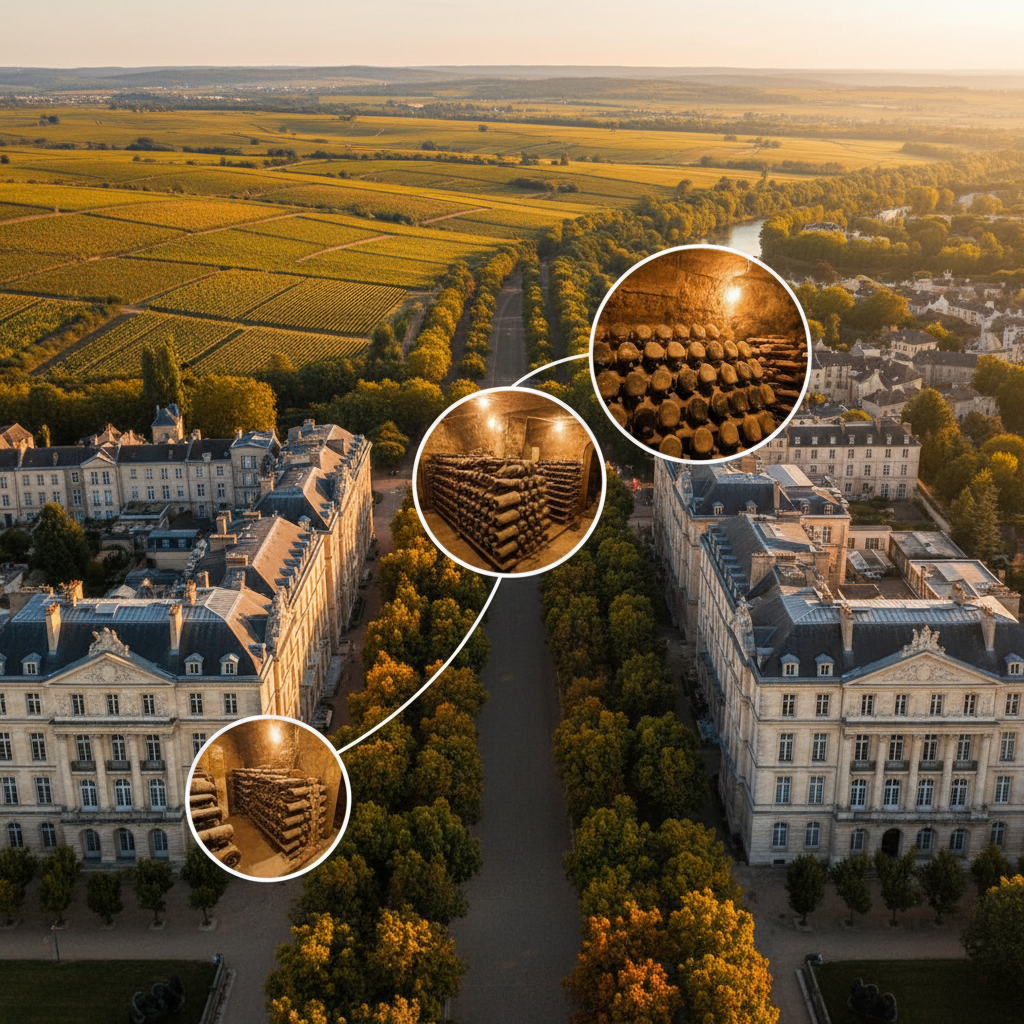
The Champagne appellation is defined by three primary grape varieties: Chardonnay, Pinot Noir, and Pinot Meunier. The white chalk subsoil — unique in all of France — lends a distinctive minerality, tension, and precision that no other terroir can replicate. The same chalk that gives the wine its character was quarried over centuries to create the labyrinthine cellars beneath Reims and Épernay, where millions of bottles age in stable, cool darkness.
The two great cities of Champagne are Reims and Épernay, each with its own character.
Reims is home to the magnificent Gothic cathedral where the kings of France were crowned, and to some of the most storied Champagne houses, including Veuve Clicquot (https://www.veuveclicquot.com/en-us/visitus.html), Taittinger, Ruinart (France's oldest established house, founded 1729), and G.H. Mumm. Veuve Clicquot's cellars beneath the city streets are a UNESCO-listed marvel — 24 kilometres of tunnels cut into pure chalk, lined with bottles in méthode traditionnelle riddling racks.
Épernay, often called the 'capital of Champagne,' is home to the legendary Avenue de Champagne (https://www.epernay-tourisme.com/en), a single boulevard whose properties harbour an estimated 200 million bottles ageing underground. Moët & Chandon, Pol Roger (Winston Churchill's house), Perrier-Jouët, and Mercier all have their cellars here. The annual fête of the Avenue de Champagne each autumn is one of France's great wine celebrations.
Beyond the grand houses, the region's true hidden treasure is its small, independent grower-producers (récoltants-manipulants), many farming just a few hectares of classified Grand Cru and Premier Cru vineyards. Houses like Egly-Ouriet, Jacques Selosse, and Pierre Peters have developed cult followings among collectors who value terroir transparency over house style.
The hierarchy of Champagne quality begins with non-vintage (NV) blends, where the skill of the chef de cave in maintaining house style across harvests is paramount. Above these sit vintage Champagnes, produced only in exceptional years. At the apex are the prestige cuvées — Cristal (Louis Roederer), Krug Grande Cuvée, Bollinger RD, Pol Roger Cuvée Sir Winston Churchill, and Salon Le Mesnil — which represent the absolute pinnacle of the appellation. For a comprehensive buyer's guide, Christie's Wine Department (https://www.christies.com/en/stories/how-to-buy-champagne-eb72f791910c43c28ebef16a4a136dcc) offers expert guidance on cellaring and collecting.
For visitors, the best approach is to combine a grand house cellar tour with a visit to a grower-producer, followed by a lunch in Épernay or dinner at one of Reims' excellent brasseries. Cellar Tours (https://www.cellartours.com/france/wine-tours/champagne) operates private chauffeured experiences combining the best of both worlds.
The Champagne region is also a UNESCO World Heritage Site, encompassing the hillside vineyards, the historic houses of Reims, and the ancient chalk cellars. It is, in every sense, a place where extraordinary geography, ancient tradition, and relentless ambition converge in liquid form.
Continue Reading