Food & Drink
Burrata: Italy's Most Indulgent Cheese & the Art of Making It
Born in Puglia in the 1950s from a dairy farmer's desire to use every drop of fresh cream, burrata has become one of the world's most copied and most beloved cheeses. The real thing, eaten within hours of making in Andria, is a different food entirely.
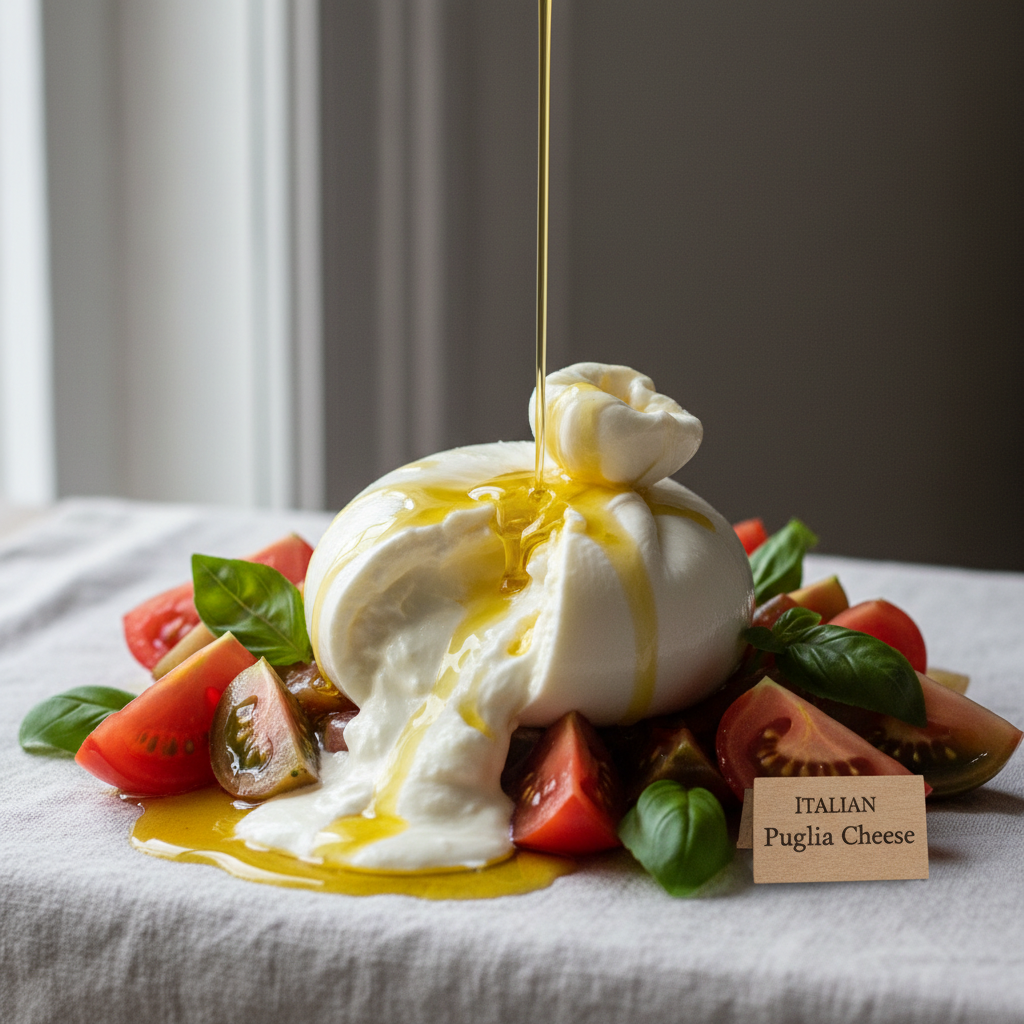
Cut into a burrata at the table and something remarkable happens. The outer shell — a thin pouch of fresh mozzarella — gives way to a flood of stracciatella: shredded curd mixed with the richest, freshest cream, pooling across the plate in a wave of absolute indulgence. It is one of the most theatrical and satisfying moments in Italian food, and it explains why burrata, a cheese invented less than a century ago, has conquered the menus of fine restaurants worldwide.
The origins of burrata are local and, by some accounts, accidental. The most widely cited story places the invention in the 1950s at the dairy farm of Lorenzo Bianchino in Andria, a city in the Puglia region of southern Italy (www.pugliapromozione.com). During a period of heavy snowfall that made transporting cream impossible, Bianchino wrapped the excess cream and fresh curd inside a mozzarella pouch — effectively creating a vessel to use every drop of perishable dairy without waste. The result was not merely practical but revelatory, and the burrata di Andria was born.
The production process is an exercise in delicacy and speed. Fresh whole cow's milk is curdled with rennet, then the curd is cut, cooked, and stretched (a technique called pasta filata) under very hot water until it achieves the characteristic smooth, elastic texture of mozzarella. A thin sheet of this stretched curd is shaped into a pouch. The filling — stracciatella — is prepared separately: curd strands are manually torn and mixed with fresh cream until the mixture is loose and flowing. The pouch is filled, sealed by hand, and the burrata is complete. The entire process, from curdling to sealing, takes a skilled cheesemaker less than 20 minutes.
Burrata's defining characteristic is its perishability. A truly fresh burrata, made that morning, has a slightly sour, lactic freshness to its outer shell and a cream filling so fresh it tastes almost of warm milk. By 24 hours, it has already lost a degree of that vivacity. By 48 hours, it remains good but begins its decline. This is why eating burrata in Andria or the wider Puglia region — where the cheese is made daily and consumed the same day — is a qualitatively different experience from eating imported burrata that has crossed an ocean.
In Puglia, burrata is served almost exclusively with the best available olive oil (the region's extra virgin oils from Coratina olives are among Italy's finest), slices of summer tomato, and nothing else. Perhaps a little sea salt. The simplicity is the point — the cheese is the entire meal.
Outside Puglia, the classic pairing of burrata with ripe heirloom tomatoes, Sicilian sea salt, and a generous pour of Taggiasca or Coratina extra virgin olive oil remains the gold standard. In summer, it benefits from torn fresh basil; in autumn, from walnuts and honey; in winter, from roasted beetroot and aged balsamic. Burrata pairs beautifully with thinly sliced prosciutto di Parma or San Daniele — the salt and sweetness of the cured ham offsetting the rich creaminess perfectly.
For wine pairing, the delicate creaminess of burrata calls for wines of similar freshness and restraint: a bright Pugliese Fiano or Verdeca, a Vermentino from Sardinia, or a dry, unoaked Soave from the Veneto. Avoid anything heavily oaked or tannic. For a sparkling match, a crisp Franciacorta Blanc de Blancs or a mineral Champagne is ideal.
For sourcing burrata outside Italy, the best option is always to buy locally from an Italian delicatessen or specialist cheesemaker who makes it fresh on the premises. In the United States, Maplebrook Farm (https://www.maplebrookfarm.com) in Vermont and Di Stefano Cheese (https://www.distefanocheese.com) in California produce consistently excellent fresh burrata. Eataly (https://www.eataly.com) carries imported Italian burrata from Puglia at their locations across the US and internationally.
Taste Atlas, the online guide to world foods, lists Burrata di Andria as one of Italy's most significant protected food products (https://www.tasteatlas.com/burrata-di-andria). In 2016, the European Union awarded burrata di Andria Indicazione Geografica Protetta (IGP) status — protecting the name for cheeses made in the Puglia tradition, though full PGI compliance requires production in defined areas of Bari and Barletta-Andria-Trani provinces.


Continue Reading