Travel
Bhutan: The Tiger's Nest, Gross National Happiness & the Last Himalayan Kingdom
Bhutan — the only country in the world that measures Gross National Happiness as an official policy metric — is the most philosophically coherent travel destination on earth: a Himalayan Buddhist kingdom that has chosen cultural preservation and environmental sustainability over mass tourism.
Bhutan is the world's most intentional travel destination. The kingdom's policy of High Value, Low Impact Tourism — implemented by limiting annual visitor numbers and requiring all international tourists to pay a Sustainable Development Fee (currently $100/day) — has created a country that is simultaneously pristine, unhurried, and deeply authentic. There are no billboards in Bhutan. Traditional architecture is legally mandated in all new construction. Forest cover is constitutionally protected at a minimum of 60% of total land area (currently above 70%). The Gross National Happiness philosophy, codified by the fourth Druk Gyalpo (Dragon King) Jigme Singye Wangchuck in the 1970s, measures national progress not by GDP but by the four pillars of sustainable development, environmental conservation, cultural preservation, and good governance.
For the traveller, the result is a country of extraordinary beauty and absolute coherence — a functioning medieval Buddhist civilisation maintained entirely intact into the 21st century, with a level of traditional cultural vitality found nowhere else in Asia.
Paro: The Arrival Valley
Paro International Airport (PBH) is one of the most spectacular and demanding airports in the world — situated at 2,235 metres in the narrow Paro Valley, surrounded by 5,000-metre peaks, approachable only in daylight and clear weather, and certified for only a handful of pilots worldwide. The arrival itself — banking between mountain walls to a short runway in a valley of apple orchards and traditional whitewashed farmhouses — is an experience unlike any other in commercial aviation. Only Bhutan Airlines (bhutanairlines.bt) and Drukair (drukair.com.bt) are permitted to operate into Paro; direct flights from Bangkok, Delhi, Kolkata, Mumbai, Kathmandu, and Singapore.
Taktsang Monastery: The Tiger's Nest
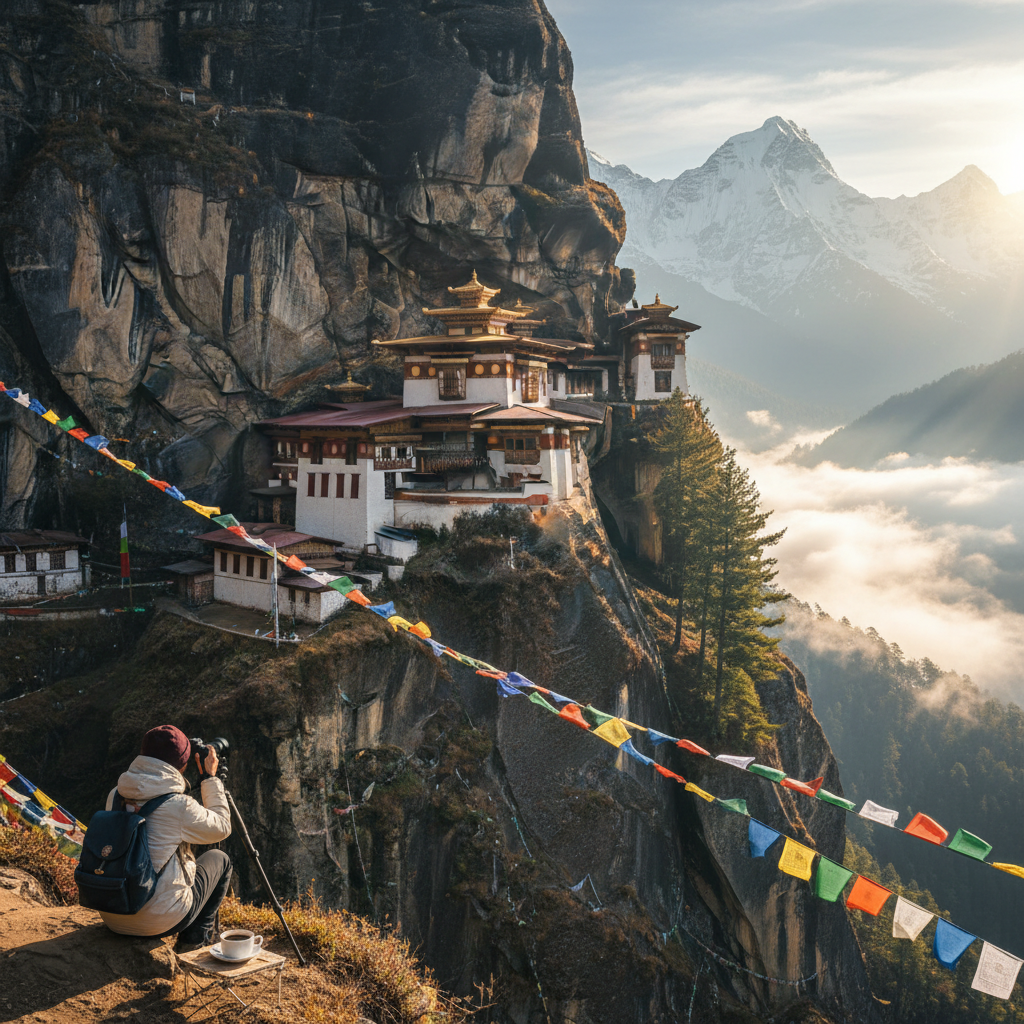
Taktsang Palphug Monastery — universally known as the Tiger's Nest — is the most iconic building in Bhutan and one of the most dramatic pieces of architecture in the world: a complex of four main temples and associated structures built directly into and onto a sheer 900-metre granite cliff face at 3,120 metres above the Paro Valley floor. According to tradition, Guru Rinpoche (Padmasambhava) flew to this cliff face on the back of a tigress in the 8th century AD and meditated in the cave that now forms the monastery's inner sanctum. The 3–4 hour hike from the valley floor to the monastery gates — through blue pine and rhododendron forest, past prayer wheels and fluttering lungta (wind horse) prayer flags — is one of the great mountain walks in Asia.
Thimphu: The Capital
Thimphu is the world's only capital city without traffic lights (junctions are directed by white-gloved policemen who consider the traffic lights briefly installed in 1998 insufficiently human). The National Memorial Chorten at the city's centre is the primary site of daily Buddhist devotion for Thimphu's residents — circumambulating monks, butter lamps, and the sound of prayer wheels are a constant presence at all hours. The Tashichho Dzong (fortress-monastery), which serves as the seat of both government and the Je Khenpo (Chief Abbot), is one of the finest examples of traditional Bhutanese architecture in the kingdom.
Where to Stay
Amankora (aman.com/resorts/amankora) operates five lodges across Bhutan's principal valleys — Paro, Thimphu, Punakha, Gangtey, and Bumthang — designed by architect Kerry Hill in traditional rammed-earth and stone construction. The interconnected lodge programme (guests travel between lodges by road, experiencing the kingdom's landscapes progressively) is the definitive luxury travel itinerary in Bhutan and one of the finest in Asia. From $1,800/person/night, all-inclusive.
Six Senses Bhutan (sixsenses.com/bhutan) operates a comparable five-lodge programme — Thimphu, Punakha, Paro, Gangtey, and Bumthang — with the brand's signature wellness focus and outstanding cuisine. From $1,500/person/night.
Festivals: The Tsechus
Bhutan's dzong (fortress) festivals — Tsechus — are among the most vivid and authentic religious festivals in the world: days of masked Cham dances, performed by monks in extraordinary costumes, celebrating the deeds of Guru Rinpoche. The Paro Tsechu (March–April) and Thimphu Tsechu (September–October) are the largest and most spectacular. Travel during festival periods should be arranged six to twelve months in advance.
Reference Links:
- Tourism Council of Bhutan: tourism.gov.bt
- Amankora Bhutan: aman.com/resorts/amankora
- Six Senses Bhutan: sixsenses.com/bhutan
- Drukair Royal Bhutan Airlines: drukair.com.bt
- Bhutan Airlines: bhutanairlines.bt
- Bhutan Sustainable Development Fee: tourism.gov.bt/sustainable-development-fee



Continue Reading