Food & Drink
The Art of Cheese: A Guide to the World's Greatest Aged Varieties
Comté aged 36 months. Parmigiano-Reggiano at 48 months. Époisses de Bourgogne. The world's greatest cheeses are works of patient craft — and understanding them changes how you eat forever.
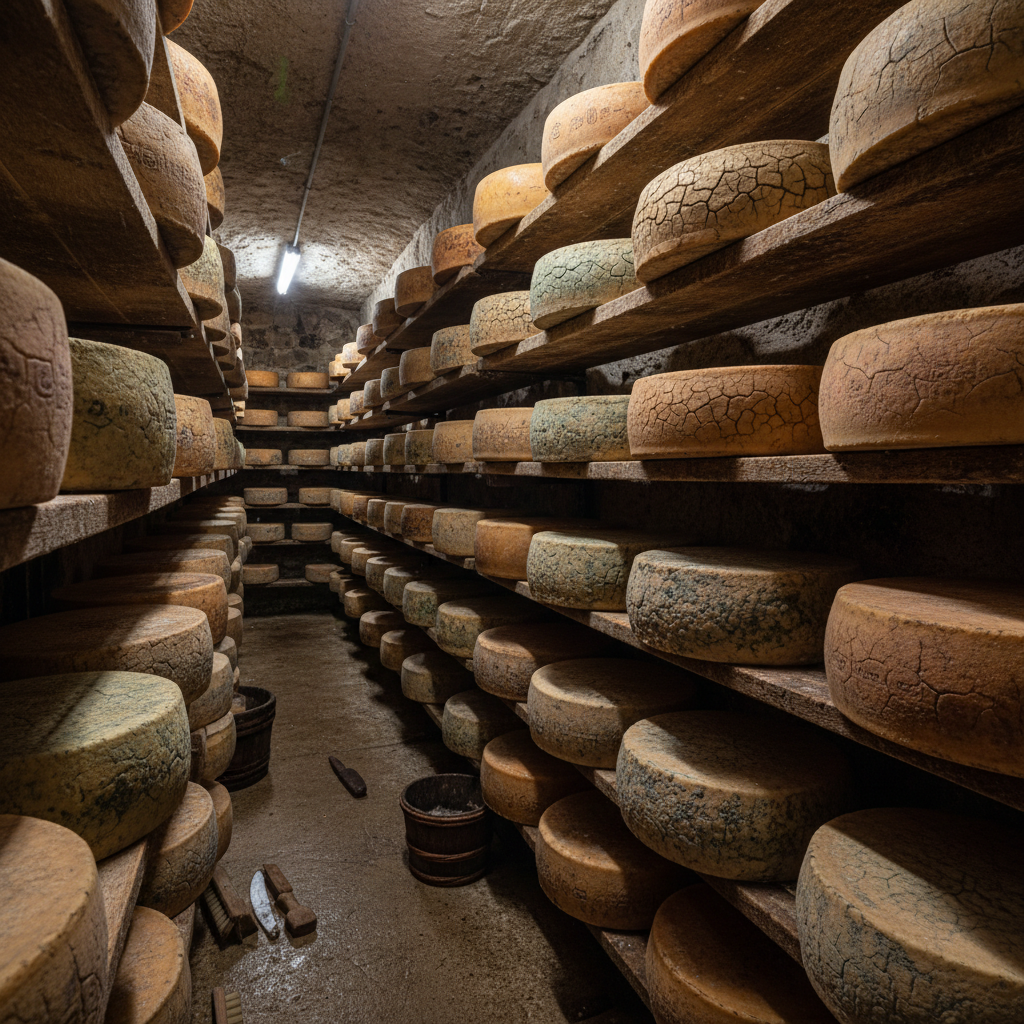
Cheese is one of humanity's oldest and most sophisticated food technologies: a method of preserving milk's nutrients and flavours through the controlled action of bacteria, rennet, salt, and time. The finest aged cheeses are the product of decades of accumulated knowledge about specific milks, specific microbial cultures, specific cave or cellar environments, and the precise conditions under which complex flavour compounds develop over months or years. They are, in the most literal sense, alive — and they reward the same depth of attention as great wine.
**The Categories**
Cheese is broadly classified by texture (fresh, soft-ripened, semi-hard, hard, extra-hard) and by rind type (bloomy rind, washed rind, natural rind, pressed), which corresponds approximately to the microbial activity happening at the cheese's surface. The most complex and age-worthy cheeses fall into the hard and extra-hard categories, where moisture reduction and extended maturation concentrate flavour compounds to an extraordinary degree.
**The World's Greatest Aged Varieties**
Comté (France): Produced in the Franche-Comté region of eastern France from the milk of Montbéliarde and French Simmental cows grazing on summer pastures in the Jura mountains, Comté is aged in vast affinage caves for a minimum of four months, though the finest expressions — those selected by affineurs Marcel Petite (marcel-petite.com) at their Fort Saint-Antoine cave — reach 24, 36, or even 48 months of maturation. At these extended ages, the paste develops lactate crystals, a deep amber interior, and flavours that move from nutty and sweet in young versions to complex, almost meaty, caramelised notes in the oldest. The AOP designation (comtegruyere.fr) governs production standards.
Parmigiano-Reggiano (Italy): The 'King of Cheeses' — produced from partially skimmed raw cow's milk in the provinces of Parma, Reggio Emilia, Modena, Mantua, and Bologna — is aged a minimum of 12 months, with the finest wheels graded at 24 months (Vecchio) and 36+ months (Stravecchio) by the Consorzio del Formaggio Parmigiano-Reggiano (parmigiano-reggiano.it). At 36 months, the paste has an almost granular, crystalline structure; the flavour — sweet, umami-rich, with deep savoury complexity — is incomparable. A 88 ⅛ lb wheel of Parmigiano-Reggiano represents approximately 581 ⅛ qt of milk and 24 hours of labour.
Époisses de Bourgogne (France): Napoleon's alleged favourite cheese — a square-moulded, washed-rind soft cheese from Burgundy whose orange-red rind is washed repeatedly during its four-to-six-week affinage with Marc de Bourgogne (pomace brandy). At peak maturity, Époisses is profoundly pungent, with an interior so soft it flows at room temperature and a flavour that is simultaneously funky, creamy, and deeply savoury. The leading producer is Fromagerie Gaugry (gaugry.fr); Fromagerie Berthaut (epoisses.com) makes the most widely exported version. AOP-protected since 1991.
Montgomery's Cheddar (England): Made at Manor Farm in North Cadbury, Somerset by Jamie Montgomery — one of only three farmhouse producers of Unpasteurised Somerset Cheddar in existence — and clothbound in traditional style, aged 12+ months in the cool cellars of Neal's Yard Dairy (nealsyarddairy.co.uk) in London. At maturity, it is simultaneously sharp, sweet, savoury, and almost crumbly — the definitive expression of English territorial cheese.
Mancego DOP (Spain): Produced exclusively in La Mancha from the milk of Manchega sheep, aged a minimum of 60 days for fresh (Semicurado) and up to two years for the most mature (Viejo). At 12+ months, the firm paste develops a complex mix of lanolin, dried fruit, and hay notes. The Denominación de Origen (queso-manchego.com) is one of Spain's most strictly enforced.
Gruyère AOP (Switzerland): The classic Swiss mountain cheese — produced in the canton of Fribourg and neighbouring cantons — develops a firm, slightly granular texture and deep complex flavours of fruit, nuts, and autumn pasture at 12+ months of cave aging. The finest is graded by the Interprofession du Gruyère (gruyere.com) and marked 'Réserve' for wheels aged 10 months or more.
**Building the Cheese Course**
A great cheese course proceeds from mildest to most intense: begin with a young chèvre or mild bloomy rind (such as Camembert de Normandie), progress through a semi-hard (Comté, Gruyère), then a blue (Roquefort or Gorgonzola Naturale), finishing with the most pungent washed rind (Époisses) or a hard, crystalline aged variety (Parmigiano Vecchio). Accompaniments: honeycomb, membrillo (quince paste), Medjool dates, toasted walnuts, good sourdough, and plain crackers.
For sourcing in the US: Murray's Cheese (murrayscheese.com) in New York is the finest specialist retailer, with an extraordinary online offering. Di Bruno Bros (dibruno.com) in Philadelphia is equally exceptional.



Continue Reading