Smoked Salmon & Dill Frittata
May 27, 2026
The frittata is the Italian answer to the question "what do I do with eggs when I want something more substantial than scrambled and less fussy than a quiche?" It finishes in the oven, holds its shape at room temperature, and — critically — can be made the day before and served cold or at room temperature with no loss of quality. For brunch hosting, that last part is worth a lot.
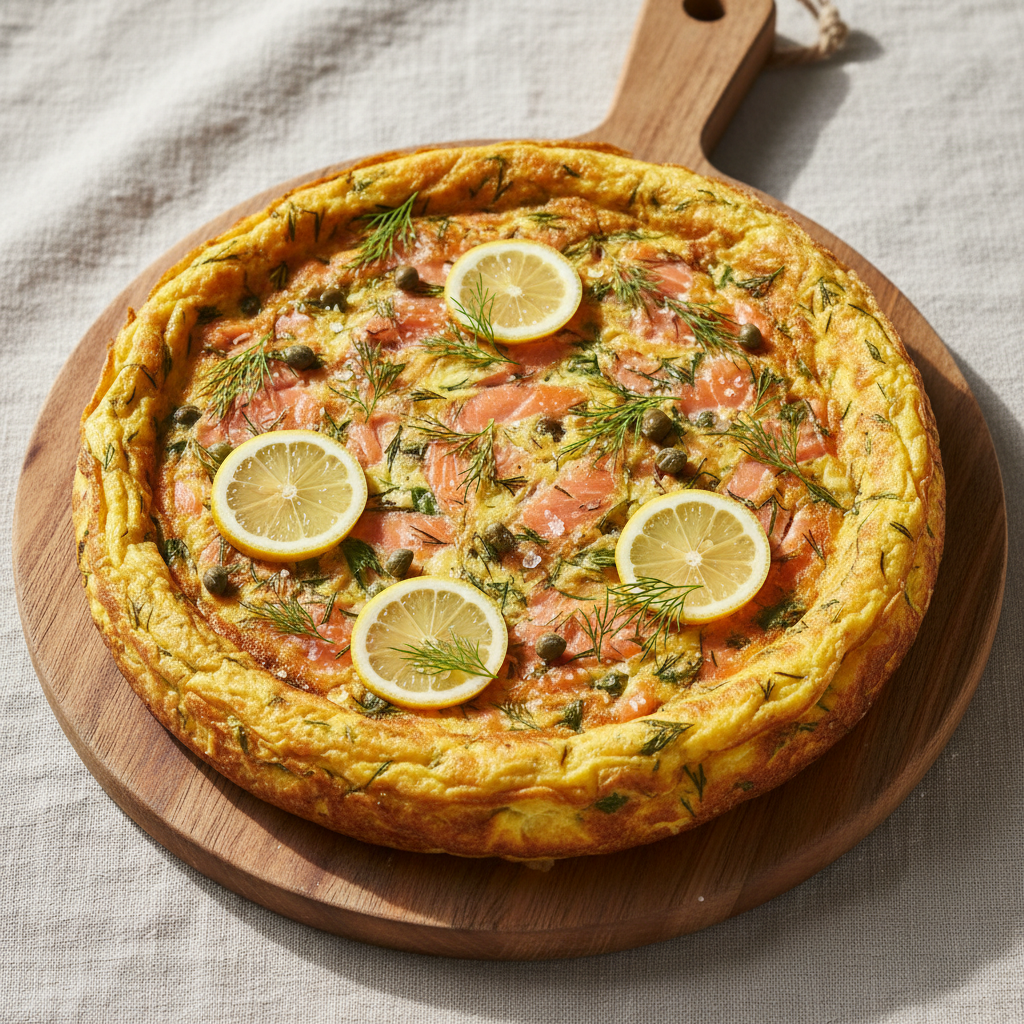
This version, with cold-smoked salmon, cream cheese cubes, dill, and capers, produces a frittata that reads more like a composed restaurant dish than a home cook's improvisation. It's naturally gluten-free, scales for any group size, and the make-ahead flexibility makes it one of the most practical centerpiece dishes available.
The History of the Frittata
The frittata (from the Italian *friggere*, to fry) has been a staple of Italian home cooking for centuries, particularly in Southern Italy where egg-based dishes have long formed the backbone of cucina povera — the resourceful, ingredient-led cooking of rural households. Unlike the French omelette, which is folded and served immediately from the pan, the frittata is finished in the oven, producing a thicker, more structured result that can be prepared well ahead of service. It became fashionable in restaurant dining in the 1980s and 1990s, when chefs began pairing it with luxury ingredients — truffles, lobster, foie gras — and it has never looked back.
The smoked salmon version draws on Scandinavian and Scottish smoking traditions. Cold-smoked Atlantic salmon — cured in salt, then smoked at low temperatures for days — has a silky, almost buttery texture that melts into a warm egg custard beautifully, releasing its delicate smoke and brine throughout every bite.
What Makes This Version Different
Most smoked salmon frittatas rely on the salmon alone for richness. This version layers three distinct textural elements: the salmon itself (silky and smoky), cold cream cheese cubes (which melt into distinct, cloud-like pockets of richness), and a base of crème fraîche-enriched egg custard (which produces a silkier, more trembling set than plain eggs). The result is a frittata of noticeably greater complexity and depth than its ingredient list suggests.
The use of capers, lemon zest, and fresh dill — the classic Scandinavian garnish trinity for smoked salmon — provides the bright, saline contrast that keeps the dish from feeling heavy despite its richness.
Ingredients (serves 6–8): - 10 large eggs - 7 oz cold-smoked Atlantic salmon (Nova-style or Scottish), roughly torn - 5 ¼ oz full-fat cream cheese, cut into ¾ in cubes and refrigerated until use - 3 tablespoons fresh dill, finely chopped, plus extra fronds for garnish - 2 tablespoons fresh chives, snipped - 2 tablespoons capers, drained and roughly chopped if large - Zest of 1 lemon + 1 tablespoon fresh lemon juice - 3 tablespoons crème fraîche or heavy cream - 1 shallot, very finely minced - 2 tablespoons unsalted butter + 2 tablespoons olive oil
- Salt and white pepper - Flaky sea salt for finishing - Optional: 1 oz salmon roe for garnish (adds a spectacular briny finish)
Instructions: Preheat oven to 375°F. In a large bowl, whisk eggs with crème fraîche, lemon juice, lemon zest, dill, chives, and a generous pinch of white pepper and salt until just combined — do not overbeat. A minute of whisking is sufficient; overbeaten eggs produce a rubbery rather than silky set.
Heat butter and olive oil together in a 12-inch oven-safe skillet (stainless steel or non-stick — not cast iron, which retains heat too aggressively and can toughen the edges) over medium heat. Sauté shallot for 2 minutes until softened and translucent. Arrange half the smoked salmon loosely across the base. Pour the egg mixture evenly over the salmon. As the edges begin to set at the 2–3 minute mark, gently lift them once or twice with a spatula to allow uncooked egg to flow underneath — then leave completely undisturbed.
Distribute the cold cream cheese cubes evenly across the surface of the eggs. Arrange the remaining smoked salmon on top. Scatter the capers.
Transfer immediately to the preheated oven and bake for 12–15 minutes until just set — the center should still have a gentle, slight trembling quality when the pan is nudged. The top should be matte rather than wet-looking, but should not be fully firm. Remove from the oven and rest in the pan for 5 minutes — it will continue to set from residual heat.
Run a flexible spatula around the edge and underneath the frittata and slide it carefully onto a large wooden board or serving platter.
Finishing and Garnish: Scatter fresh dill fronds and snipped chives generously over the surface. Finish with flaky sea salt and a few twists of cracked black pepper. If using salmon roe, dot it sparingly across the top — it adds jewel-like visual drama and a wonderful burst of brine. Serve with lemon wedges on the side.
Cutting and Serving: For a formal brunch, slice into wedges at the table. For a grazing or buffet presentation, cut into smaller squares or rectangles — the frittata holds its shape beautifully and can be served with cocktail picks as a passed appetizer. A single frittata will generously serve 8 as part of a wider spread.
Make-Ahead: Make completely, cool to room temperature, cover with plastic wrap, and refrigerate up to 24 hours. Serve at room temperature — the flavors are arguably more developed cold than warm, and it requires no reheating. This is the extraordinary practical advantage of the frittata over scrambled eggs, omelettes, or quiche.
Mimosa Pairings
The smoked salmon frittata is one of the most mimosa-compatible brunch dishes, and the pairing requires thought — the smokiness, salt, and richness of the frittata interact differently with different juice bases and wine styles.
Classic Orange Mimosa — The standard starting point. The frittata's richness and the salmon's salinity make a good Classic Champagne Mimosa taste brighter and more citrusy by contrast. The acidity of fresh orange juice cuts through the cream cheese beautifully. This is the safest, most crowd-pleasing combination.
Blood Orange Mimosa — A noticeably better pairing than standard orange. Blood orange juice has a deeper, more complex citrus profile with subtle berry undertones that harmonize with the salmon's smoke. A Blood Orange Mimosa served alongside this frittata is one of the more refined beverage pairings on a brunch table.
Grapefruit & Rosemary Mimosa — An outstanding pairing for those who enjoy bitter, aromatic flavors. The grapefruit's natural bitterness contrasts the richness of the frittata in the same way a squeeze of lemon over smoked salmon works — it cuts, brightens, and refreshes. The rosemary in a Grapefruit & Rosemary Mimosa echoes the herbaceousness of the dill in the frittata with remarkable synergy.
Cucumber Mint Mimosa — For a more spa-like, elegant brunch aesthetic, a Cucumber Mint Mimosa pairs beautifully with this dish. The cucumber's cool, watery freshness and the mint's brightness create a beverage that feels almost cleansing alongside the richness of salmon and cream cheese.
Lemon Verbena Mimosa — For the most considered pairing, the Lemon Verbena Mimosa is exceptional. The intensely citrusy, almost floral lemon verbena notes mirror the lemon zest within the frittata while the sparkling wine's mineral finish complements the salmon's brine.
Mimosa to Avoid: Very sweet, fruit-forward mimosas — tropical mango, pineapple coconut, or passionfruit — tend to clash with smoked salmon. The sweetness amplifies the fishy notes in a way that a drier, more citrus-forward mimosa does not. For this dish, dryness and acidity in the glass are always preferable to sweetness.
Serving the Frittata at a Mimosa Brunch
The smoked salmon frittata is a natural anchor dish for a mimosa brunch spread, particularly when paired with lighter accompaniments. Consider pairing with:
- A simple Arugula Salad dressed with lemon vinaigrette for freshness and contrast - Lox & Herb Cream Cheese Bites to lean into the smoked salmon theme with smaller passed bites - Smoked Salmon Cucumber Bites for a lighter appetizer to precede the frittata - Granola Parfait Bar as a lighter sweet option alongside
Variations
Goat Cheese & Sun-Dried Tomato: Replace cream cheese with crumbled goat cheese and add 3 tablespoons of finely chopped sun-dried tomatoes to the egg mixture. Omit the salmon and dill; use fresh basil instead. Pairs beautifully with a Provence Rosé & Lavender Mimosa.
Truffle & Asparagus: Substitute the salmon for 12 blanched asparagus spears (halved) and add 1 tablespoon of black truffle paste to the egg mixture. Pair with a St. Germain Mimosa for an extraordinary combination of earthy truffle and floral elderflower.
Spanish Chorizo & Manchego: Replace salmon with 3 ½ oz thinly sliced dry-cured chorizo, sautéed briefly in the pan before adding the eggs, and cream cheese with crumbled Manchego. A Cava Blood Orange & Aperol Mimosa is the natural accompaniment — Spanish wine for a Spanish-inspired dish.
Herb & Ricotta (Vegetarian): Replace salmon with 5 ¼ oz whole-milk ricotta in place of cream cheese, and add a generous amount of fresh basil, parsley, and mint to the egg mixture. Beautiful cold as part of a picnic spread.
Pro Tips: The cream cheese cubes must be cold and cut large enough to resist full incorporation — this creates the distinct pockets of richness that distinguish this frittata. Slightly underdone center continues cooking from residual heat and produces the silkier, more restaurant-quality result. The choice of pan matters: stainless steel or non-stick gives more control over the final set. A wider, shallower pan produces a thinner, more elegant frittata; a narrower, deeper pan produces a thicker, more substantial one. For the most beautiful presentation, slide onto the board rather than cutting in the pan.
Rate this recipe
Be the first to rate this recipe
to submit your rating.
Recent Posts

Couscous Royale: North Africa's Grand Platter of Lamb, Chicken, and Merguez
October 14, 2026

Seattle Cream Cheese Dog Bites: Hadley Long's 1989 Pioneer Square Invention
October 14, 2026

Khao Soi: Chiang Mai's Northern Thai Coconut Curry Noodles
October 13, 2026

Korean Bibimbap: Jeonju's Joseon Dynasty Mixed Rice
October 11, 2026

Spaghetti alla Carbonara: Rome's World War II Pasta of Eggs, Guanciale, and Pecorino
October 9, 2026