The Mountain Huckleberry Honey Champagne Mimosa
August 30, 2026
The mountain huckleberry (Vaccinium membranaceum) is a wild berry of the Northern Rockies, prized for centuries by the Native peoples of the inland Northwest and adopted in 2000 as the official state fruit of Idaho. Unlike the blueberry, which was domesticated and bred for size and shelf stability, the mountain huckleberry has resisted every attempt at commercial cultivation: it grows only at elevation, in the acidic soils of subalpine forests, and its berries will not ripen once picked. The result is a fruit that remains genuinely wild — gathered each late summer by hand in the mountains of Idaho, Montana, and Wyoming, with a flavor that is darker, more complex, and more tart than any cultivated berry.
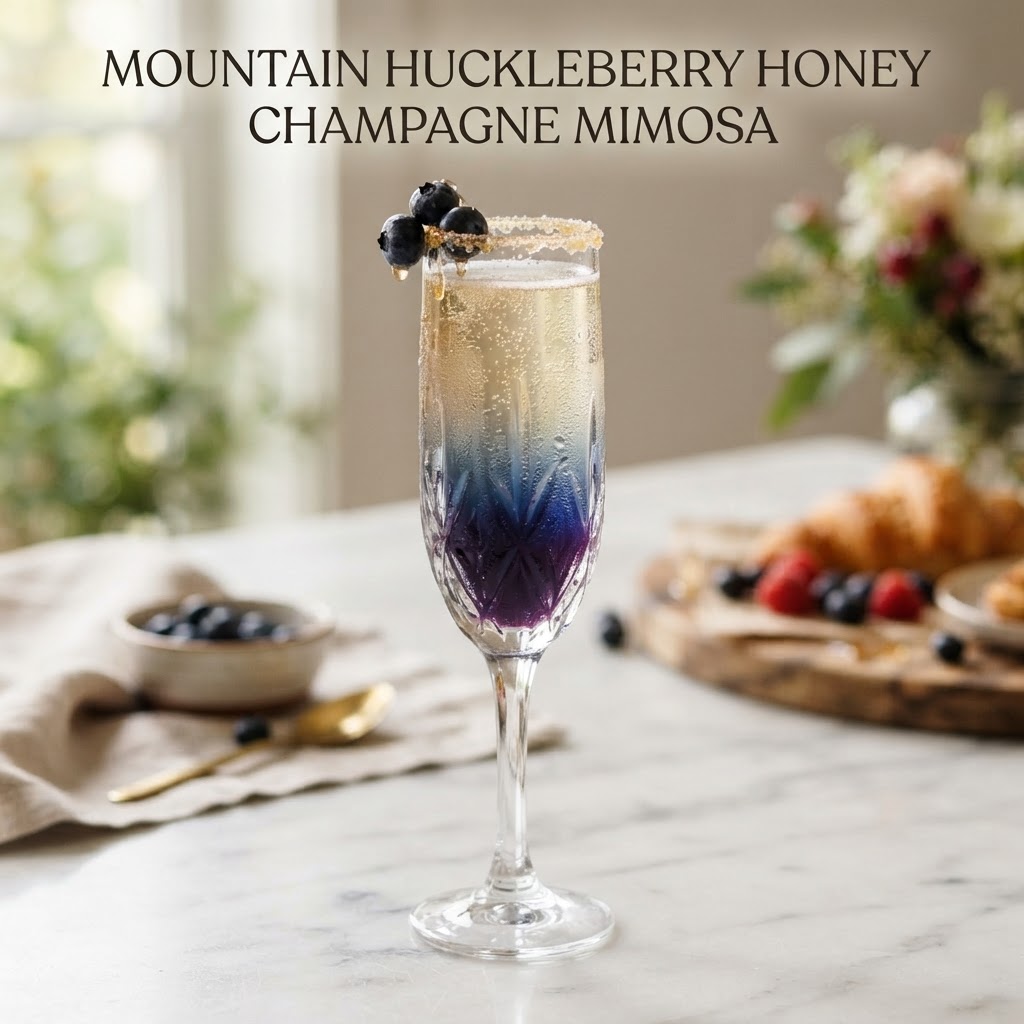
It is this wild, dark-tart character that makes a huckleberry mimosa so remarkable. The berry's deep indigo juice carries a flavor somewhere between a blueberry and a blackcurrant, with a wild, woodsy depth that cultivated fruits lack. Over Champagne, sweetened just enough with mountain wildflower honey, it produces a drink of extraordinary color — a deep, luminous indigo that blooms through pale wine like a mountain sunset.
About Mountain Huckleberries
Several huckleberry species are native to the western United States, but the mountain or "thin-leaved" huckleberry (Vaccinium membranaceum) is the most prized for flavor. It grows at elevations between 2,000 and 11,000 feet, ripening from August into September, and it has never been successfully domesticated despite decades of effort — the plant depends on specific forest mycorrhizal fungi that cannot be replicated in cultivation. Native American tribes of the Northern Rockies, including the Nez Perce and Kootenai, have managed and harvested huckleberry patches for millennia, using fire to encourage the plants' growth. Reference: Idaho State Fruit — Huckleberry
For a mimosa, fresh wild huckleberries are ideal in season; frozen wild huckleberries (available year-round from specialty suppliers) produce an excellent purée. Cultivated "huckleberry" products sold as flavorings are often blueberry-based and lack the genuine wild character — seek true Vaccinium membranaceum.
Huckleberry-Honey Purée: - 2 cups fresh or frozen wild mountain huckleberries - 2 tablespoons mild wildflower honey - 1 tablespoon fresh lemon juice
If using frozen berries, thaw them first. Simmer the huckleberries in a saucepan over medium-low heat for 8–10 minutes, pressing gently, until the berries burst and release their juices. Sweeten with honey to taste (huckleberries are quite tart). Blend briefly, then strain through a fine-mesh sieve, pressing firmly to extract maximum color and flavor while leaving the tiny seeds behind. Stir in lemon juice. Chill thoroughly. The purée will be a deep, luminous indigo-violet. Use within 3 days.
Ingredients (serves 6): - 1 cup huckleberry-honey purée (above) - 1 bottle (25 oz chilled Champagne Brut NV or Blanc de Blancs (Blanc de Blancs — such as Pierre Peters Cuvée de Réserve — provides the crisp, citrus-mineral character that balances the huckleberry's wild tartness; Champagne Brut provides more structure) - A few fresh huckleberries and a delicate honey drizzle for garnish - Optional: ½ oz of crème de cassis per serving for amplified berry depth
Instructions: Chill Champagne flutes for 5 minutes. Pour 1½ oz of the huckleberry-honey purée into each flute. Add crème de cassis if using. Top slowly with chilled Champagne, pouring down the side. The deep indigo purée will bloom through the pale wine in dramatic dark-violet gradients. Garnish with a few fresh huckleberries on a cocktail pick and a delicate honey drizzle on the foam. Do not stir.
For a Mimosa Bar (serves 12): - 2 cups huckleberry-honey purée - 3 oz crème de cassis (optional) - 2 bottles Champagne Brut or Blanc de Blancs, chilled - Fresh huckleberries and honey for garnish
Variations: - Replace Champagne with sparkling rosé for a deeper magenta-indigo hue. - Add ½ oz of bourbon (Buffalo Trace) per serving for a Mountain Huckleberry Bourbon Mimosa with American woodland warmth. - Steep a sprig of fresh thyme in the warm purée for an aromatic, earthy dimension.
Mimosa Pairing Logic: The huckleberry's wild, dark-tart depth and the honey's floral warmth call for a crisp, mineral Champagne whose bright acidity balances the berry's intensity. The wine's citrus notes complement the huckleberry's natural tartness. For a related pour, the Blueberry Lavender Mimosa is the cultivated cousin, and the Blackberry Sage Mimosa shares the dark-berry-over-Champagne logic.
Reference Links: - Idaho State Fruit (huckleberry, designated 2000): State Symbols USA - Huckleberries of the West (USDA Forest Service): USDA Forest Service
Make-Ahead: Huckleberry-honey purée (3 days, refrigerated). Assemble per glass just before serving.
Pro Tips: True mountain huckleberries are dramatically more flavorful than cultivated blueberries, so seek them frozen from specialty suppliers if fresh are unavailable, and avoid "huckleberry" syrups made from blueberry. The seeds are tiny but numerous, so straining through a fine-mesh sieve is essential for a smooth drink. The honey should be a mild wildflower variety; strong buckwheat honey overwhelms the berry's delicate wild character. Huckleberries are quite tart, so sweeten to taste and err on the less-sweet side, as the Champagne's dryness will balance the drink in the glass. The crème de cassis is optional but it deepens the berry character and adds a polished, classic dimension.
Rate this recipe
Be the first to rate this recipe
to submit your rating.
Perfect Mimosa Pairings
Mimosas that pair perfectly with this dish
Recent Posts

Couscous Royale: North Africa's Grand Platter of Lamb, Chicken, and Merguez
October 14, 2026

Seattle Cream Cheese Dog Bites: Hadley Long's 1989 Pioneer Square Invention
October 14, 2026

Khao Soi: Chiang Mai's Northern Thai Coconut Curry Noodles
October 13, 2026

Korean Bibimbap: Jeonju's Joseon Dynasty Mixed Rice
October 11, 2026

Spaghetti alla Carbonara: Rome's World War II Pasta of Eggs, Guanciale, and Pecorino
October 9, 2026