Chinese Beggar's Chicken: The Hangzhou Legend of Lotus Leaves and Clay
June 7, 2026
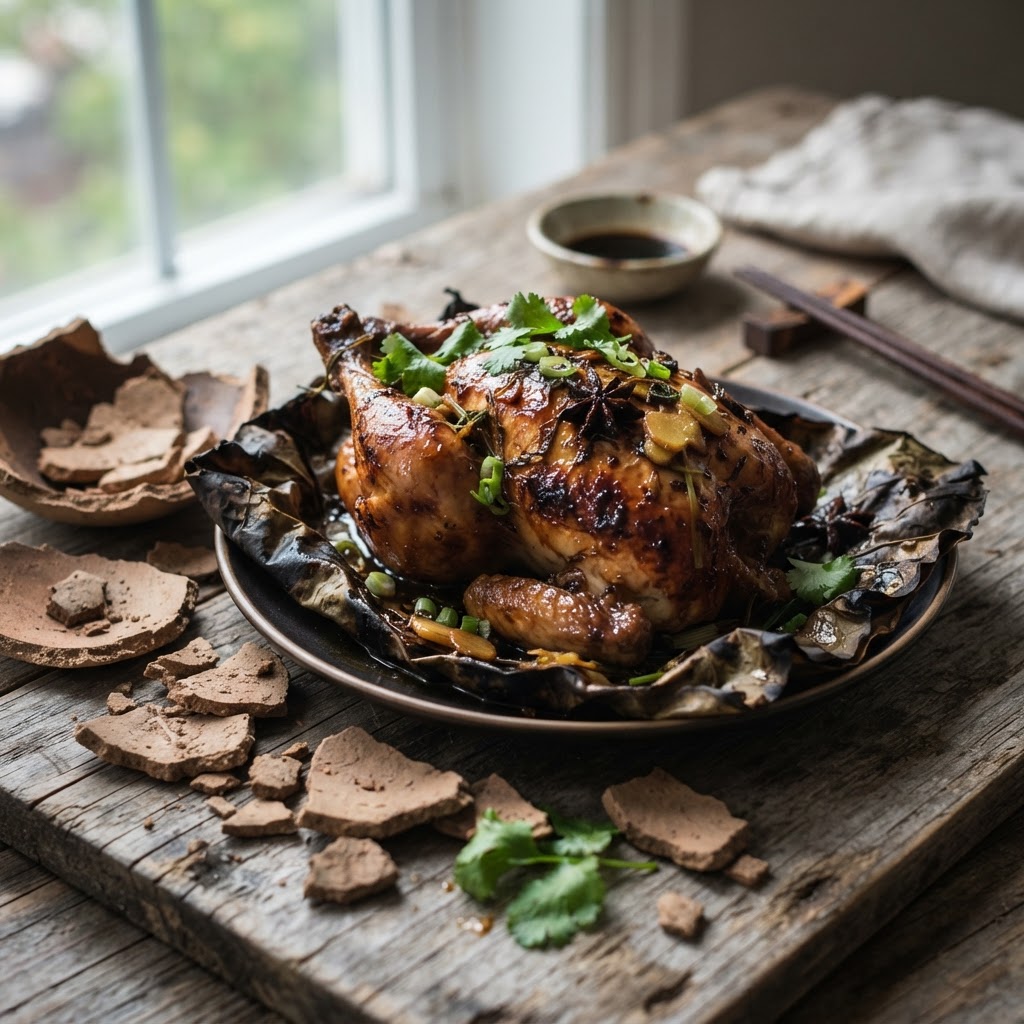
In the Qing Dynasty, in the city of Hangzhou in eastern China, a starving beggar is said to have stolen a chicken from a nobleman's estate and fled to the riverbank. With no pot and no fire, he wrapped the bird in lotus leaves, packed it in river clay, and buried it in the embers of a fire he built on the bank. When he cracked open the hard clay shell hours later, the feathers came away with the clay, and the meat inside was fragrant, tender, and steamed in its own juices. The beggar's improvised cooking method, the legend says, was discovered by the nobleman's men, who tracked the scent back to the riverbank, and the dish was brought to the Imperial Court, where it became a banquet specialty. Whether the story is true or not, beggar's chicken, called _jiaohua ji_ in Mandarin after the beggar, is one of the oldest and most dramatic dishes in Chinese cuisine (Wikipedia — Beggar's Chicken; Emmymade — Homemade Beggar's Chicken Recipe).
The technique is ancient and theatrical. A whole chicken is marinated in soy sauce, Shaoxing wine, ginger, scallions, star anise, and sugar, then stuffed with glutinous rice, mushrooms, and sometimes pork. It is wrapped in lotus leaves, which impart a distinctive grassy, floral fragrance, and then packed in a thick shell of clay or salt dough. The sealed parcel is baked slowly for hours, and the clay hardens into a shell that traps all the steam and the aroma inside. At the table, the shell is cracked with a hammer, the lotus leaves are peeled back, and the chicken emerges glossy, tender, and intensely fragrant. The dish is a centerpiece, a theatrical event as much as a meal, and it is served at banquets and celebrations across China, particularly in Hangzhou, where the legend is rooted.
Ingredients (serves 6): - 1 whole chicken (about 4 lb), giblets removed - ¼ cup soy sauce - 2 tablespoons Shaoxing wine (or dry sherry) - 2 tablespoons hoisin sauce - 1 tablespoon sugar - 1 tablespoon grated fresh ginger - 3 scallions, cut into 2-inch pieces - 2 star anise - 1 cup glutinous rice, soaked 2 hours and drained - 4 dried shiitake mushrooms, soaked and sliced - 2 tablespoons vegetable oil - 4 large dried lotus leaves, soaked in warm water for 1 hour - 4 cups all-purpose flour and 2 cups water (for the clay shell), mixed into a thick dough - Salt, to taste
Instructions: In a large bowl, combine the soy sauce, Shaoxing wine, hoisin, sugar, ginger, scallions, and star anise. Add the chicken and turn to coat. Marinate in the refrigerator for at least 4 hours or overnight, turning occasionally. In a skillet, heat the oil and sauté the drained glutinous rice and sliced mushrooms for 3 minutes. Add 2 tablespoons of the marinade and cook until the rice absorbs it. Remove from heat. Stuff the chicken cavity with the rice and mushroom mixture. Lay two soaked lotus leaves flat, overlapping, and wrap the chicken tightly, folding the leaves around it like a parcel. Wrap with the remaining two leaves to ensure complete coverage. Tie with kitchen string. Roll out the flour-and-water dough into a large rectangle. Wrap the dough completely around the lotus-leaf parcel, sealing all seams. Preheat the oven to 350°F. Place the clay parcel on a baking sheet and bake for 2 to 2½ hours, until the dough shell is hard and golden. Bring to the table and crack the shell with a hammer. Peel back the lotus leaves and carve the chicken.
For a Crowd (serves 12): - Use two chickens and make two separate clay parcels. The chickens can be marinated and stuffed a day ahead, wrapped in lotus leaves, and the clay shell applied just before baking. The baking time is the same for two parcels.
Variations: - Salt Dough Shell: Use a salt dough (2 cups salt, 4 cups flour, water) for a more traditional, harder shell. - Pork and Chestnut Stuffing: Add diced pork and chestnuts to the glutinous rice stuffing for a richer version. - Foil Version: Skip the clay and wrap in aluminum foil for a home-cook-friendly version that still captures the steamed-in-leaf effect.
Pairing: Beggar's chicken pairs with a Chinese green tea such as Dragon Well (Longjing), the tea of Hangzhou, or with a light, dry Riesling. For a brunch gathering, a sparkling mimosa or a jasmine tea is a nod to the Chinese table. Serve with stir-fried greens and steamed rice. For another Chinese banquet dish, try our Peking duck pancakes.
Reference Links: - Beggar's Chicken (Hangzhou, Qing Dynasty, lotus leaves, clay, jiaohua ji): Wikipedia - Homemade Beggar's Chicken Recipe (lotus leaves, clay, slow baking): Emmymade
Pro Tips: The lotus leaves are the soul of the dish, because they give the chicken its distinctive grassy, floral aroma. Soak them until pliable, at least an hour, and wrap the chicken in at least two layers with no gaps. The clay or dough shell must be sealed completely, with no cracks or holes, because it traps the steam that cooks the chicken. Do not rush the baking; 2 hours at 350°F is the minimum for a 4 lb bird. The shell will be hard, so use a hammer or the back of a heavy knife to crack it, and peel it away in pieces. Carve the chicken at the table, because the theatrical unveiling is half the dish. The glutinous rice stuffing absorbs the chicken juices and the marinade, so serve it alongside the meat, spooned over each portion.
Rate this recipe
Be the first to rate this recipe
to submit your rating.
Perfect Mimosa Pairings
Mimosas that pair perfectly with this dish
Recent Posts

Couscous Royale: North Africa's Grand Platter of Lamb, Chicken, and Merguez
October 14, 2026

Seattle Cream Cheese Dog Bites: Hadley Long's 1989 Pioneer Square Invention
October 14, 2026

Khao Soi: Chiang Mai's Northern Thai Coconut Curry Noodles
October 13, 2026

Korean Bibimbap: Jeonju's Joseon Dynasty Mixed Rice
October 11, 2026

Spaghetti alla Carbonara: Rome's World War II Pasta of Eggs, Guanciale, and Pecorino
October 9, 2026