Peking Duck with Mandarin Pancakes
June 8, 2026
Peking Duck has been prepared since the Imperial era of China, with its origins tracing to the court of the Yuan Dynasty (1271–1368) in Beijing, then called Khanbaliq. Originally known as "Jinling roast duck" after the archaic name for Nanjing, the dish was brought to Beijing by the Ming Dynasty court when the capital was moved there in 1416. Beijing chefs bred a local variety of duck, the Pekin duck, that was plumper and had a thinner skin than the Nanjing variety, which made it ideal for roasting. The dish was refined over centuries within the Imperial court and was first served to civilians in 1864, when Quanjude, the most famous Peking Duck restaurant in Beijing, opened its doors and popularized the "open-fire roasting" method, hanging the duck in a brick oven over a fruitwood fire, which produces the signature crispy skin.
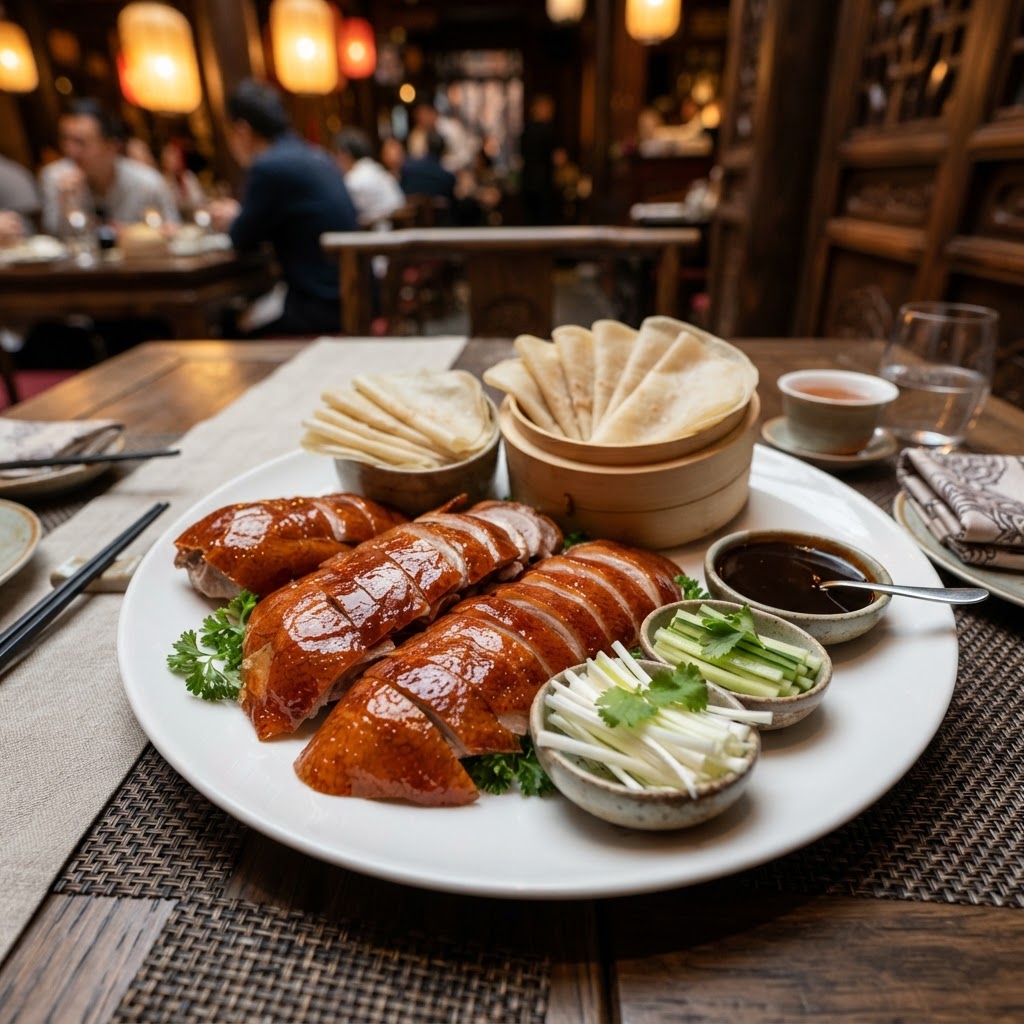
A whole Peking duck is air-dried, lacquered with a maltose glaze, and roasted until the skin is paper-thin, mahogany-colored, and shatteringly crisp, while the meat beneath remains juicy and tender. The dish is served with thin Mandarin pancakes, julienned scallions, cucumber matchsticks, and sweet bean sauce (tianmianjiang), with each diner assembling their own pancake by spreading sauce, adding duck, scallions, and cucumber, and rolling it into a neat parcel. The crisp, lacquered skin is the hallmark of Peking Duck, and the quality of the dish is judged primarily by the quality of the skin.
The traditional preparation is elaborate: the duck is inflated with air to separate the skin from the fat, blanched in boiling water to tighten the skin, coated with a maltose glaze, hung to air-dry for 24 hours, then roasted. The air-drying is the essential step, dehydrating the skin so that it crisps and becomes glass-like during roasting. The duck is carved tableside by a trained chef, who slices it into approximately 108 thin pieces, traditionally ensuring that each diner receives both skin and meat.
Ingredients (serves 6–8 as a main course):
The Duck: - 1 whole duck (5–6 lbs / 2.5–5 ⅞ lb), preferably Pekin/Long Island duck, giblets removed, neck reserved - Air pump (or a bicycle pump with a needle valve — used to inflate the duck) - 2 ⅛ qt boiling water (for blanching)
The Glaze: - 3 tablespoons maltose (or honey, if maltose is unavailable — maltose is the traditional choice and produces a deeper, less sweet glaze) - 2 tablespoons rice vinegar - 2 tablespoons hot water (to dissolve the maltose) - 1 tablespoon Shaoxing wine (optional)
The Air-Drying: - A hook or string for hanging the duck - A fan (to circulate air around the duck)
Mandarin Pancakes: - 8 ⅞ oz all-purpose flour - ⅔ cup boiling water - 1 tablespoon sesame oil - Additional flour for dusting
Accompaniments: - 7 oz sweet bean sauce (tianmianjiang — available at Asian markets; hoisin sauce can be substituted, though it is sweeter and less complex) - 6 scallions, julienned into thin strips - 1 English cucumber, cut into thin matchsticks - 1 tablespoon toasted sesame oil - Hoisin sauce (alternative to sweet bean sauce)
Preparing the Duck — Step 1: Separating the Skin: This is the most important and most unusual step. The goal is to separate the duck skin from the meat and fat beneath, so that the fat renders out during roasting and the skin crisps. Insert the air pump needle under the skin at the neck cavity (or use a bicycle pump with a needle valve). Pump air between the skin and the meat, working the air down the body of the duck with your hands. The skin should balloon away from the meat. This step is traditional and essential for authentic Peking Duck — without it, the fat remains trapped between the skin and meat and the skin never crisps properly.
Step 2: Blanching: Pour boiling water over the entire surface of the duck — this tightens the skin and opens the pores, which helps the glaze adhere and promotes crisping. The skin should visibly shrink and tighten.
Step 3: Glazing: Dissolve the maltose (or honey) in hot water. Stir in rice vinegar and Shaoxing wine. Brush the entire duck — inside and out — with the glaze. The vinegar helps the skin crisp, and the maltose provides the mahogany color and lacquered finish.
Step 4: Air-Drying: Hang the duck in a cool, well-ventilated place (or in front of a fan) for at least 12 hours, ideally 24 hours. The duck must be completely dry — any moisture left in the skin will steam rather than crisp during roasting. This is the step that makes or breaks Peking Duck. In professional kitchens, ducks are hung in refrigerated drying rooms; at home, a cool room with a fan works well.
Mandarin Pancakes: Place the flour in a bowl. Pour in the boiling water all at once and stir with chopsticks or a wooden spoon until the dough comes together in a rough ball (the boiling water partially cooks the flour, producing a softer, more pliable dough). Knead briefly until smooth. Cover with a damp towel and rest 30 minutes.
Divide the dough into 24 equal pieces. Roll each into a ball. Brush the top of one ball with sesame oil and place another ball on top. Roll the two-oiled-sides-together balls into a thin 6-inch circle. (This technique — rolling two pieces together — produces thinner, more delicate pancakes than rolling individually, and the oil prevents them from sticking.)
Heat a dry skillet over medium heat. Cook each double-pancake for 1 minute per side until lightly speckled but not browned. They will puff up. Peel the two pancakes apart while still warm. Stack on a plate under a damp towel. (Pancakes can be made 1 day ahead and reheated by steaming for 2 minutes.)
Roasting the Duck: Preheat oven to 400°F (392°F). Place the duck on a rack in a roasting pan (breast side up). Pour 1 cup of water into the bottom of the pan (to catch the fat and prevent smoking). Roast 15 minutes at 400°F, then reduce to 350°F (347°F) and roast for an additional 60–75 minutes. The duck is done when the skin is deeply mahogany and shatteringly crisp, and a thermometer inserted into the thickest part of the thigh reads 165°F (165°F).
Alternatively, for the most authentic result, hang the duck in a preheated oven (if your oven allows hanging, or use a vertical roaster) — this allows heat to circulate evenly and produces the most uniform crispness.
Carving: Remove the duck from the oven and rest 10 minutes. The traditional carving method produces approximately 108 slices, with each slice containing both skin and meat. At home, carve the duck into thin slices, making sure each slice includes a piece of the crisp skin. Reserve the carcass for soup.
Service: Provide each diner with a warm pancake. Spread a teaspoon of sweet bean sauce on the pancake. Add 2–3 slices of duck, a few strips of scallion, and a few cucumber matchsticks. Roll the pancake into a neat cylinder and eat with the hands. The combination of crisp skin, juicy meat, sweet-savory sauce, sharp scallion, and cool cucumber is one of the finest bites in all of cuisine.
The Mimosa Pairing Logic: The rich, lacquered character of Peking Duck and the sweet-savory sauce call for a mimosa with bright citrus that cuts through the richness while complementing the sweet, umami flavors. A classic orange mimosa is the most natural pairing — the citrus echoes the bright, sweet notes of the tianmianjiang and the champagne's acidity balances the richness of the duck. A lychee rose mimosa is inspired — the lychee's floral sweetness creates a beautiful resonance with the Asian flavor profile, and the rose echoes the aromatic complexity of the duck. For a more structured pairing, a ginger-based mimosa, such as a peach ginger mimosa, provides a warm, spicy counterpoint that echoes the ginger family in Chinese cooking. Avoid very dry, bitter mimosas — the duck's sweet, savory character needs a mimosa with complementary fruit.
Reference Links: - Peking Duck history: Wikipedia - Peking Duck complex history: National Geographic - Peking Duck recipe and technique: The Woks of Life - Mandarin pancakes recipe: The Spruce Eats - Tianmianjiang (sweet bean sauce) guide: The Spruce Eats
Make-Ahead: The duck must be air-dried 12–24 hours ahead — this cannot be rushed. The Mandarin pancakes can be made 1 day ahead and reheated by steaming for 2 minutes. The sweet bean sauce can be thinned with a little water and sesame oil ahead of time. The duck should be roasted just before service and carved at the table for the full Peking Duck experience.
Pro Tips: The air-inflation step is the single most important technique in Peking Duck — separating the skin from the meat allows the fat to render out during roasting, leaving the skin paper-thin and shatteringly crisp. Skipping this step produces a duck with rubbery, fatty skin that never crisps. The 24-hour air-drying is non-negotiable — moisture is the enemy of crispy skin, and the drying process dehydrates the skin so it crisps and becomes glass-like in the oven. Maltose is the traditional glaze — it produces a deeper, richer, less sweet lacquer than honey, and it caramelizes more effectively. The boiling-water blanching is essential — it tightens the skin, opens the pores for better glaze absorption, and starts the crisping process. The pancakes should be thin and delicate — rolling two pieces of dough together with oil between them is the professional technique that produces pancakes thin enough to be translucent.
Rate this recipe
Be the first to rate this recipe
to submit your rating.
Recent Posts

Couscous Royale: North Africa's Grand Platter of Lamb, Chicken, and Merguez
October 14, 2026

Seattle Cream Cheese Dog Bites: Hadley Long's 1989 Pioneer Square Invention
October 14, 2026

Khao Soi: Chiang Mai's Northern Thai Coconut Curry Noodles
October 13, 2026

Korean Bibimbap: Jeonju's Joseon Dynasty Mixed Rice
October 11, 2026

Spaghetti alla Carbonara: Rome's World War II Pasta of Eggs, Guanciale, and Pecorino
October 9, 2026