Caribbean
Trinidad's Carnival: The Canboulay of 1783 That Became the World's Greatest Street Festival
Trinidad's Carnival is the greatest street festival in the Caribbean, born in the pre-Lenten masquerade balls the French brought in 1783, transformed by the emancipated Africans into the canboulay, and carried into the streets of Port of Spain as calypso, steelpan, and jouvert.
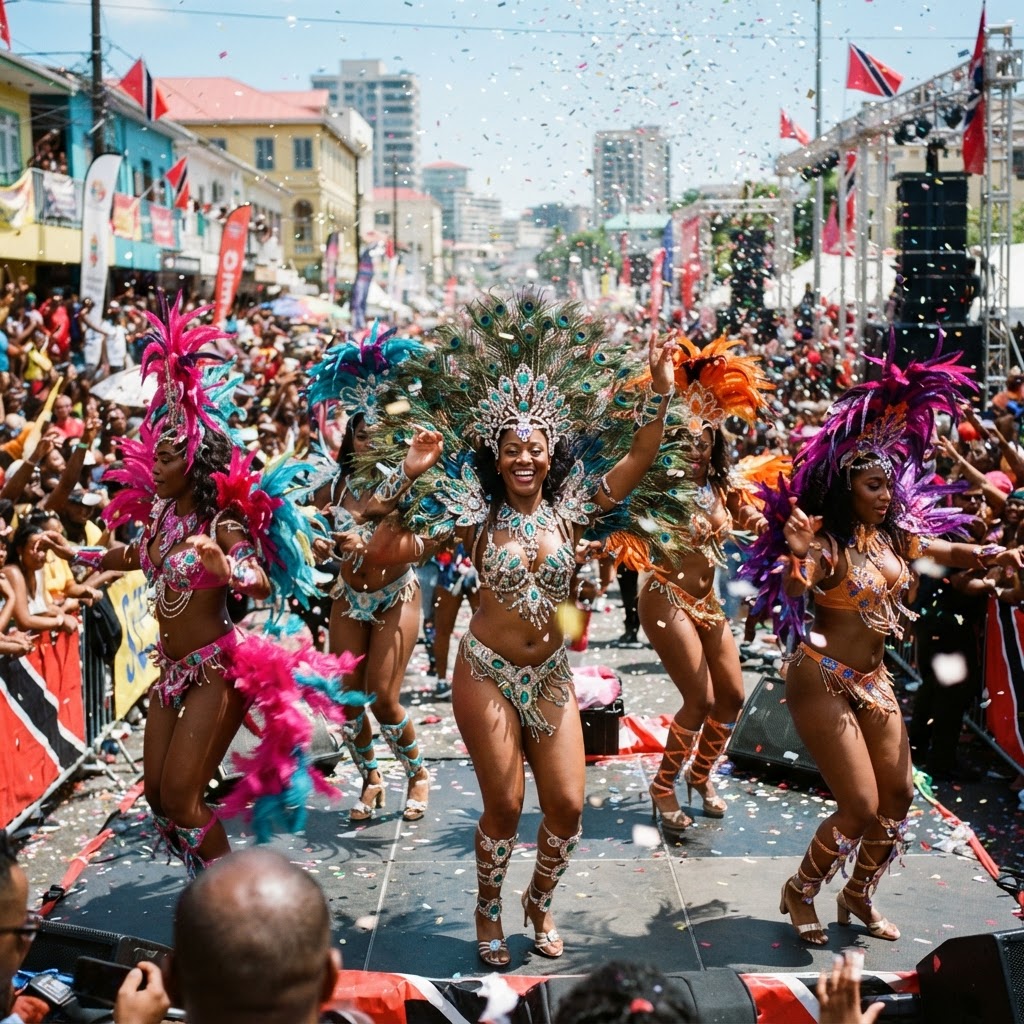
Trinidad's Carnival is the largest and most influential street festival in the Caribbean, a two-day eruption of music, costume, and dance that takes over the streets of Port of Spain every February or March, on the Monday and Tuesday before Ash Wednesday. The festival has its origins in the pre-Lenten masquerade balls staged by French settlers who began arriving in Trinidad in 1783, when the Spanish Crown, which then ruled the island, issued the Cédula de Población, offering land and tax incentives to Catholic immigrants. According to the [National Archives of Trinidad and Tobago](https://www.natt.gov.tt/), Carnival in Trinidad has its origins in the pre-Lenten masquerade balls staged by French emigrants who began arriving on the island in 1783, and the [Early Caribbean Digital Archive at Northeastern University](https://ecda.northeastern.edu/carnival-an-act-of-opposition-introduction/carnivals-indigneous-origins/) traces the festival's deeper roots to the ritual of Cannes Brulées, the burning of the cane, when enslaved Africans were forced to gather and harvest the sugarcane at night, a ritual that became the canboulay.
Canboulay and the Emancipation
After the emancipation of enslaved Africans in 1834, the Carnival that had been the private entertainment of the French planters was claimed by the freed people, who took it into the streets of Port of Spain and Laventille with drums, torches, and stick-fighting. The canboulay, from the French *cannes brulées* (burnt cane), became the heart of the street Carnival, a procession that reenacted the harvest rituals of the plantation and that the colonial authorities tried, repeatedly, to suppress. In 1881, the police attempted to ban the canboulay, and the resulting confrontation, the Canboulay Riot, was a victory for the masqueraders, who refused to surrender their festival. The stick-fighting, the drums, and the torches were eventually banned, but the spirit survived, and the festival grew into the Carnival that the world knows today.
Jouvert, Steelpan, and Calypso
The modern Carnival begins at dawn on Carnival Monday with Jouvert, from the French *jour ouvert* (daybreak), a procession of mud-covered, oil-smeared, and costumed revelers who dance through the streets to the sound of steelpan and soca music. Jouvert is the descendant of the canboulay, the raw, defiant, pre-dawn Carnival of the emancipated, and it is the moment when the festival returns to its roots. The steelpan, the only acoustic musical instrument invented in the twentieth century, was born in the Carnival of Trinidad, created in the 1930s and 1940s by the young men of the Laventille neighborhood from discarded oil drums, and it is now the national instrument of Trinidad and Tobago. Calypso, the social commentary music of Trinidad, grew out of the Carnival tents, where singers competed to see who could craft the cleverest, most biting commentary on the events of the year.
Port of Spain and the Savannah
The Carnival converges on Port of Spain, the capital of Trinidad, and on the Queen's Park Savannah, the great oval park at the center of the city where the grandstand is erected for the judging of the bands. The bands, some with thousands of masqueraders in matching costumes, cross the stage over two days, and the King and Queen of Carnival are crowned for the most spectacular costumes, which can be thirty feet tall and pulled on wheels. The festival is the economic and cultural engine of the island, drawing visitors from every Caribbean nation and from the diaspora communities of Toronto, London, and New York, and it is the model for the Carnivals of Brooklyn, Notting Hill, and Toronto, all of which were created by Trinidadian immigrants carrying their festival abroad.
A Mimosa for the Savannah
A morning after Jouvert, with the mud still on the revelers and the soca still in the air, calls for a bright, tropical sparkling drink that can match the energy of the festival. A [passionfruit mimosa](/recipes/passionfruit-mimosa) is the natural match, the tropical passionfruit a bright companion to the heat of the Carnival and the bubbles lifting the soca rhythm. A [tropical mango mimosa](/recipes/tropical-mango-mimosa) is equally lovely, its ripe mango sweetness a bright counter to the calypso tents.
**Reference Links:**
- Carnival's Indigenous Origins (Cannes Brulées, canboulay, 1783 French settlers): [Early Caribbean Digital Archive, Northeastern University](https://ecda.northeastern.edu/carnival-an-act-of-opposition-introduction/carnivals-indigneous-origins/)
- National Archives of Trinidad and Tobago (1783 French emigrants, Carnival history): [National Archives of Trinidad and Tobago](https://www.natt.gov.tt/)



Continue Reading