Food & Drink
Ramen: Tokyo's Obsessive Noodle Culture and the Art of the Perfect Bowl
From a postwar working-class meal to a Michelin-starred art form, Tokyo's 5,000 ramen shops represent one of the most obsessively refined food traditions on earth — where a single bowl is the product of dozens of deliberate decisions.
Ramen — the wheat noodle soup that has become one of the most iconic and obsessively refined dishes in the world of food — is, in its modern Japanese form, a relatively recent invention. While noodle soups have existed in China for centuries, the ramen that we know today — a bowl of Chinese-style alkaline wheat noodles in a rich, savoury broth, topped with sliced pork, egg, and other garnishes — emerged in Japan in the early 20th century, evolving from Chinese noodle dishes served in Yokohama's Chinatown. The word 'ramen' itself is believed to derive from the Chinese lamian, meaning 'pulled noodles,' though the Japanese pronunciation and the dish itself have evolved into something distinctly Japanese. By the postwar period, ramen had become a staple of Japanese working-class cuisine, and by the 1980s and 1990s, it had been elevated to a culinary art form that is pursued with an intensity that borders on the obsessive (en.wikipedia.org/wiki/Ramen).
A bowl of ramen is composed of five essential elements: the noodles, the broth, the tare (the seasoning base), the aroma oil, and the toppings. Each of these elements is the subject of intense specialisation, and the quality of a ramen shop is judged by the mastery of all five. The noodles, made from wheat flour, water, salt, and kansui — an alkaline mineral water that gives the noodles their characteristic yellow colour, springy texture, and resistance to softening in hot broth — are the foundation. The thickness, waviness, and hydration of the noodles are carefully calibrated to match the style of broth they will be served in: thin, straight noodles for delicate broths; thick, wavy noodles for rich, hearty broths. Many of the best ramen shops make their own noodles in-house, using specialized machines that roll and cut the dough to precise specifications.
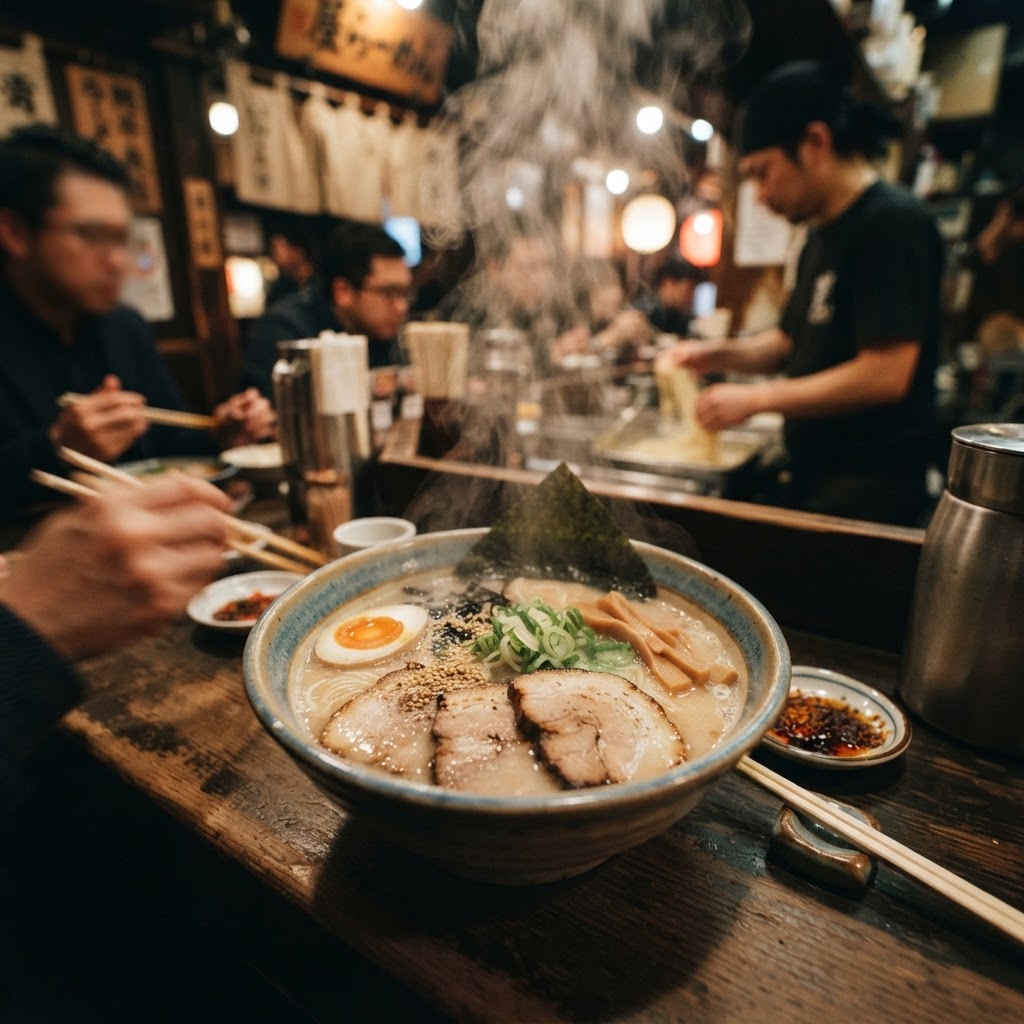
The broth is the heart of the ramen bowl, and it is where the greatest variation and the most intense obsession are found. The four major broth styles are defined by their base ingredients and their level of richness. Shoyu (soy sauce) ramen, the Tokyo style, features a clear, brown broth made from chicken, pork, or fish bones, seasoned with soy sauce — it is the original style of ramen, and it remains the most common. Shio (salt) ramen features a pale, clear broth seasoned with salt, often made from chicken or pork bones, and is prized for its lightness and clarity of flavour. Miso ramen, originated in Sapporo, Hokkaido, features a broth seasoned with fermented soybean paste (miso), producing a rich, hearty, slightly sweet bowl that is particularly popular in northern Japan. And tonkotsu ramen, the style that has perhaps the most passionate international following, features a rich, milky, opaque broth made from pork bones — particularly leg bones, neck bones, and trotters — that have been boiled for 12 to 24 hours or more, until the collagen and marrow dissolve and emulsify into the water, creating a creamy, intensely savoury liquid that is almost sauce-like in its richness. Tonkotsu ramen originated in Hakata, a district of Fukuoka City on the southern island of Kyushu, and it is there that the most obsessive tonkotsu is still made (en.wikipedia.org/wiki/Ramen).
The tare — the seasoning base that is placed in the bottom of the bowl before the broth is added — is what gives each bowl of ramen its fundamental flavour character. The tare is a concentrated seasoning, typically made from soy sauce, salt, or miso, combined with mirin, sake, kombu (kelp), katsuobushi (dried bonito flakes), niboshi (dried sardines), or other umami-rich ingredients, and reduced to an intense, syrupy liquid. A single tablespoon of tare, combined with a bowl of broth, transforms the neutral bone broth into a fully seasoned soup. The tare is the ramen chef's signature — the secret recipe that distinguishes one shop from another — and many shops guard their tare recipes with the same secrecy that a perfumer guards a fragrance formula. The best tare is aged, sometimes for months or years, as the ingredients meld and deepen in complexity.
The aroma oil — a small amount of flavoured oil added to the bowl before the broth — is an often-overlooked element that plays a crucial role in the overall experience. The oil, which may be rendered chicken fat, pork lard, or a vegetable oil infused with garlic, onion, ginger, or other aromatics, floats on the surface of the broth and releases its fragrance as the bowl is brought to the table. This aromatic layer is what hits the nose first, creating the initial impression of the bowl, and it is an essential component of the ramen experience that is frequently missing from ramen served outside of Japan.
The toppings — chashu (braised pork belly), ajitsuke tamago (marinated soft-boiled egg), menma (fermented bamboo shoots), negi (green onions), nori (seaweed), and others — are the final elements that complete the bowl. The chashu is typically pork belly that has been rolled, tied, and braised in a mixture of soy sauce, mirin, sake, and sugar until it is meltingly tender, with the fat rendered and the meat infused with the sweet-savoury braising liquid. The ajitsuke tamago — the marinated egg — is soft-boiled to a precise temperature that leaves the yolk still liquid and custardy, then marinated in the same soy-mirin mixture used for the chashu, absorbing the flavour while maintaining its delicate texture. The egg is one of the most prized elements of the ramen bowl, and the quality of a shop's egg is considered a reliable indicator of the shop's overall quality and attention to detail.
Tokyo is home to over 5,000 ramen shops, ranging from tiny counter-only establishments with six or eight seats to large, multi-floor operations. The density and quality of Tokyo's ramen scene is unmatched anywhere in the world, and the competition among shops drives an extraordinary level of quality and innovation. Ichiran, a chain that originated in Fukuoka and has expanded across Japan and internationally, is famous for its individual booth seating (designed to eliminate distraction and allow the diner to focus entirely on the bowl) and its customisable tonkotsu, where every element — from the richness of the broth to the firmness of the noodles to the intensity of the garlic — can be adjusted to the diner's preference. Tsuta, in Sugamo, became the first ramen shop in the world to receive a Michelin star, in 2015, for its refined shoyu ramen made with premium ingredients including black truffle. Nakiryu, also in Tokyo, earned a Michelin star in 2017 for its dandan-style ramen. And the Nakano and Shinjuku neighbourhoods are legendary among ramen enthusiasts for their concentration of exceptional shops, each with its own specialty and its own devoted following (ichelan.co.jp).
For the traveller, Tokyo offers a ramen experience that is unmatched anywhere else in the world. The Shin-Yokohama Ramen Museum, opened in 1994, is a food-themed amusement park that features replications of ramen shops from across Japan, allowing visitors to taste regional styles in a single location. The Tokyo Ramen Show, held annually in October in Komazawa Olympic Park, brings together ramen shops from across the country for a multi-day celebration of the dish. And for those who want to explore on their own, neighbourhoods like Ebisu, Nakano, Shinjuku, and Ikebukuro are dense with ramen shops of every style and quality level, from the famous to the obscure. The best approach is to follow the lines — in Tokyo, as in all of Japan, a queue of patient, quiet customers is the most reliable indicator of quality.
What makes ramen so significant in the world of food and drink is the way it demonstrates that a dish born of humble origins — a cheap, filling meal for workers and students — can be elevated, through obsessive attention to detail and relentless pursuit of quality, to the level of fine dining. A bowl of ramen, at its best, is the product of dozens of individual decisions: the blend of flours in the noodles, the composition of the bones in the broth, the duration and temperature of the boil, the recipe for the tare, the choice of aroma oil, the doneness of the egg, the thickness of the chashu slice. Each of these decisions is made by a chef who has dedicated years, often decades, to the mastery of this single dish. And the result — a bowl of soup that costs less than $15 but that delivers a depth of flavour, a complexity of texture, and an intensity of satisfaction that rivals dishes costing ten times as much — is a testament to the principle that greatness in food comes not from expense or exclusivity but from care, skill, and the relentless pursuit of perfection in a single, specific thing.
For those planning a visit, the Shin-Yokohama Ramen Museum provides information on regional ramen styles and visiting (raumen.jp). The Michelin Guide Tokyo provides reviews of the city's Michelin-starred ramen shops (guide.michelin.com). Tabelog, Japan's most popular restaurant review site, is the essential resource for finding the best ramen shops in Tokyo (tabelog.com).


Continue Reading