Food & Drink
Prosciutto di Parma: The Art of Dry-Cured Ham in Emilia-Romagna
Made from just four ingredients and cured for a minimum of 400 days in the unique microclimate of the Parma hills, Prosciutto di Parma is proof that the most extraordinary food often comes from the most radical simplicity.
Prosciutto di Parma is a dry-cured ham produced exclusively in the hills around Parma, in the Emilia-Romagna region of Italy. It is made from only four ingredients — pork, salt, air, and time — and the entire production process, from the selection of the pigs to the final curing, takes a minimum of 400 days, with many hams aged for 18 to 24 months or longer. The ham holds a Protected Designation of Origin (DOP) status from the European Union, meaning that only hams produced according to the strict specifications within the designated geographical area may bear the name 'Prosciutto di Parma.' The Consorzio del Prosciutto di Parma, founded in 1963, oversees the production standards and certifies every ham with the distinctive Ducal crown brand that is fire-branded onto the rind of each ham that passes inspection (prosciuttodiparma.com).
The geographical designation is essential to the character of Prosciutto di Parma. The pigs must be raised in one of eleven specified regions in central and northern Italy, and must be fed a diet that includes the whey from Parmigiano Reggiano production — a traditional practice that gives the meat its distinctive sweetness. The curing must take place in the hills around Parma, where the unique microclimate — moderated by the sea breeze from the Ligurian coast that funnels through the Val di Magra and the Apennine valleys — provides the ideal conditions for slow, natural curing. The air of Parma is itself an ingredient: it carries the beneficial bacteria and moulds that colonise the surface of the hams during curing, contributing to the development of flavour and acting as a natural protective barrier. This is why Prosciutto di Parma cannot be replicated elsewhere — the air of the Parma hills is as essential as the pork or the salt.
The production process begins with the selection of heavy pigs — typically Duroc, Large White, or Landrace breeds — weighing at least 340 pounds at slaughter. The hind legs are trimmed to the characteristic 'chicken leg' shape that distinguishes Prosciutto di Parma from other hams, and the curing process begins within 24 hours of slaughter. The first step is salting: the hams are massaged by hand with sea salt and rested in cold rooms for approximately one week. This initial salting draws out moisture and begins the preservation process. Unlike many other cured hams, Prosciutto di Parma uses no nitrates, nitrites, preservatives, or additives of any kind — only pure sea salt, applied in a precise, controlled manner by the salatore (salter), whose skill is the first critical step in the entire process.
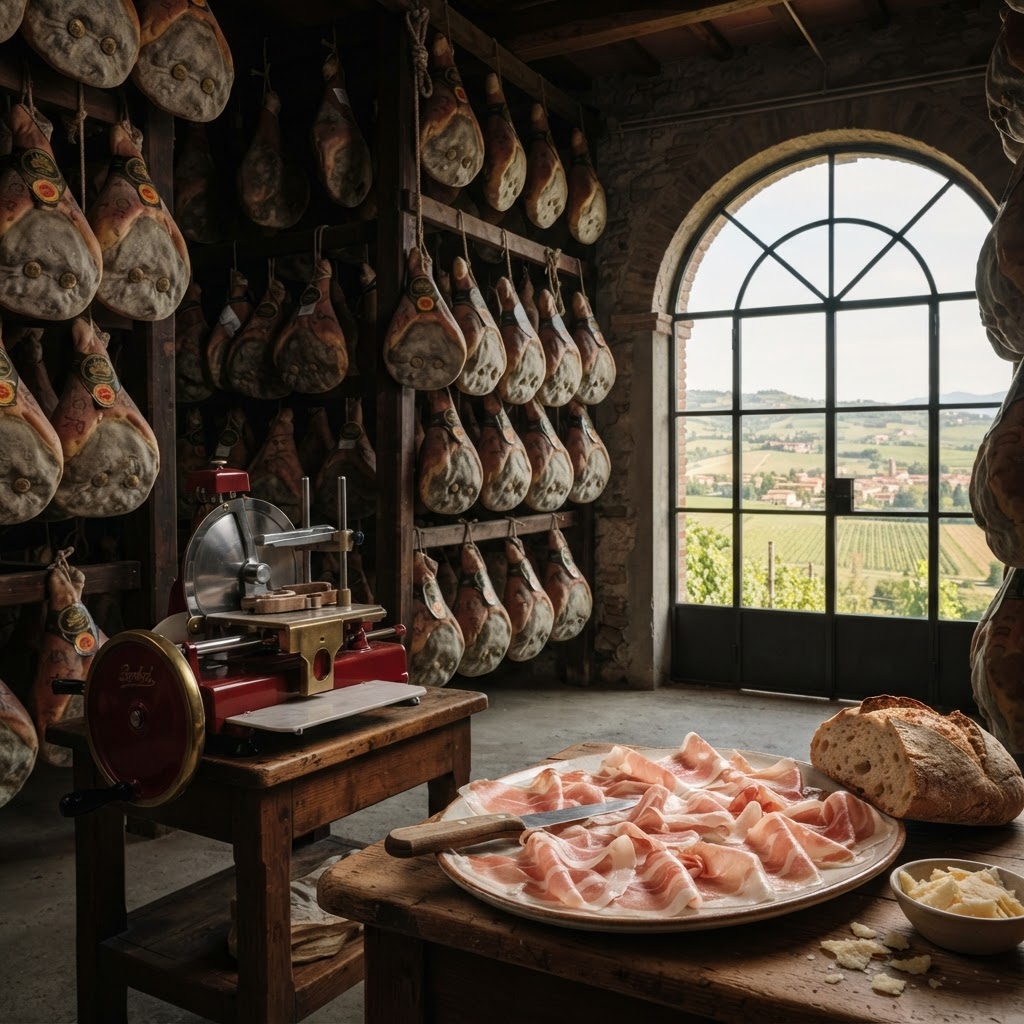
After the initial salting, the hams are rested, salted a second time, and then washed and brushed to remove excess salt. They are then transferred to drying rooms where they hang for approximately two months, losing moisture and beginning the slow process of flavour development. After this initial drying period, the hams are coated with a mixture of lard and ground rice (sugna), which is applied to the exposed muscle to prevent the meat from drying too quickly and to maintain the right level of moisture. The hams are then moved to large, well-ventilated aging rooms — cellai — where they hang for the remaining months of their curing period, exposed to the natural variations of the Parma air. It is during this long, slow aging that the meat transforms: enzymes break down proteins into free amino acids, the fat develops its characteristic sweetness, and the ham acquires its delicate, complex flavour — savoury, sweet, slightly nutty, and utterly distinctive.
At the end of the minimum 400-day aging period, each ham is inspected by an independent expert from the Consorzio del Prosciutto di Parma. The inspection is conducted using a needle made from horse bone — a traditional tool that is inserted into five specific points on the ham, drawing out tiny samples that the expert evaluates by smell. Only hams that pass this olfactory test at all five points are branded with the Ducal crown and certified as authentic Prosciutto di Parma. Approximately 150 producers — small and medium-sized family operations — make Prosciutto di Parma, collectively producing around 9 million hams per year. The hams are sold whole, bone-in or boneless, or sliced to order at the deli counter, where the proper slicing — paper-thin, with each slice translucent — is essential to the experience (prosciuttodiparma.com).
The distinction between Prosciutto di Parma and other prosciutti is significant. Prosciutto di San Daniele, produced in Friuli-Venezia Giulia, is sweeter and darker, shaped differently (compressed into a guitar shape), and cured in the unique microclimate of the foothills of the Carnic Alps. Prosciutto Toscano, from Tuscany, is cured with a salt mixture that includes pepper, garlic, and herbs, giving it a more assertive, savoury flavour. Prosciutto di Modena, from the neighbouring Emilian province, is milder and lighter. Each of these hams is a DOP product with its own distinct character, and each reflects the terroir and tradition of its region. But Prosciutto di Parma, with its delicate sweetness, its silky texture, and its long, clean finish, remains the most internationally celebrated — the benchmark against which all other dry-cured hams are measured.
For the traveller, the Parma region offers an extraordinary food experience. The Consorzio del Prosciutto di Parma maintains a 'Parma Ham Museum' (Museo del Prosciutto di Parma) in the village of Langhirano, the heart of the curing region, which documents the history and process of Prosciutto di Parma. Many producers offer tours of their cellai, where visitors can see the thousands of hams hanging in the aging rooms and learn about the curing process from the producers themselves. The Parma region is also home to Parmigiano Reggiano, Culatello di Zibello (the 'heart' of the prosciutto, considered the most prized cut), and traditional balsamic vinegar of the neighbouring provinces, making it one of the most gastronomically dense regions in the world. The nearby city of Parma, designated a UNESCO Creative City of Gastronomy, is home to exceptional restaurants where Prosciutto di Parma is served at its finest — sliced paper-thin, at room temperature, perhaps with a glass of local Malvasia or Lambrusco.
What makes Prosciutto di Parma so significant in the world of food and drink is its demonstration that the most extraordinary culinary achievements often come from the most radical simplicity. Four ingredients — pork, salt, air, and time — and a process that cannot be rushed, faked, or industrialised. The salt must be applied by hand. The air must be the air of the Parma hills. The time must be at least 400 days. And the result — a slice of ham so delicate that it melts on the tongue, so complex that it rewards contemplation, and so distinctive that it carries the taste of its place — is a testament to the principle that the best food is not manufactured but cultivated, in the fullest sense of the word. It is an inheritance, refined over centuries, that cannot be separated from the land, the air, and the tradition that produced it.
For those seeking to learn more or plan a visit, the Consorzio del Prosciutto di Parma provides comprehensive information on production, producers, and tours (prosciuttodiparma.com). The Parma region's tourism board offers guides to the area's gastronomic heritage (turismo.parma.it). The European Union's register of Protected Designation of Origin products provides the official legal specifications (ec.europa.eu).


Continue Reading