Food & Drink
Parmigiano Reggiano: The King of Cheeses and Its 900-Year History
Made from just four ingredients by 350 dairies in a single Italian region, the 900-year-old King of Cheeses is a masterclass in how terroir, tradition, and patience produce something that no factory can replicate.
Parmigiano Reggiano is produced exclusively in the provinces of Parma, Reggio Emilia, Modena, and parts of Bologna (to the left of the Reno river) and Mantua (to the right of the Po river) in Emilia-Romagna, Italy. It is made from raw cow's milk, with only four ingredients permitted: milk, salt, rennet, and time. The cheese has been produced in this region for nearly 900 years, with historical accounts tracing its origins to Benedictine monks in the 12th century who developed the technique of making large wheels of hard cheese from skimmed evening milk and full-cream morning milk — a method that remains essentially unchanged today (parmigianoreggiano.com).
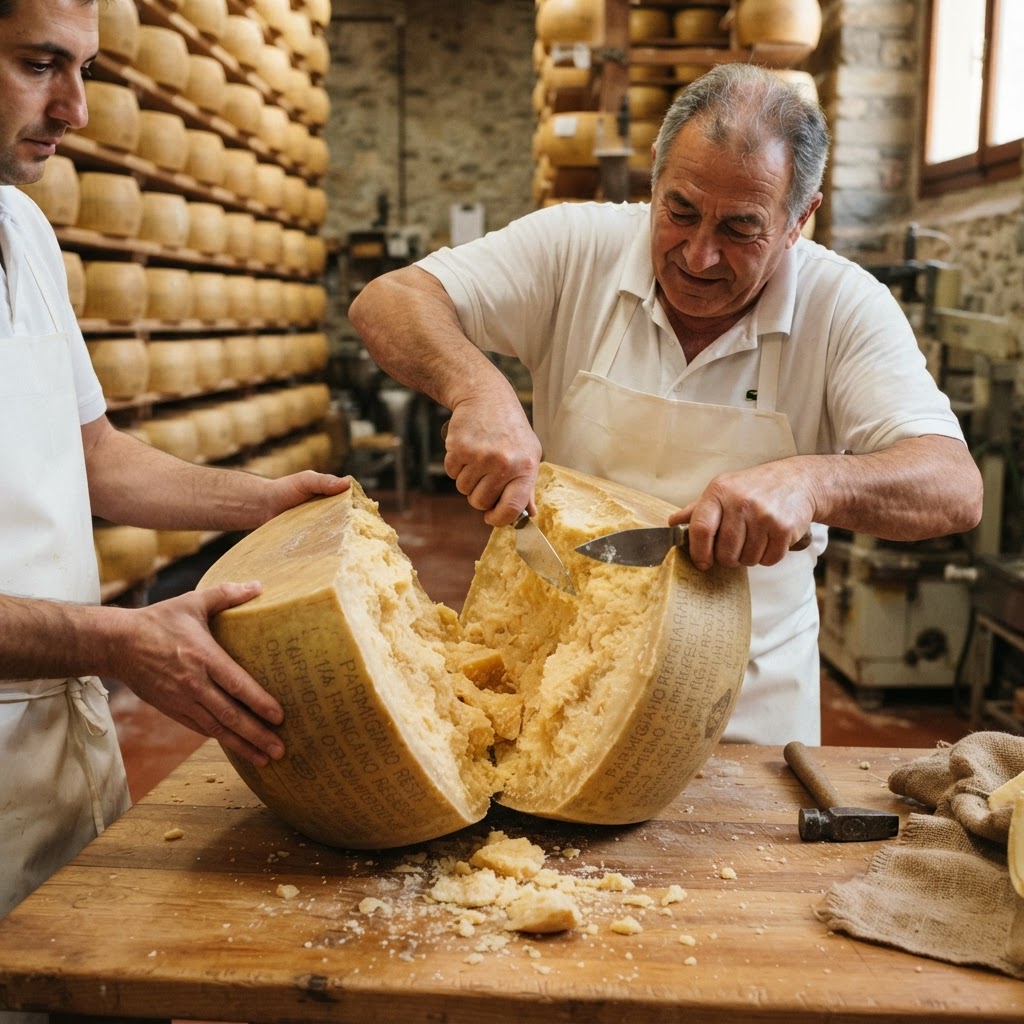
The name Parmigiano Reggiano is a Protected Designation of Origin (DOP) product in the European Union, meaning that only cheese produced according to the strict specifications within the designated geographical area may bear the name. The Consorzio del Formaggio Parmigiano Reggiano, founded in 1934, oversees the production standards and quality control. Every wheel is inspected by an expert from the consortium at 12 months of age, and only those that pass are branded with the official certification mark — the dotted stencil on the rind that guarantees authenticity. A single wheel weighs approximately 88 pounds, and it takes about 144 ¾ qt (290 pounds) of milk to produce one wheel. There are approximately 350 dairies producing Parmigiano Reggiano, collectively crafting around 3.6 million wheels per year (parmigianoreggiano.com).
The production process is governed by precise regulations. The cows must be fed only on forage grown within the designated area — no silage or fermented feed is permitted. The milk from the evening milking is left to rest overnight in large copper vats, allowing the cream to rise to the surface. The cream is skimmed off, and the remaining partially skimmed milk is combined with the full-cream milk from the following morning. Calf rennet and whey starter (a natural culture from the previous day's production) are added, and the milk is heated in copper vats shaped like bells. The curd is broken into tiny pieces using a traditional tool called a spino, then collected in linen cloth, placed in round moulds, and pressed into wheels. After a few days in salt brine, the wheels are transferred to aging rooms where they rest on wooden shelves for a minimum of 12 months, though many are aged 24, 36, or even 48 months or more.
The aging process is where Parmigiano Reggiano develops its extraordinary complexity. As the cheese ages, it loses moisture and the proteins break down into amino acids, forming the characteristic white crystals — tyrosine — that give aged Parmigiano Reggiano its distinctive crunch. At 12 months, the cheese is young and milky, with a supple, slightly elastic texture. At 24 months, it develops nutty, buttery notes and a more granular, crumbly texture. At 36 months and beyond, the cheese becomes intensely savoury, with notes of dried fruit, spice, and brothy umami — a result of the high concentration of free glutamate, the same compound that gives aged soy sauce and Parmesan its savoury depth.
The nickname 'King of Cheeses' is frequently attributed to the French playwright Molière, who is said to have declared Parmigiano Reggiano the 'roi des fromages,' though the exact provenance of this quotation is uncertain. What is certain is that the cheese has been prized by gourmands for centuries — the Italian writer Boccaccio mentions it in the Decameron (written around 1353), where a character describes a mountain made entirely of grated Parmigiano, upon which people 'dwell upon nothing but maccheroni and ravioli.' The cheese was a favourite of Napoleon, who is said to have been introduced to it during his Italian campaigns, and Thomas Jefferson was so enamoured of it that he purchased a wheel to bring back to Monticello (parmigianoreggiano.com).
For the traveller, visiting the Parmigiano Reggiano production area offers a glimpse into a food tradition that has remained virtually unchanged for centuries. Many dairies offer tours of the morning production, where visitors can watch the entire process — from the skimming of the evening milk to the breaking of the curd in the copper vats — and taste the cheese at various stages of aging. The town of Parma itself, designated a UNESCO Creative City of Gastronomy, is also home to Prosciutto di Parma, Culatello di Zibello, and Aceto Balsamico Tradizionale di Reggio Emilia and Modena, making it one of the most gastronomically rich regions in the world. The Museo del Parmigiano Reggiano in Soragna provides a comprehensive history of the cheese, from its medieval monastic origins to its modern global status.
What makes Parmigiano Reggiano so significant in the world of food and drink is its embodiment of the principle that the greatest culinary achievements are often the simplest. Four ingredients, a thousand-year tradition, and the patience to let time do its work — this is the entire formula. There are no additives, no shortcuts, no industrial optimisation. The cheese cannot be made outside its designated region because the milk itself carries the terroir of the Emilian countryside: the grasses the cows eat, the bacteria in the air, the microclimate of the aging rooms. It is, in its purest form, an edible expression of place — and a reminder that the most extraordinary food is not invented but discovered, refined, and patiently awaited.
For those seeking to learn more or plan a visit, the Consorzio del Formaggio Parmigiano Reggiano provides comprehensive information on production, aging, and dairy tours (parmigianoreggiano.com). The Parma region's tourism board offers guides to the area's gastronomic heritage (turismo.parma.it). The European Union's register of Protected Designation of Origin products provides the official legal specifications (ec.europa.eu).


Continue Reading