Food & Drink
The New York Bagel: An Immigrant Icon of the American Brunch Table
No object tells the story of New York breakfast quite like the bagel. It is a circle of boiled-then-baked dough that arrived with Eastern European Jewish immigrants and became, within a century, the defining bread of the American brunch.
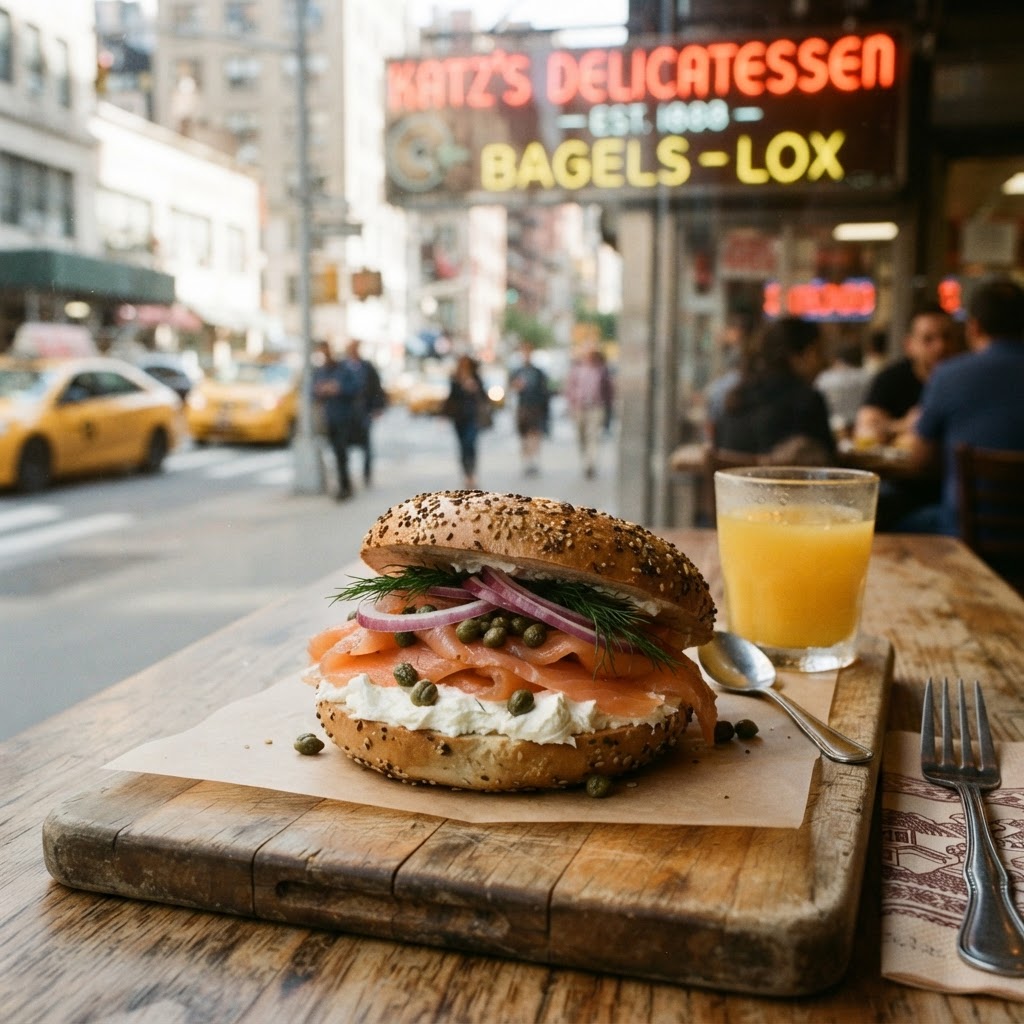
No object tells the story of New York breakfast quite like the bagel. It is a circle of boiled-then-baked dough that arrived with Eastern European Jewish immigrants at the turn of the twentieth century and became, within a hundred years, the defining bread of the American brunch. Chewy inside, crackly outside, split and piled with cream cheese, smoked salmon, capers, and onion, the New York bagel brunch is one of the great immigrant-born food rituals of the United States.
**From Krakow to the Lower East Side**
The bagel is older than New York. Ring-shaped boiled breads appear across Central and Eastern Europe — the obwarzanek of Poland, the beigel of the Ashkenazi Jewish kitchen — and the word itself is rooted in the Yiddish and German words for "ring." What made the bagel American was the great wave of Eastern European Jewish immigration to New York between 1880 and 1920. Settling largely on the Lower East Side, these immigrants brought their bakers, their ovens, and their trade. By 1900, the bagel was a fixture of the Jewish bakeries of Manhattan, sold warm in the early morning and eaten as a quick, sustaining breakfast.
**The Union and the Craft**
For much of the twentieth century, the New York bagel was controlled by a tightly knit guild. Bagel Bakers Union Local 338, founded in the early 1930s, governed who could make a true New York bagel and how. The work was hard and physical: the dough was hand-rolled, boiled, and baked in coal- or gas-fired ovens, often through the night. The union's standards — the texture, the size, the shine — were the standards of the city. A real New York bagel, the saying went, could only be made by a union man, and a union man only made them in New York.
**What Makes It a New York Bagel**
The defining technique is the boil. A true New York bagel is shaped, rested, briefly boiled on both sides, and only then baked. The boil gelatinizes the starches on the surface, which is what produces the glossy, slightly chewy crust and the dense, chewy crumb. Skip the boil and you have a roll with a hole. The dough itself is simple — high-gluten flour, water, salt, yeast, a little malt — but the proportions and the patience are everything. New York's famously soft water is often credited with the texture, though bakers will argue about this for as long as you let them.
**The Bagel Brunch**
The form most Americans recognize — a split bagel with cream cheese, lox (smoked salmon), tomato, red onion, and capers — is a twentieth-century synthesis. Cream cheese was an American invention of the 1870s, mass-produced and distributed by Philadelphia. Smoked salmon, once a luxury, became affordable as refrigeration and the smoked-fish trade expanded. By the mid-twentieth century, the combination was the canonical New York brunch order, served in delis and diners across the city and copied wherever Americans gathered for breakfast.
The bagel went national in the 1960s and 1970s, aided by the Lender's Bagel company of New Haven, which froze and shipped bagels to a country that had never tasted them. Frozen bagels were a pale imitation, but they primed the market, and soon freshly baked bagels spread across the continent. Today, the best remain in New York, where the union is gone but the technique survives.
**The Brunch Connection**
A bagel brunch is salty, rich, and briny — exactly the profile that a bright, acidic mimosa exists to refresh. A Classic Champagne Mimosa or a Grapefruit Rosemary Mimosa cuts through the cream cheese and the smoked salmon; a Cucumber Mint Mimosa cools the salt and the onion. The pairing is now so natural that the mimosa-and-bagel brunch has become, for many New Yorkers, the default weekend meal — an immigrant bread and an immigrant cocktail, side by side on the same table.
**References**
- Wikipedia: Bagel — https://en.wikipedia.org/wiki/Bagel
- Wikipedia: Cuisine of New York City — https://en.wikipedia.org/wiki/Cuisine_of_New_York_City
- Wikipedia: Brunch — https://en.wikipedia.org/wiki/Brunch


Continue Reading