Culture
Mardi Gras: New Orleans' Greatest Carnival and the Greatest Free Show on Earth
From a 1699 campsite named Pointe du Mardi Gras to the krewes, floats, and coconuts of Fat Tuesday, Mardi Gras is New Orleans' defining cultural ritual — a centuries-old collision of French Catholic tradition, African American culture, and pure spectacle that locals call the Greatest Free Show on Earth.
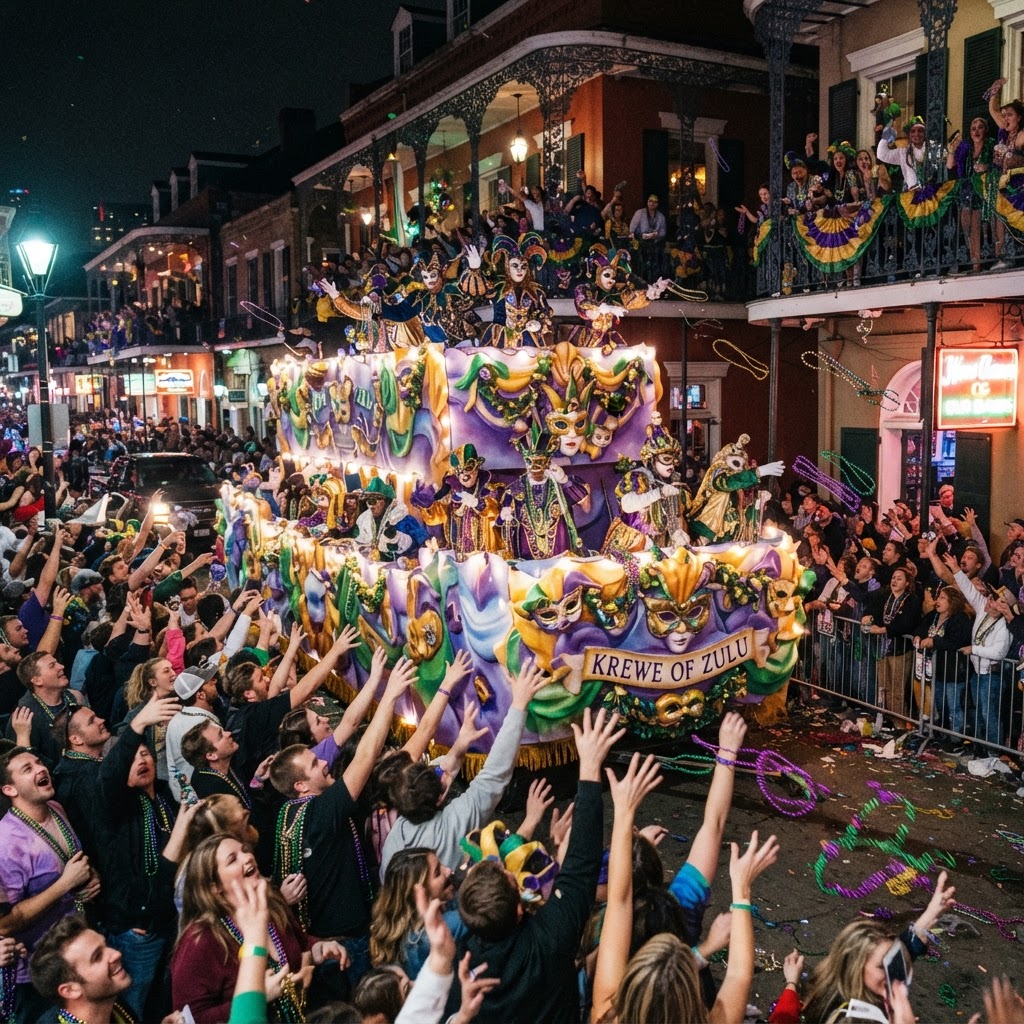
If you want to understand New Orleans, go during Carnival. Mardi Gras — French for Fat Tuesday, the day before Ash Wednesday — is the city's defining cultural ritual, a season of parades, masked balls, and street revelry that stretches from Twelfth Night (January 6) to midnight on Fat Tuesday. It is, as locals proudly call it, the Greatest Free Show on Earth.
**Origins**
As Mardi Gras New Orleans records, the origins of Mardi Gras can be traced to medieval Europe, passing through Rome and Venice in the 17th and 18th centuries to the French House of Bourbon, from which the traditional revelry of the 'Boeuf Gras,' or fatted calf, followed France to her colonies. On March 2, 1699, the French-Canadian explorer Jean Baptiste Le Moyne, Sieur de Bienville, arrived at a plot of ground 60 miles south of present-day New Orleans and named it 'Pointe du Mardi Gras' when his men realized it was the eve of the festive holiday. Bienville established Fort Louis de la Mobile (now Mobile, Alabama) in 1702, and in 1703 the tiny settlement celebrated America's very first Mardi Gras — a claim Mobile still proudly makes.
New Orleans was established in 1718 by Bienville. By the 1730s, Mardi Gras was celebrated openly in New Orleans, and by the early 1740s the governor, the Marquis de Vaudreuil, established elegant society balls that became the model for today's Mardi Gras balls. The earliest reference to Mardi Gras 'Carnival' in New Orleans appears in a 1781 report to the Spanish colonial governing body.
**The Krewes**
The modern era began in 1856, when six young Mobile natives formed the Mistick Krewe of Comus, bringing dazzling floats and masked balls to New Orleans and establishing the secret society, or 'krewe,' as the organizing unit of Carnival. In 1870, the Twelfth Night Revelers became the second krewe, and the first recorded account of Mardi Gras 'throws' — the beads and trinkets tossed from floats — appeared. In 1872, a group of businessmen invented a King of Carnival, Rex, to preside over the first daytime parade, and to honor the visiting Russian Grand Duke Alexis Romanoff, they introduced his family's colors — purple (justice), gold (power), and green (faith) — as the official colors of Mardi Gras. In 1875, Governor William Warmoth signed the Mardi Gras Act, making Fat Tuesday a legal holiday in Louisiana, which it remains.
The Krewe of Zulu, a Social Aid and Pleasure Club rooted in the African American community, dates to the early 1900s and first paraded in 1915. Zulu's signature throw is the painted coconut — once tossed, now handed down to prevent injuries — and its members ride in blackface paint, wigs, and grass skirts, traditions that trace back to the minstrel and vernacular roots of Carnival. Today, the great parading krewes include Endymion, Bacchus, Muses, Orpheus, and Proteus, each with signature throws and traditions, and the whole season builds to the dual parades of Zulu and Rex on Mardi Gras morning.
**The Traditions**
Mardi Gras is built on a constellation of traditions: the king cake, a braided, iced pastry with a hidden baby, eaten from Twelfth Night onward; the flambeaux, the gaslight torches once carried by enslaved men and now carried as a tradition to light the parades; the throws — beads, doubloons, cups, and the coveted Zulu coconuts — tossed to crowds shouting 'Throw me something, mister!'; the masked balls and tableau; and the Black Masking Indians, the magnificent beaded and feathered suits that are among the most extraordinary cultural expressions of the city.
**Why It Matters**
Mardi Gras is the cultural synthesis that defines New Orleans — French Catholic tradition, African American culture, Caribbean festival, and American excess, fused into something found nowhere else. It is a civic ritual as serious as it is joyful, a season in which the whole city participates, and a living tradition that has reinvented itself in every generation while remaining unmistakably itself.
**References**
- Mardi Gras New Orleans: History — https://www.mardigrasneworleans.com/history/
- New Orleans & Company: Ultimate Guide to Mardi Gras — https://www.neworleans.com/events/holidays-seasonal/mardi-gras/the-ultimate-mardi-gras-guide/
- Wikipedia: Mardi Gras — https://en.wikipedia.org/wiki/Mardi_Gras

Continue Reading