Culture
Chinese New Year: The World's Largest Celebration and Human Migration
Based on the lunar calendar and rooted in a myth of a monster called Nian, the Chinese New Year — Spring Festival — is the most important holiday of the Chinese world, a 15-day celebration that triggers Chunyun, the largest annual human migration on the planet.
If you want to understand the scale and the soul of Chinese civilization, go during the New Year. The Chinese New Year — the Spring Festival — is the most important holiday in the Chinese cultural world, a 15-day celebration rooted in the lunar calendar, the family, and the ancient myth of a monster called Nian. It is also the trigger of Chunyun, the Spring Festival travel rush — the largest annual human migration on the planet, when hundreds of millions of people travel home to reunite with their families.
**Origins and the Myth of Nian**
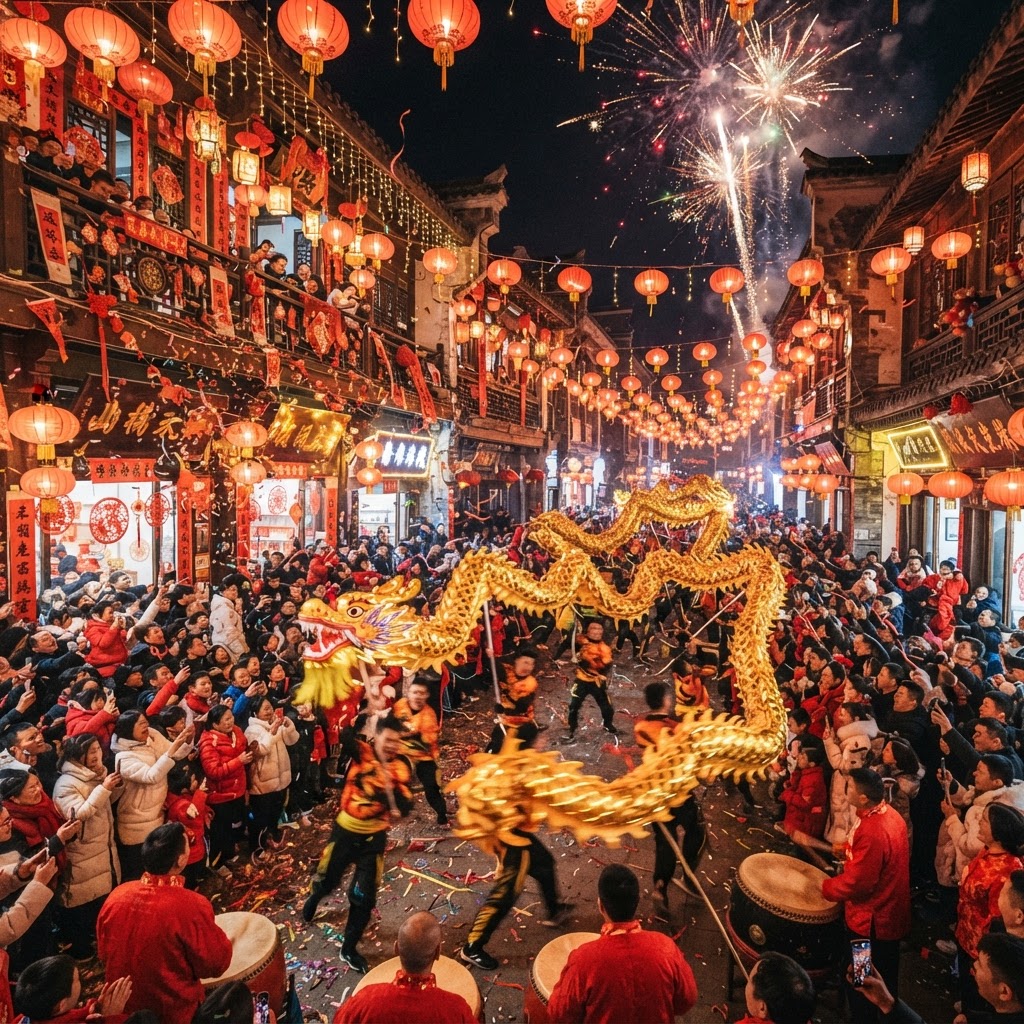
The Chinese New Year falls on the new moon between January 21 and February 20, marking the beginning of the lunar year and the arrival of spring. Its deepest roots lie in the myth of Nian, a fearsome beast that, according to legend, emerged at the turn of the year to devour livestock, crops, and children — until villagers discovered that Nian feared three things: the color red, fire, and loud noises. From that discovery come the defining customs of the festival: the red paper couplets pasted on doorways, the red lanterns strung across streets, the firecrackers and fireworks, and the lion and dragon dances that fill the streets with sound and color. The word for 'year' in Chinese, *nian*, is the name of the monster itself.
**The Reunion Dinner**
The heart of the festival is the reunion dinner on New Year's Eve, when families gather from across the country and the world to share the most important meal of the year. The table is laden with foods of meaning: dumplings (shaped like ancient gold ingots), fish (the word *yu* sounds like 'surplus'), long noodles (for a long life), sticky rice cake (*nian gao*, for rising prosperity), and oranges and tangerines (for luck and wealth). At midnight, firecrackers drive away the old year and welcome the new, and the celebrations continue for 15 days, ending with the Lantern Festival on the full moon, when families light and carry lanterns and eat tangyuan, sweet glutinous rice balls.
**Red Envelopes and Customs**
Across the festival, older generations give *hongbao* — red envelopes of money — to children and the unmarried, a gesture of luck and blessing. Homes are cleaned and decorated in red, the most auspicious color; the old year's debts are settled; and families avoid cleaning on the first day, lest they sweep away good fortune. The Chinese zodiac assigns each year one of twelve animal signs, cycling every twelve years, so that every person is associated with a birth animal that shapes fortune and compatibility.
**Chunyun: The World's Largest Human Migration**
Since the reform and opening up of China in the late 1970s, the Chinese New Year has triggered Chunyun — the Spring Festival travel rush, called the largest annual human migration in the world. As Wikipedia records, the travel season usually begins 15 days before New Year's Day and lasts around 40 days. In 2026, the Chunyun period is predicted to record 539 million passenger trips in the 40-day window, as hundreds of millions of migrant workers, students, and travelers return to their hometowns for the reunion dinner. The pressure on China's rail and road networks during Chunyun is among the great logistical feats of the modern world.
**Why It Matters**
The Chinese New Year is the great cultural ritual of the Chinese world — a celebration that, across the centuries and across the diaspora, has kept the family at the center of Chinese life and that binds more than a billion people to a shared calendar and a shared story. In the red of the lanterns, the noise of the firecrackers, and the journey home, you see the deepest continuities of one of the world's oldest civilizations.
**References**
- Wikipedia: Chinese New Year — https://en.wikipedia.org/wiki/Chinese_New_Year
- Wikipedia: Chunyun (Spring Festival travel rush) — https://en.wikipedia.org/wiki/Chunyun
- Wikipedia: Nian (the myth of the beast) — https://en.wikipedia.org/wiki/Nian



Continue Reading


