Home
The Home Office: Designing a Workspace That Actually Works
The home office has become a permanent fixture of modern life. Here is how to design one that is genuinely productive, beautiful, and worthy of the hours you will spend in it.
Since 2020, the home office has moved from occasional convenience to daily necessity for a significant proportion of the professional population. Yet the majority of home offices — a laptop on a kitchen table, a makeshift desk in a corner — are designed for neither productivity nor beauty. The result is a working environment that actively undermines the quality of the work produced in it.
Designing a proper home office requires the same seriousness of intention that would be applied to any significant domestic project. It is, in every meaningful sense, as important as any other room in the home.
**Location and Light**
Position your desk perpendicular to, rather than directly facing or backed by, a window. Direct window-facing creates screen glare; backing a window creates silhouette. The perpendicular position captures natural side-light that illuminates your workspace without interfering with your screen. North-facing rooms provide the most consistent natural light throughout the day — the choice of professional artists and architects for studio work.
**The Desk**
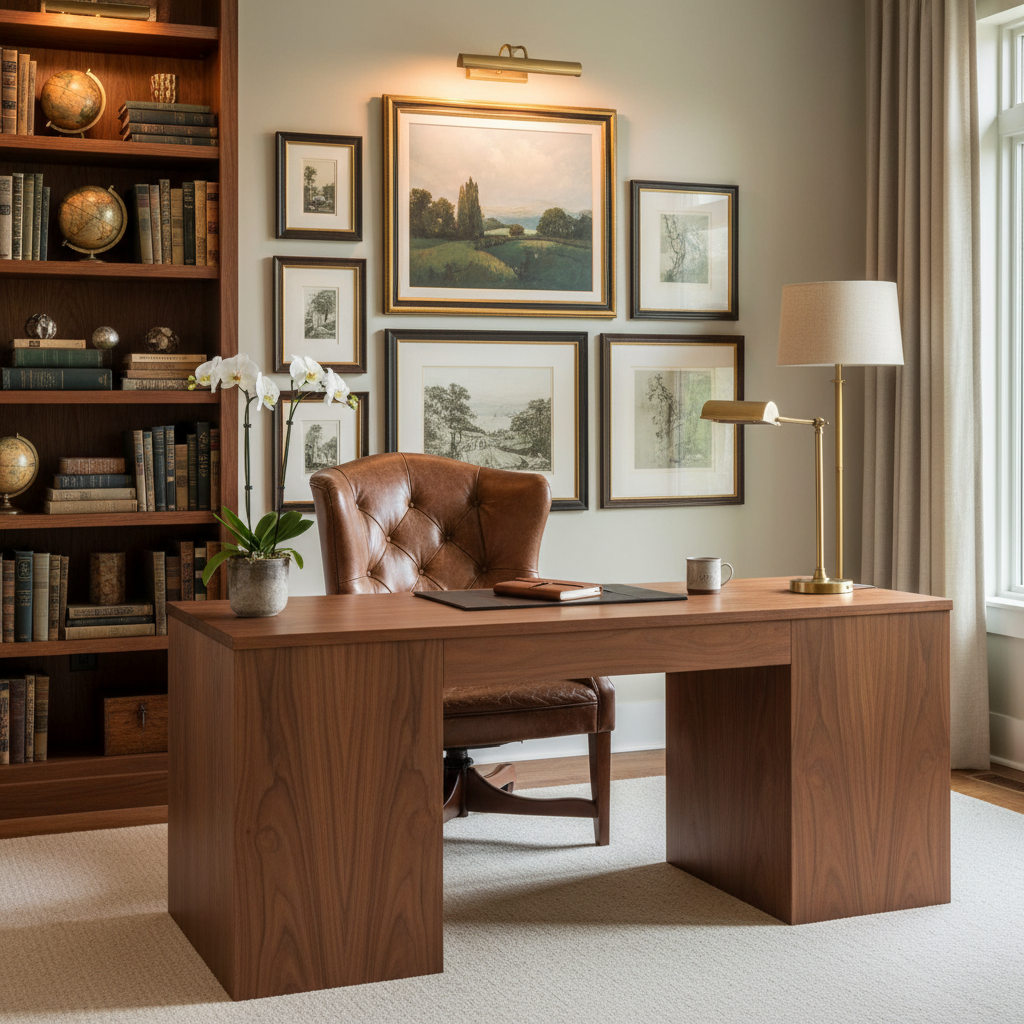
The desk is the architectural centre of the home office and deserves investment. Dimensions matter: a 60-inch-wide surface is the minimum for comfortable dual-screen work; 72 inches allows for spreading documents and maintaining visual clarity. Height matters even more: the desk should position your keyboard with your forearms parallel to the floor and your shoulders relaxed.
Recommended desks: the Herman Miller AGL Standing Desk (store.hermanmiller.com) for those who benefit from height variation; the Humanscale Float table for a beautifully designed fixed-height option; for a more traditional aesthetic, the Stickley (stickley.com) Mission-style desk in white oak is one of the finest pieces of American furniture design currently in production.
**The Chair**
The single most important investment in any home office. Eight or more hours per day in a poorly designed chair creates compounding postural damage. The Herman Miller Aeron (store.hermanmiller.com) — used in more high-performance work environments than any other chair in the world — is the benchmark. The Steelcase Leap (steelcase.com) is equally excellent, with many users preferring its seat cushion. Both require a minimum of $1,200 investment and represent the finest cost-per-hour-of-comfort ratio available. Buy refurbished from Crandall Office Furniture (crandalloffice.com) to reduce cost by 50–60%.
**Lighting**
Three light sources, minimum. Ambient light from ceiling or floor lamp (2700–3000K, warm white). Task light: a proper architect's lamp positioned to illuminate the desk surface without creating screen glare. BenQ (benq.com) produces monitor-mounted and desk-mounted lamps designed specifically to prevent eye strain during extended screen work. Screen bias light: a strip of warm LED light behind your monitor reduces the contrast between screen and background, measurably reducing eye fatigue over long sessions.
**The Monitor Setup**
The centre of your primary monitor should sit at or just below eye level, approximately 20–28 inches from your eyes. Use a monitor arm (Ergotron LX, widely available) rather than a stand — it provides precise height and angle adjustment and frees the desk surface beneath. A second monitor (positioned at a slight angle to the primary) dramatically increases productivity for most knowledge workers: research from the University of Utah found a 42% increase in productivity with dual monitors versus single.
**Storage and Organisation**
The home office that functions best is also the most visually calm. Use closed storage (a credenza, a filing cabinet, or floor-to-ceiling shelving with box files) rather than open surfaces covered in paper. The Getting Things Done (GTD) system by David Allen — detailed at gettingthingsdone.com — provides a complete organisational framework for the home office that has been adopted by executives in every major industry.
**The Details**
A potted plant (the Boston fern or peace lily is particularly effective at air purification according to NASA's Clean Air Study). A good speaker (Sonos Era 100 for premium audio in a compact format). A wall calendar or large-format paper planner. A single piece of art that inspires rather than distracts. The desk surface kept completely clear at the end of each working day — the most important ritual in a productive home office.



Continue Reading