Food & Drink
Darjeeling: The Champagne of Teas and the Himalayan Gardens
Planted in 1841 in the foothills of the Himalayas, Darjeeling produces just 10,000 tonnes a year of what many consider the finest tea on earth — a tea so prized that four times as much is sold under its name as is actually produced.
Darjeeling tea is grown in the Darjeeling district of West Bengal, India, in the foothills of the Himalayas, at altitudes ranging from 600 to 2,000 metres (2,000 to 6,500 feet) above sea level. The tea plants, Camellia sinensis, were first planted in the Darjeeling area in 1841 by Archibald Campbell, a British civil surgeon working for the East India Company who was stationed in the jungle-covered, sparsely populated area to develop a hill station for the British stationed in Kolkata. Campbell began experimenting with tea cultivation using seeds brought from China, and the results were so promising that within six years, the British government initiated commercial tea cultivation in the region. The British were seeking an alternative supply of tea apart from China, which held a monopoly on the trade, and Darjeeling's cool climate, mountainous terrain, and abundant rainfall proved ideal for growing the Chinese variety of the tea plant (en.wikipedia.org/wiki/Darjeeling_tea).
Darjeeling tea is produced in 87 tea gardens spread across the Darjeeling hills, covering approximately 17,500 hectares (43,000 acres) of cultivated land. The gardens are located in a narrow band of mountainous terrain, and the unique combination of altitude, cool temperatures, heavy rainfall, mist, and the mineral composition of the Himalayan soil creates a terroir that is unlike any other tea-growing region in the world. The tea is harvested in three main 'flushes' — the first flush in spring (March to April), the second flush in summer (May to June), and the autumnal flush (October to November) — each producing tea with distinctly different characteristics. The first flush, harvested after the winter dormancy, produces a light, golden, floral tea with a delicate astringency and a fresh, green aroma. The second flush, harvested in the warmer months, produces a fuller-bodied, amber-coloured tea with the distinctive 'muscatel' flavour — a grape-like note that is the hallmark of the finest Darjeeling and that has earned it the nickname 'the Champagne of teas' (gomdenstea.com).
The 'muscatel' flavour of Darjeeling tea is one of the most prized and distinctive characteristics in the world of tea. It is a flavour note that resembles the Muscat grape — sweet, fruity, and slightly winey — and it is produced by a combination of factors unique to the Darjeeling terroir: the specific varieties of the tea plant grown (primarily the Chinese var. sinensis, as opposed to the larger-leaved Assam var. assamica), the high altitude, the cool growing conditions that stress the plant and concentrate its flavours, the particular species of insects (including the tea mosquito bug, Helopeltis theivora) that feed on the tea leaves and trigger the plant's production of defensive compounds that contribute to the muscatel character, and the traditional processing methods used by the tea gardens. The muscatel note is most pronounced in the second flush, and it is this quality that distinguishes the finest Darjeeling from all other black teas (happyfeartea.com).
Darjeeling tea holds a Geographical Indication (GI) tag, which was granted by the Tea Board of India in 2004 — the first product in India to receive GI protection. This means that only tea grown in the 87 designated gardens of the Darjeeling hills, processed in the traditional manner, may be sold as 'Darjeeling tea.' The Tea Board of India, a government body established in 1953, regulates the production, certification, and export of Darjeeling tea, and every batch of authentic Darjeeling carries a certification mark that guarantees its origin and quality. Despite this protection, Darjeeling faces a significant challenge from adulteration: it is estimated that approximately 40,000 tonnes of tea sold as 'Darjeeling' worldwide each year is not genuine Darjeeling, while the actual annual production of authentic Darjeeling tea is only about 8,000 to 10,000 tonnes — meaning that the vast majority of 'Darjeeling tea' sold globally is counterfeit or blended with teas from other regions (teaboard.gov.in).
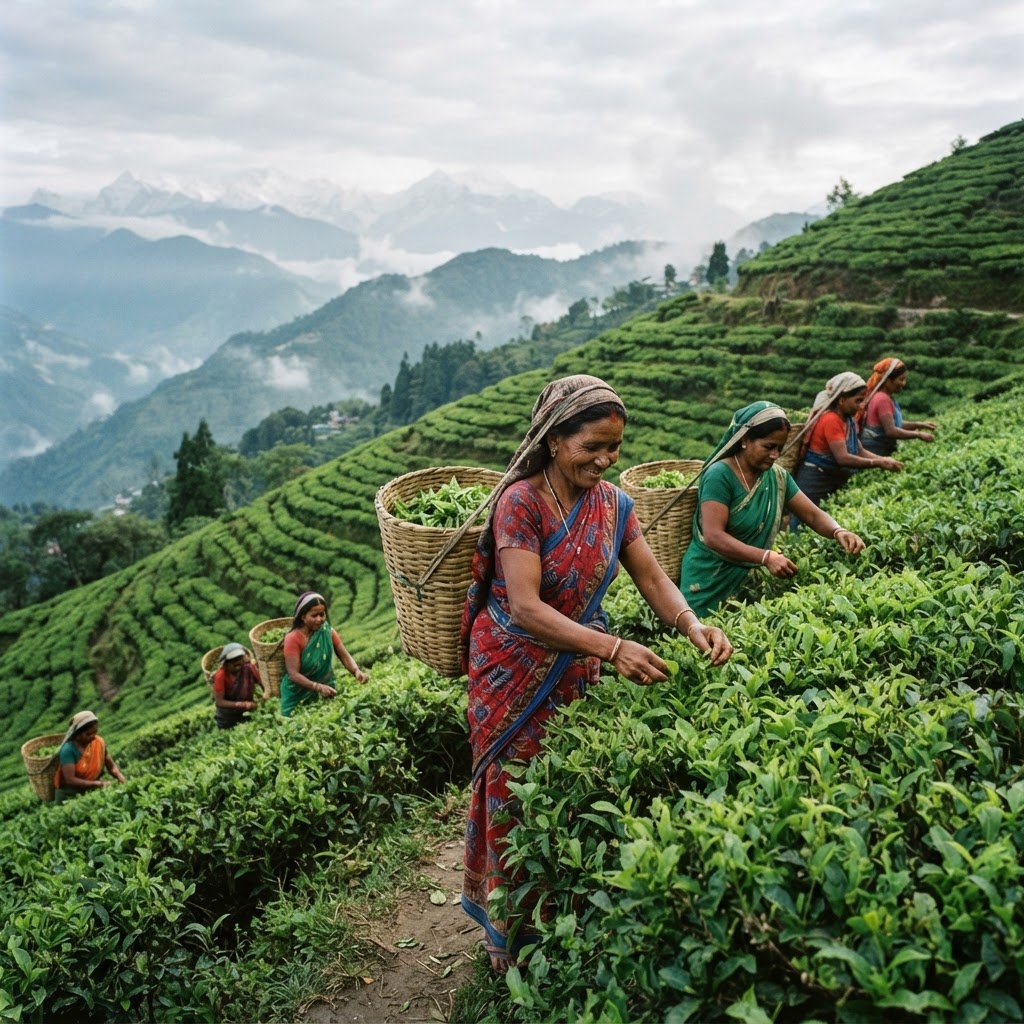
The production process for Darjeeling tea follows the traditional Orthodox method, which has remained essentially unchanged since the 19th century. After plucking — done by hand, by women tea pickers who work in the gardens from dawn, selecting only the top two leaves and a bud from each shoot — the leaves are withered (dried to reduce moisture content), rolled (to break the cell walls and initiate oxidation), fermented (oxidised, which develops the characteristic colour and flavour), fired (dried to halt oxidation and preserve the tea), and sorted (by leaf size and grade). The withering is done in large, well-ventilated troughs; the rolling is done by machine in most gardens, though some premium lots are still hand-rolled; the fermentation is carefully monitored, as the degree of oxidation determines the final character of the tea; and the firing is done in ovens that reach temperatures of 90-248°F. The entire process, from plucking to packing, takes place within the tea garden, and the master tea maker — responsible for judging the exact moment to halt withering, adjust rolling pressure, and stop fermentation — is the key figure whose skill determines the quality of the final product.
For the traveller, the Darjeeling tea gardens offer one of the most beautiful and culturally rich tea tourism experiences in the world. The Darjeeling Himalayan Railway — a UNESCO World Heritage Site known as the 'Toy Train' — winds through the tea gardens, offering views of the terraced hillsides, the mist-covered mountains, and the workers picking tea in their colourful saris. Many tea gardens, including Makaibari, Castleton, Glenburn, and Happy Valley, offer tours and tastings, and some — like Glenburn Tea Estate — offer accommodation in restored colonial bungalows set among the tea fields. The town of Darjeeling itself, perched at 2,042 metres (6,700 feet) above sea level, offers spectacular views of Kanchenjunga — the third-highest mountain in the world — and is home to a vibrant tea culture, with tea shops and tasting rooms where visitors can sample different flushes and grades of Darjeeling tea (incredibleindia.org).
The future of Darjeeling tea faces significant challenges. Climate change is altering the temperature and rainfall patterns of the Darjeeling hills, affecting the timing and quality of the flushes. Labour shortages, as younger generations leave the tea gardens for education and urban employment, threaten the traditional hand-plucking that is essential to quality. Competition from cheaper teas, and the persistent problem of adulteration and counterfeiting, undermine the economic viability of the genuine product. And political tensions in the Darjeeling hills, including periodic strikes and calls for a separate state of Gorkhaland, have disrupted production. Despite these challenges, the 87 tea gardens of Darjeeling continue to produce what many consider the finest tea in the world, and the Tea Board of India and the Darjeeling Tea Association are working to protect the GI, combat counterfeiting, and ensure the long-term sustainability of this extraordinary agricultural tradition (darjeelingtea.com).
What makes Darjeeling tea so significant in the world of food and drink is the way it embodies the principle that the most extraordinary products come from the most specific combination of place, plant, and practice. Darjeeling tea cannot be grown anywhere else. The Chinese variety of the tea plant, planted in the Himalayan foothills, at altitude, in the mist and the mineral soil, picked by hand by workers whose families have worked the same gardens for generations, and processed by a master tea maker whose skill has been passed down through decades — this is the formula. It cannot be replicated in a factory, accelerated by technology, or produced at scale without losing the qualities that make it extraordinary. It is, in its purest form, an edible expression of a single, specific place — the Darjeeling hills — and a reminder that the finest things in the world of food and drink are not manufactured but grown, in the fullest sense of the word.
For those seeking to learn more or plan a visit, the Darjeeling Tea Association provides information on the tea gardens, the GI tag, and tea tourism (darjeelingtea.com). The Tea Board of India provides official information on Darjeeling tea certification and regulations (teaboard.gov.in). Incredible India, the official tourism board of India, offers guides to Darjeeling and the tea gardens (incredibleindia.org).
Continue Reading