Travel
Cartagena, Colombia: The Caribbean's Most Beautiful Colonial City
Cartagena is the jewel of the Colombian Caribbean — a UNESCO walled city of pastel-coloured colonial buildings, bougainvillea-draped balconies, and a living street culture that is unmatched in Latin America.
Cartagena, on Colombia's Caribbean coast, is the most beautifully preserved Spanish colonial city in the Americas. Founded in 1533 by the Spanish commander Pedro de Heredia, Cartagena de Indias was for three centuries one of the most important ports in the Spanish Empire — the transshipment point for gold, silver, and emeralds bound for Spain, and the entry point for enslaved Africans and European goods flowing into South America. Its wealth and strategic importance made it a target for pirates and rival powers, and the city responded by building one of the most extensive systems of fortifications in the New World. Those walls, along with the colonial churches, mansions, and plazas within them, have been preserved with extraordinary fidelity, and in 1984 the Port, Fortresses, and Group of Monuments of Cartagena were inscribed as a UNESCO World Heritage Site.
The Walled City
The **Walled City** (Ciudad Amurallada) of Cartagena is one of the most complete colonial urban ensembles in the Americas. The walls, built between the sixteenth and eighteenth centuries, extend for approximately 11 kilometres and enclose the old city. The walls are up to 20 metres thick in some places, and at sunset they are the favourite gathering place for residents and visitors, who climb to the top to watch the sun sink into the Caribbean.
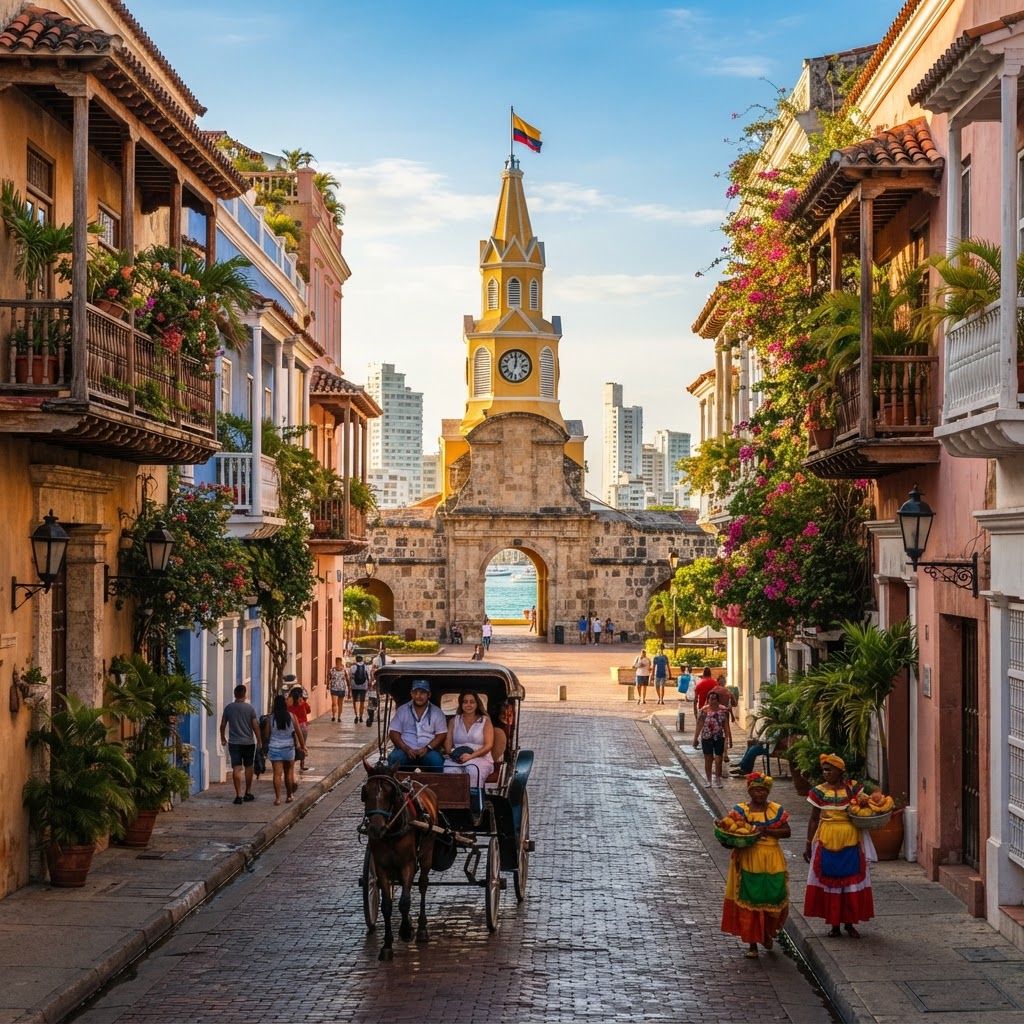
The main entrance to the old city is through the **Torre del Reloj** (Clock Tower), the iconic gate that opens onto the Plaza de los Coches, once the site of the slave market and now lined with candy vendors and horse-drawn carriages. Beyond lies the Plaza de la Aduana, the largest square in the old city, and the Plaza de Bolívar, which contains the statue of Simón Bolívar and the Inquisition Palace (Palacio de la Inquisición), a museum housed in one of the finest colonial buildings in the city.
The most beautiful street in Cartagena is arguably **Calle de San Agustín**, a narrow cobblestone lane of pastel-coloured colonial houses with carved wooden balconies dripping with bougainvillea. The **Convento de San Agustín**, built in the sixteenth century, sits at the end of the street.
The Churches
Cartagena's churches are among the finest colonial religious buildings in the Americas. The **Catedral de Santa Catalina de Alejandría** (Cartagena Cathedral), begun in 1577 and completed in 1612, is a fortress-church with thick walls and a massive bell tower — designed to serve as a refuge during pirate attacks. The **Iglesia de San Pedro Claver**, built in the seventeenth century and dedicated to the Jesuit saint who ministered to enslaved Africans, contains the saint's remains and a fine museum of colonial religious art.
Castillo San Felipe de Barajas
The **Castillo San Felipe de Barajas** is the greatest Spanish fortification in the Americas and one of the most impressive military structures in the New World. Built on a hill overlooking the city and the harbour, the castle was constructed in stages beginning in 1536 and expanded significantly in the seventeenth and eighteenth centuries. Its complex system of tunnels, galleries, and gun emplacements made it virtually impregnable, and it was never taken by force despite multiple attacks by the British and French. The most famous attack was the 1741 British assault by Admiral Edward Vernon, who was defeated despite commanding a force of over 180 ships and 23,000 men.
Getsemaní
**Getsemaní**, the neighbourhood just outside the old city walls, was historically the working-class quarter where dock workers, artisans, and freed slaves lived. In recent years, it has been transformed into one of the most vibrant and artistic neighbourhoods in Latin America, with street art, boutique hotels, and some of the best restaurants and bars in the city. The **Plaza de la Trinidad**, the main square of Getsemaní, comes alive every evening with street performers, food stalls, and an atmosphere of spontaneous celebration.
The Rosario Islands
The **Rosario Islands** (Corales del Rosario), a chain of 27 islands about an hour by boat from Cartagena, are one of the most beautiful tropical archipelagos in the Caribbean. The islands are part of a protected national park (Parque Nacional Natural Corales del Rosario y de San Bernardo) and are known for their coral reefs, white-sand beaches, and turquoise water. Day trips and overnight stays on the islands are one of the most popular excursions from Cartagena.
The Hotels
The **Sofitel Legend Santa Clara de Cartagena** is the city's most celebrated luxury hotel. Built in a seventeenth-century convent (the Convento de Santa Clara, founded in 1621), the hotel combines colonial architecture with modern luxury. The convent was transformed into a hotel in 1995, and the property includes a central courtyard, a pool, and a restaurant that is one of the finest in the city.
**Casa San Agustín** is a boutique hotel in a restored colonial house on Calle de San Agustín, with 30 rooms, a pool, and a restaurant. It is one of the most charming properties in the walled city.
**Bastión Luxury Hotel**, built into a section of the city walls, offers modern luxury within a historic setting.
The Cuisine
Cartagena's cuisine is a distinctive blend of Spanish, African, and indigenous Caribbean traditions, with an emphasis on seafood, coconut rice (arroz de coco), plantains, and tropical fruits. **Celele** in Getsemaní, under chef Javier Echeverri, was named one of Latin America's 50 Best Restaurants and specializes in the cuisine of the Caribbean coast of Colombia. **Carmen y Ángel** in the walled city offers modern Colombian cuisine, and **La Cevicheria** serves what may be the best ceviche in Colombia.
For a true Cartagena experience, the **Mercado de Bazurto** — the city's enormous, chaotic, and vibrant public market — is where the city eats. It is not for the faint of heart, but it is the most authentic food experience in Cartagena and the source of the city's best seafood.
Reference Links:
- Cartagena Tourism: cartagena.travel
- UNESCO Cartagena: whc.unesco.org/en/list/285
- Sofitel Legend Santa Clara: sofitel.com
- Castillo San Felipe de Barajas: colombofilos.com
- Rosario Islands National Park: parquesnacionales.gov.co
- Getsemaní Neighborhood: cartagena.travel/getsemani
- Celele Restaurant: celelerestaurante.com

Continue Reading