Food & Drink
The Art of Afternoon Tea: London's Most Elegant Ritual
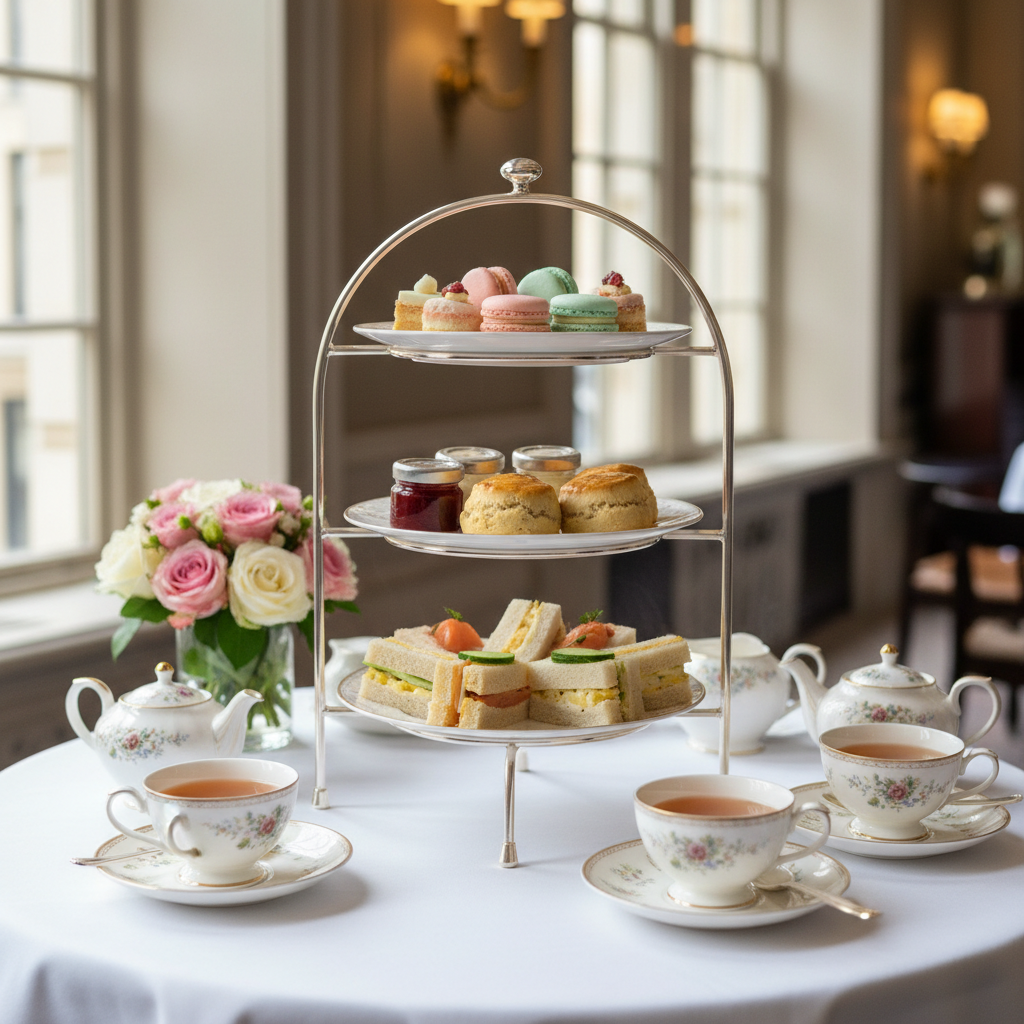
Afternoon tea — the three-tiered stand of sandwiches, scones, and cakes served with precisely brewed Darjeeling — is Britain's most refined culinary ritual and one of the world's great luxury food experiences.
Afternoon tea was invented in the early 1840s by Anna Maria Russell, the 7th Duchess of Bedford, who complained of 'a sinking feeling' in the late afternoon and began requesting tea and small cakes be brought to her private chambers at around 4pm. Within a decade, the Duchess had begun inviting friends to join her, the fashion spread through aristocratic society, and one of the world's great culinary institutions was born.
Today, the finest afternoon teas in London are served in settings of such concentrated luxury — ballrooms of mirrored grandeur, sitting rooms of Edwardian splendor, conservatories of sculptural artifice — that the experience extends well beyond food into theater, history, and the very particular pleasure of being made to feel, for the duration of two unhurried hours, that the entire world has slowed to match your pace.
**Understanding the Three Formats**
A critical clarification: afternoon tea, cream tea, and high tea are three distinct things frequently confused by visitors.
*Afternoon tea* (also called 'low tea', as it was served at low drawing room tables) is the three-tiered stand of finger sandwiches on the bottom tier, plain and fruit scones with clotted cream and jam on the middle tier, and pastries and cakes on the top tier, accompanied by loose-leaf tea served in fine china, and optionally a glass of Champagne.
*Cream tea* is a simpler affair — scones with clotted cream and jam, and tea. It is the staple of Devon and Cornwall and a different, more casual experience.
*High tea* (served at high dining tables, hence the name) was originally a working-class supper — heartier food including cold meats, pies, and bread — not the elegant experience the term now mistakenly suggests in American usage. When a London hotel advertises 'high tea', they typically mean afternoon tea, a misnomer that has become standard.
**The Hierarchy of London's Great Teas**
The Ritz London (theritz.co.uk) has served afternoon tea in its magnificent Palm Court since 1906 — gilded columns, Louis XVI furniture, a soaring ceiling of extraordinary plasterwork, and the sound of a live pianist floating beneath the sound of teaspoons on bone china. The food is impeccable: the finger sandwiches (cucumber with cream cheese, smoked salmon, coronation chicken, egg and cress, and rare roast beef) are among the finest in the city; the scones arrive warm; the pastry selection changes seasonally. Book 13 weeks in advance — the Palm Court has a waiting list that extends months. From £75 per person.
Claridge's (claridges.co.uk) in the Foyer and Reading Room is many discerning Londoners' preference — the setting (art deco, immaculate, with a sweeping central staircase) is perhaps the most beautiful of any afternoon tea room in the world, and the food reflects the kitchen's Michelin-starred sensibility. The champagne service here uses Gordon & MacPhail blends paired to the tea selection. From £85 per person.
The Savoy (fairmont.com/savoy) Thames Foyer, beneath its glass cupola and central tree, offers a more relaxed but equally accomplished experience. The Savoy's own Afternoon Tea Blend (a house blend of Assam, Darjeeling, and Ceylon) is sold in beautiful tins at the hotel boutique. From £70 per person.
For the most theatrical experience: Sketch (sketch.london) in Mayfair — the Gallery room, in which Yinka Shonibare's 239 identical framed portraits line the walls, serves afternoon tea of genuine culinary ambition alongside cocktails. From £65 per person.
**The Scone Debate: Cream First or Jam First?**
This is perhaps the most ardent culinary controversy in Britain. The Devon method places clotted cream on the scone first, then jam. The Cornwall method places jam first, then cream. The Ritz and most London hotels follow the Devon method. The correct answer, if one is needed, is whichever allows you to construct the thickest possible layer of clotted cream — which is always the correct priority.
**The Tea Selection: Navigating the Blend**
The tea list at the finest afternoon teas runs to 20 or more varieties. For the uninitiated:
*First Flush Darjeeling* (harvested March–April) — the most delicate and aromatic of all black teas, with a muscatel and floral character that is the traditional afternoon tea choice. Margaret's Hope Estate and Castleton Estate are benchmark producers.
*Assam* — full-bodied, malty, deeply satisfying with milk. The base of most classic English Breakfast and Afternoon Tea blends.
*Ceylon OP (Orange Pekoe)* — bright, clear, and slightly astringent. A lighter afternoon tea choice.
*Lapsang Souchong* — smoked over pine needles, deeply smoky and complex. Polarizing, extraordinary, worth trying.
**The Champagne Upgrade**
Every London hotel offers Champagne as an addition to afternoon tea, and it is always worth ordering. The pairing of Champagne with afternoon tea sandwiches and scones is one of the great underappreciated food and wine combinations — the acidity cuts through the richness of the cream and amplifies the delicacy of the cucumber sandwiches. The Ritz pours Laurent-Perrier Blanc de Blancs; Claridge's serves Bollinger La Grande Année. Both are perfect.
Continue Reading