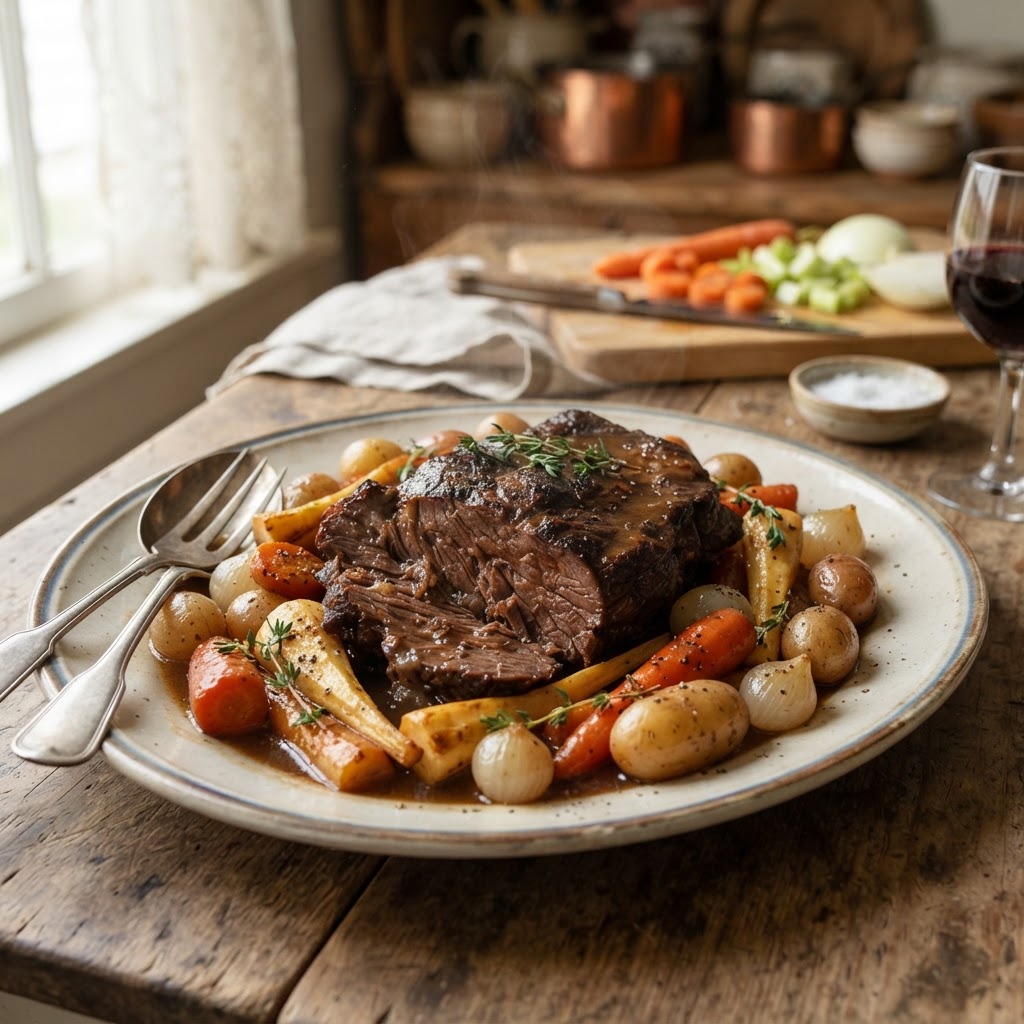
Yankee Pot Roast: New England's Braised Beef Classic
February 11, 2026
The term "pot roast" began appearing in American cookbooks in the late 19th century, though the braising technique behind it is centuries older. New England cooks, facing long winters and limited access to fresh ingredients, turned tough cuts of beef into tender, deeply flavored meals by searing the meat and then simmering it for hours in a covered pot with root vegetables and stock. The dish earned the prefix "Yankee" as a nod to its New England origins and the resourcefulness that characterized Yankee cooking. Journalist Allan Keller, in his 1955 memoir "Grandma's Cooking," recalled his Connecticut grandmother browning the meat in suet donated by the local butcher, a detail that captures the frugality at the heart of this tradition.
What distinguishes Yankee pot roast from its European cousins like boeuf bourguignon or Italian stracotto is its deliberate simplicity. There is no wine, no cream, and no exotic spices. Just beef, vegetables, broth, and perhaps a splash of cider or Worcestershire. The vegetables are classic New England: carrots, parsnips, onions, potatoes, and sometimes turnips. The entire dish cooks in a single pot, making it the ideal make-ahead meal for a small gathering.
About the Ingredients: Beef chuck is the correct cut for pot roast. It has abundant marbling and connective tissue that breaks down over long, slow cooking into gelatin, producing both tender meat and a silky sauce. A boneless chuck roast of 3 to 4 pounds will serve 6 to 8 people. The root vegetables should be cut into large, even pieces so they hold their shape during the long braise. Yukon Gold potatoes are ideal, as they maintain their texture better than russets.
Ingredients (serves 6–8): - 1 (3–4 lb) boneless beef chuck roast - Kosher salt and freshly ground black pepper - 3 tablespoons vegetable oil - 2 large onions, quartered - 4 carrots, cut into 2-inch chunks - 4 parsnips, cut into 2-inch chunks - 1 lb Yukon Gold potatoes, halved - 4 garlic cloves, smashed - 3 tablespoons tomato paste - 2 cups beef stock - 1 tablespoon Worcestershire sauce - 2 sprigs fresh rosemary - 4 sprigs fresh thyme - 2 bay leaves
Instructions: Preheat oven to 325°F. Pat the roast dry with paper towels and season generously with salt and pepper on all sides.
Heat the oil in a large Dutch oven over medium-high heat until shimmering. Sear the roast for 4–5 minutes per side until deeply browned on all sides. Transfer to a plate.
Reduce heat to medium. Add the onions to the pot and cook 5 minutes until beginning to soften. Add the garlic and tomato paste. Cook, stirring, for 2 minutes until the tomato paste darkens slightly. Return the roast to the pot. Add the beef stock, Worcestershire, rosemary, thyme, and bay leaves. The liquid should come about halfway up the sides of the roast. Bring to a simmer.
Cover the pot and transfer to the oven. Cook for 1 hour 30 minutes. Add the carrots, parsnips, and potatoes to the pot, submerging them in the liquid. Cover and cook for 1 hour more, until the meat is fork-tender and the vegetables are soft.
Transfer the roast and vegetables to a serving platter. Tent with foil. Strain the cooking liquid into a saucepan and skim the fat from the surface. Simmer over medium heat for 5–8 minutes until slightly reduced. Adjust seasoning. Slice the roast against the grain or shred it. Pour the sauce over the meat and vegetables.
The Mimosa Pairing Logic: The deep, savory richness of braised beef and root vegetables calls for a mimosa with bright fruit and a touch of acidity. The Cranberry Holiday Mimosa is an inspired match for a New England pot roast, its tart cranberry echoing the regional character of the dish. The Classic Champagne Mimosa provides a clean, simple contrast that lets the beef's flavor shine.
Reference Links: - Yankee Pot Roast Recipe With a History – New England Today - The New England Origins of Yankee Pot Roast – Chowhound
Make-Ahead: Yankee pot roast is one of the best make-ahead dishes in American cooking. It improves overnight as the flavors meld and the meat absorbs the braising liquid. Store the meat and vegetables in the cooking liquid, covered, in the refrigerator for up to 3 days. Reheat gently on the stovetop over low heat, or in a 300°F oven covered, for 30 minutes. Skim the solidified fat from the surface before reheating.
Pro Tips: Do not rush the sear. A deep, dark crust on the meat is the foundation of the sauce's flavor. If your Dutch oven is not large enough to sear the entire roast at once, cut it in half and sear in batches. The braising liquid should never boil. A bare simmer is all that is needed. Boiling toughens the meat fibers and makes them stringy rather than tender.
Rate this recipe
Be the first to rate this recipe
to submit your rating.
Recent Posts

Couscous Royale: North Africa's Grand Platter of Lamb, Chicken, and Merguez
October 14, 2026

Seattle Cream Cheese Dog Bites: Hadley Long's 1989 Pioneer Square Invention
October 14, 2026

Khao Soi: Chiang Mai's Northern Thai Coconut Curry Noodles
October 13, 2026

Korean Bibimbap: Jeonju's Joseon Dynasty Mixed Rice
October 11, 2026

Spaghetti alla Carbonara: Rome's World War II Pasta of Eggs, Guanciale, and Pecorino
October 9, 2026