Whipped Feta & Roasted Red Pepper Crostini
May 25, 2026
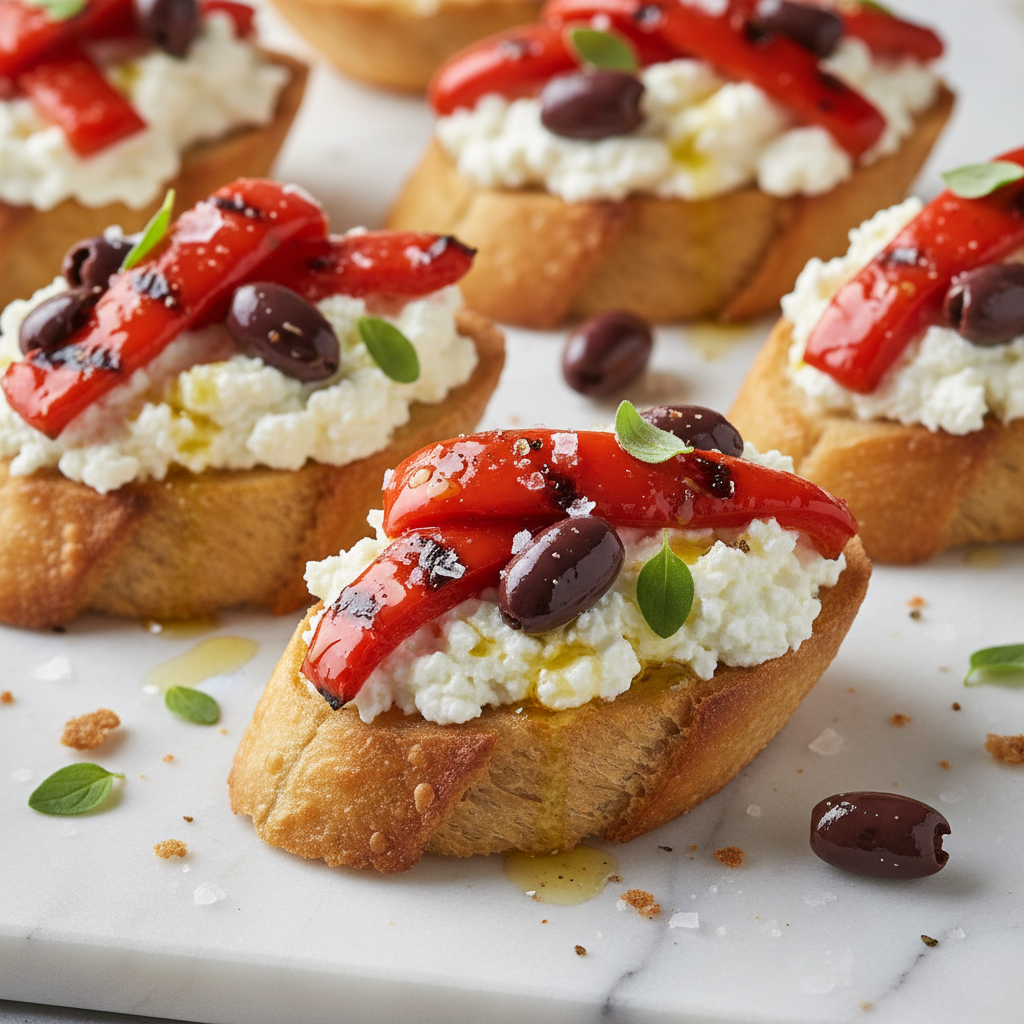
Whipped feta — Greek feta blended with cream cheese and olive oil until smooth, fluffy, and spreadable — is one of the most versatile preparations in the contemporary mezze and canapé canon. Salty, tangy, and creamy simultaneously, it improves every surface it touches. On a golden crostini with strips of oven-roasted red peppers, Kalamata olives, and a scatter of fresh oregano, it delivers a Mediterranean flavor profile that is simultaneously bold and refreshing.
The whipping technique (which became fashionable in the early 2010s via food media and restaurant menus) is simple: process feta with cream cheese and good olive oil until the texture transforms from crumbly and sharp to smooth, pillowy, and pipeable. The cream cheese reduces the salt intensity while adding body; the olive oil provides emulsification and richness. The result is something that tastes authentically of feta but is entirely different in texture.
About Greek Feta
Feta is one of the oldest cheeses in recorded history — descriptions of a similar cheese appear in Homer's Odyssey (the Cyclops Polyphemus making cheese in his cave is interpreted by food historians as feta production). Modern feta production is governed by a European Union DOP (Protected Designation of Origin) designation — only cheese made in specific regions of Greece (primarily Macedonia, Thrace, Epirus, Thessaly, Central Greece, Peloponnese, and Lesvos) from sheep's milk (or up to 30% goat's milk) can be labelled as "feta" in EU markets. In the United States, the designation is not yet enforced, and imported Greek PDO feta and domestic "feta-style" cheeses coexist on the market.
For this preparation, barrel-aged Greek feta (packed in brine) is dramatically better than pre-crumbled domestic alternatives — the flavor is sharper, the texture firmer, and the brine provides additional seasoning and depth.
Ingredients (makes 30 crostini): - 1 sourdough baguette, sliced thin on the diagonal (30 slices) - 3 tablespoons extra virgin olive oil for brushing
Whipped Feta: - 7 oz authentic Greek feta (PDO-certified, barrel-aged, packed in brine), roughly crumbled - 3 ½ oz full-fat cream cheese, at room temperature - 3 tablespoons excellent extra virgin olive oil - 1 tablespoon fresh lemon juice + zest of ½ lemon - 1 small garlic clove, grated - ½ teaspoon dried Greek oregano (dried is better than fresh for this preparation) - Cracked black pepper
Roasted Red Peppers: - 4 large red bell peppers (or 2 jars quality roasted red peppers, drained and patted very dry — Mezzetta or Divina brands) - 2 tablespoons extra virgin olive oil - 1 teaspoon sherry vinegar - 1 small garlic clove, minced - ½ teaspoon dried oregano - Pinch of red pepper flakes - Pinch of sugar
Assembly: - 2 ⅛ oz Kalamata olives, pitted and roughly sliced - 2 tablespoons capers, drained - Fresh oregano or thyme leaves - Good olive oil for finishing - Cracked black pepper and flaky sea salt
Roasted Red Peppers (if using fresh): Place whole peppers directly over a gas burner flame or under the broiler, turning every 2–3 minutes until charred and blistered on all sides. Place in a bowl, cover tightly with plastic wrap, and steam 15 minutes. Peel off the charred skin under cold running water. Remove seeds and stem. Tear into strips. Dress with olive oil, sherry vinegar, garlic, oregano, red pepper flakes, and sugar. (Can be made 4 days ahead; refrigerate in the dressing.)
Whipped Feta: Process feta, cream cheese, olive oil, lemon juice, lemon zest, and grated garlic in a food processor for 3–4 minutes until completely smooth, very light, and slightly fluffy. Add dried oregano and cracked pepper. Taste — the feta should be clearly present, tangy, and salty; the cream cheese should provide body and reduce the sharpness to a pleasant level. If too salty, add a little more cream cheese. Transfer to a piping bag. (Can be made 3 days ahead; refrigerate and re-process briefly before use.)
Crostini: Brush baguette slices with olive oil. Bake at 400°F for 8–10 minutes until deeply golden and crisp. Cool on a wire rack.
Assembly: Pipe a generous mound of whipped feta onto each crostino. Arrange 2–3 strips of roasted red pepper across the whipped feta. Place 3–4 Kalamata olive slices alongside. Add 2–3 capers. Tuck a fresh oregano sprig or thyme sprig at the base. Drizzle excellent olive oil over the entire crostino. Finish with cracked pepper and a pinch of flaky salt.
The Mimosa Pairing Logic: The Mediterranean flavor profile of feta, roasted pepper, and olive creates a natural pairing with citrus-forward and herb-accented mimosas. A grapefruit rosemary mimosa pairs with particular elegance — the rosemary's herbal note echoes the oregano while the grapefruit's bitterness matches the olive's complexity. A blood orange mimosa or cava-based mimosa are natural pairings for the preparation's Greek character. Avoid very sweet fruit-forward mimosas — the salt in the feta needs acid, not additional sweetness, as its pairing counterpoint.
Reference Links: - Authentic Greek feta PDO guide: Greek Foods - Whipped feta technique: Serious Eats - Roasting red peppers technique: The Kitchn - Mezzetta roasted red peppers: Mezzetta
Make-Ahead: Roasted red peppers (4 days, refrigerated); whipped feta (3 days, refrigerated); crostini (3 days, airtight). Assemble no more than 30 minutes before service — the crostini remain pleasantly crisp for about 30 minutes once topped.
Variations: - Add a layer of hummus beneath the whipped feta for a double-layer Mediterranean spread - Replace Kalamata olives with Castelvetrano olives (green, buttery, and mild) for a less assertive olive note - Top with a small amount of pomegranate molasses drizzle for a Middle Eastern-inspired dimension
Pro Tips: The cream cheese is the balancing element — too little and the feta's salinity is overwhelming; too much and the feta flavor is lost. The 2:1 feta-to-cream-cheese ratio is the tested balance. Processing long enough (3–4 full minutes) is essential for a smooth, pipeable texture — under-processed whipped feta is still grainy and lumpy. Use the highest-quality olive oil for finishing — it will be tasted directly and a mediocre olive oil will noticeably diminish the dish.
Rate this recipe
Be the first to rate this recipe
to submit your rating.
Recent Posts

Couscous Royale: North Africa's Grand Platter of Lamb, Chicken, and Merguez
October 14, 2026

Seattle Cream Cheese Dog Bites: Hadley Long's 1989 Pioneer Square Invention
October 14, 2026

Khao Soi: Chiang Mai's Northern Thai Coconut Curry Noodles
October 13, 2026

Korean Bibimbap: Jeonju's Joseon Dynasty Mixed Rice
October 11, 2026

Spaghetti alla Carbonara: Rome's World War II Pasta of Eggs, Guanciale, and Pecorino
October 9, 2026