Vietnamese Pho Cups with Beef and Herbs: The Early 20th-Century Hanoi Soup as an Elegant Party Shot
May 30, 2026
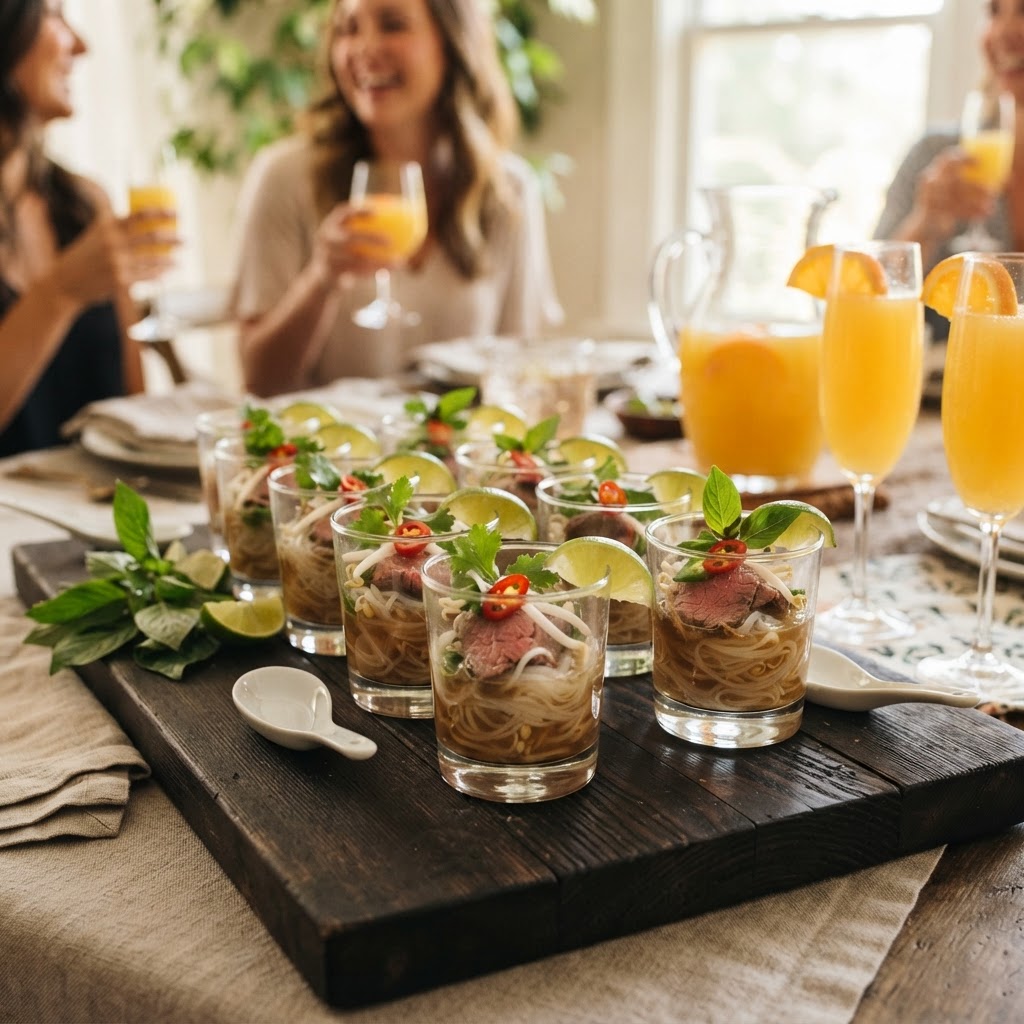
Pho cups are the Vietnamese national soup reimagined as a party shot, small glasses or cups filled with aromatic beef broth, thin rice noodles, sliced rare beef, bean sprouts, Thai basil, and a squeeze of lime, sized for a single slurp. They are the kind of appetizer that makes people pause, the fragrance of star anise and cinnamon rising from the glass, the warmth of the broth, the freshness of the herbs, before the party continues.
The History of Pho
Pho is a relatively recent dish, born in Northern Vietnam in the early 20th century. According to Wikipedia, pho first appeared in written records between 1900 and 1907, with residents of Nam Định Province, southeast of Hanoi, credited as its creators. The modern form emerged at the intersection of French colonialism and Chinese culinary tradition: the French demand for beef produced beef bones, which Chinese workers from Yunnan and Guangdong used to make a beef noodle soup called *ngưu nhục phấn*, the precursor to pho. The rice noodles and spices (star anise, cinnamon, cloves) connect to Chinese tradition, while the beef itself was a French colonial introduction, as the Vietnamese traditionally used water buffalo for farming, not food.
The word *phở* itself is debated. One theory derives it from the French *pot-au-feu*; another from the Cantonese *phấn* (rice noodles). Pho was originally sold as a snack at dawn and dusk by street vendors who shouldered mobile kitchens on carrying poles (*gánh phở*), one side a cauldron over a wood fire, the other storing noodles, spices, and cookware. The first fixed pho stands appeared in Hanoi around 1918. After the Vietnam War, refugees popularized pho throughout the world, and in 2017, Vietnam made December 12 the "Day of Pho."
About the Ingredients
Beef broth — the soul of pho: beef bones simmered for hours with charred onion, ginger, star anise, cinnamon, cloves, coriander seeds, and fish sauce; the broth should be clear, deeply aromatic, and savory.
Rice noodles — *bánh phở*, flat rice noodles, cooked and cut short for cups.
Rare beef — thinly sliced eye round or sirloin, added raw to the hot broth so it cooks gently in the cup; the beef should be sliced paper-thin, almost translucent.
Herbs — Thai basil, cilantro, bean sprouts, lime, sliced chili; the herbs are what make pho pho — they go in raw and bright.
Ingredients (makes 12 cups): - 4 cups beef pho broth (homemade or high-quality store-bought) - 4 oz thin rice noodles (bánh phở), cooked and cut into 1-inch pieces - 8 oz eye round or sirloin, sliced paper-thin against the grain - 1 cup bean sprouts - 1/2 cup Thai basil leaves - 1/4 cup cilantro leaves - 1 lime, cut into small wedges - 1 Thai chili, thinly sliced (optional) - 1 tbsp fish sauce (if broth needs adjustment) - 12 small cups or shot glasses
Instructions: Prepare the broth: if making from scratch, simmer beef bones with charred onion, charred ginger, star anise, cinnamon stick, cloves, coriander seeds, and fish sauce for 4–6 hours, skimming regularly, then strain and keep hot. If using store-bought, bring to a simmer and adjust with fish sauce. Place a small mound of rice noodles in each cup. Add a few bean sprouts. Lay 2–3 slices of raw beef on top — the beef will cook when the hot broth is poured. Pour the hot broth into each cup, covering the beef. Top with Thai basil, cilantro, a squeeze of lime, and a slice of chili. Serve immediately, while the broth is steaming and the beef is just turning from red to pink. Twelve cups, each one a miniature bowl of Hanoi.
The Mimosa Pairing Logic: Aromatic, spiced broth and bright sparkling citrus is a Vietnamese brunch. A lychee rose mimosa is the romantic pick — the lychee's floral sweetness mirrors the star anise in the broth, and the rose is Southeast Asia. A yuzu honey mimosa is the pan-Asian alternative — the yuzu's citrus-fragrance and honey's sweetness play against the warm spices. Either way, slurp the cup while the broth is hot, the herbs are bright, and the beef is just pink.
Reference Links: - Pho (1900–1907 Nam Định origin, French and Chinese influences): Wikipedia - Pho history and etymology: Wikipedia — Pho History
Make-Ahead: The broth can be made days ahead and kept refrigerated or frozen — in fact, it's better the next day, once the flavors have deepened. The noodles can be cooked and cut ahead. The herbs can be prepped and held in damp paper towels. But assemble at the last second: pour the hot broth over the raw beef just before serving, so the beef cooks gently and the herbs stay bright. A pho cup that sits is a pho cup with overcooked beef and wilted basil.
Pro Tips: Slice the beef paper-thin — freeze it for 20 minutes first, then slice against the grain; the thinner the slice, the more gently it cooks in the broth. Strain the broth until it's crystal clear — cloudy broth is not pho. Don't skip the star anise and cinnamon — they are the spices that make pho smell like pho. And serve the cups on a tray with a small dish of lime and chili, so each guest can adjust their own. The cup is ready when the broth is steaming, the beef is just pink, and the basil is bright green.
Rate this recipe
Be the first to rate this recipe
to submit your rating.
Recent Posts

Couscous Royale: North Africa's Grand Platter of Lamb, Chicken, and Merguez
October 14, 2026

Seattle Cream Cheese Dog Bites: Hadley Long's 1989 Pioneer Square Invention
October 14, 2026

Khao Soi: Chiang Mai's Northern Thai Coconut Curry Noodles
October 13, 2026

Korean Bibimbap: Jeonju's Joseon Dynasty Mixed Rice
October 11, 2026

Spaghetti alla Carbonara: Rome's World War II Pasta of Eggs, Guanciale, and Pecorino
October 9, 2026