Vermont Maple Baked Beans with Brown Bread: New England's Saturday-Night Tradition
May 14, 2026
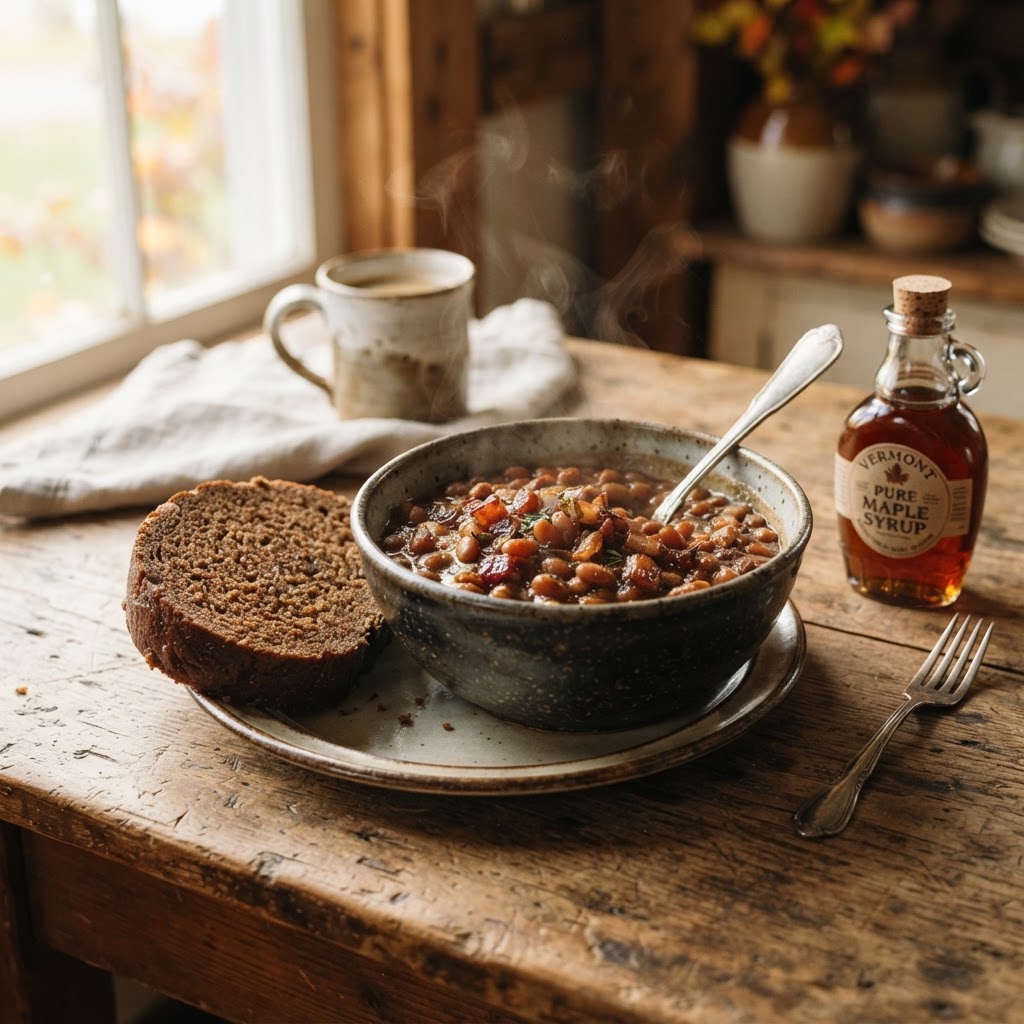
Baked beans with brown bread is the old New England Saturday-night tradition — navy or pea beans slow-baked in molasses and salt pork until dark, syrupy, and tender, served beside a slice of steamed brown bread made with cornmeal, rye, and whole-wheat flour. According to New England Today, "baked beans, steamed brown bread … more than 300 years of family history in New England," and the Pilgrims would bake beans Saturday night so they wouldn't have to cook on the Sabbath. Jane Stanford records the tradition of "Saturday Night Fare: Baked Beans and Steamed Brown Bread," noting that early settlers from the British Isles substituted molasses for the maple syrup and salt pork for the bear fat, but kept the tradition of slow cooking the beans. Elisabet Joan Roca notes that in Vermont, maple sugar is sometimes still used to make the dish, and it was a Saturday dinner tradition.
In Vermont, the maple is the local note — maple sugar or maple syrup sweetens the beans in place of the molasses of Boston, and the whole dish takes on a softer, woodsy sweetness. The brown bread, steamed in a can or mold, is dense, dark, and slightly sweet — the perfect foil for the beans.
About the Ingredients
Beans — navy, pea, or soldier beans, soaked overnight and slow-baked 6–8 hours until tender.
Sweetener — Vermont maple syrup or maple sugar (the Vermont variation), or molasses (the Boston original); the maple gives a softer, woodsy sweetness.
Salt pork — a piece of salt pork buried in the beans gives the richness and the salt; bacon is a fair substitute.
Brown bread — cornmeal, rye flour, and whole-wheat flour, with molasses and buttermilk, steamed in a can or mold for 2–3 hours until dense and dark.
Ingredients (serves 8): For the beans: - 1 lb navy or pea beans, soaked overnight - 1/2 lb salt pork, rind scored, or thick-cut bacon - 1 small onion, chopped - 1/2 cup Vermont maple syrup (or molasses) - 1 tsp dry mustard - 1 tsp salt - 1/2 tsp black pepper - Boiling water to cover
For the brown bread: - 1 cup cornmeal - 1 cup rye flour - 1 cup whole-wheat flour - 1 tsp baking soda - 1 tsp salt - 1/2 cup molasses - 2 cups buttermilk - 1 cup raisins (optional)
Instructions: Drain the soaked beans and put them in a heavy bean pot or Dutch oven. Bury the salt pork (or bacon) in the beans, rind up. Mix the maple syrup, mustard, salt, pepper, and onion; pour over the beans. Add boiling water just to cover. Cover and bake at 300°F (302°F) for 6 hours, checking once to add water if dry. Uncover for the last hour to develop a dark, syrupy top. (Vermont bean-hole bakers dig a pit, line it with hot coals, and bury the pot for a full day — the home version in the oven is simpler and nearly as good.)
Make the brown bread: butter a 2-quart mold or two 1-pound coffee cans. Whisk the cornmeal, rye and wheat flours, baking soda, and salt. Stir in the molasses, buttermilk, and raisins. Scrape into the mold, filling two-thirds full; cover tightly with foil. Set the mold on a rack in a deep pot; add boiling water halfway up the sides. Cover and steam 2 1/2 hours, adding water as needed, until a tester comes out clean. Unmold and slice.
Serve the hot beans in bowls with a slice of steamed brown bread, buttered. The leftovers make the famous New England baked-bean sandwich on Sunday morning — cold beans on buttered bread.
The Mimosa Pairing Logic: The deep, maple-sweet beans and the dense brown bread want a bright, refreshing drink that can cut the sweetness and lift the molasses. A classic Champagne mimosa is the safe and perfect choice — the citrus balances the maple sweetness and the wine's effervescence refreshes the palate of the rich beans. A pomegranate mimosa is equally lovely, the tart pomegranate a bright contrast to the dark, sweet beans. This pairing is, in its way, the brunch equivalent of baked beans and a cup of strong New England coffee — a sparkling toast to Vermont and the Saturday-night bean supper.
Reference Links: - Franks and Beans: A Saturday Night Tradition (Pilgrim origins): New England Today / Yankee Magazine - Saturday Night Fare: Baked Beans and Steamed Brown Bread: Jane Stanford - Boston Baked Beans: A History (Vermont maple sugar): Elisabet Joan Roca
Make-Ahead: Baked beans are the great make-ahead dish — they improve overnight, and the tradition is to bake them Saturday for Saturday supper and Sunday breakfast. The brown bread can be steamed a day ahead and reheated by steaming. Both freeze well. Soak the beans the night before; the slow bake is the whole afternoon.
Pro Tips: Soak the beans overnight; quick-soaked beans cook unevenly. Bake the beans long and slow at a low temperature; high heat makes the skins tough. Keep the beans just covered with liquid so they stay saucy, not dry. The maple is the Vermont note — use a good, dark amber syrup; the lighter the syrup, the thinner the flavor. Steam the brown bread, don't bake it; the steaming gives the dense, moist crumb that is the bread's character. Don't skip the brown bread; the beans and the bread are one dish, not two.
Rate this recipe
Be the first to rate this recipe
to submit your rating.
Recent Posts

Couscous Royale: North Africa's Grand Platter of Lamb, Chicken, and Merguez
October 14, 2026

Seattle Cream Cheese Dog Bites: Hadley Long's 1989 Pioneer Square Invention
October 14, 2026

Khao Soi: Chiang Mai's Northern Thai Coconut Curry Noodles
October 13, 2026

Korean Bibimbap: Jeonju's Joseon Dynasty Mixed Rice
October 11, 2026

Spaghetti alla Carbonara: Rome's World War II Pasta of Eggs, Guanciale, and Pecorino
October 9, 2026