Turkish Delight (Lokum): The Rosewater Sugar Confection of Istanbul
May 4, 2026
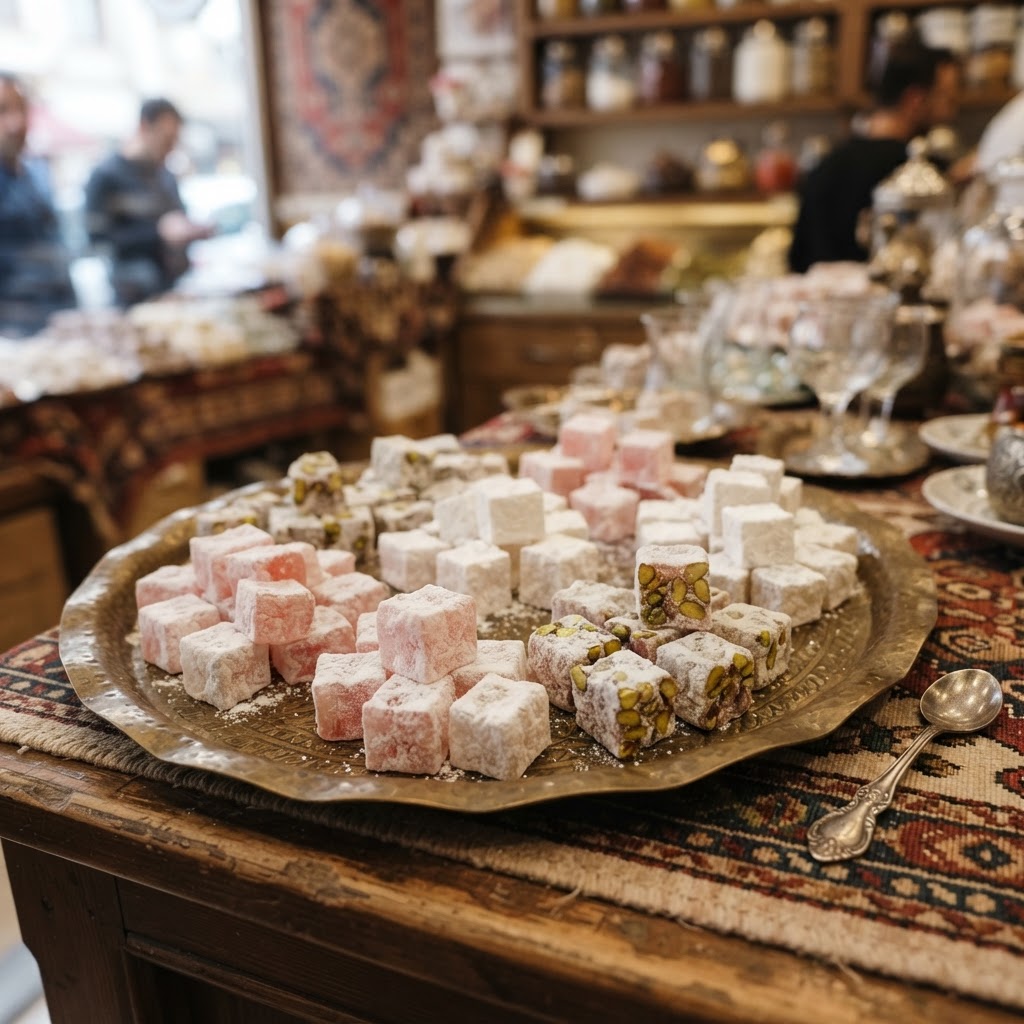
Turkish delight — *lokum* — is the great confection of Turkey: small, soft, jewel-like cubes of sugar and cornstarch jelly, flavored with rosewater, lemon, or bergamot, often studded with pistachios or hazelnuts, dusted with a snow of powdered sugar to keep them from sticking, a candy made in Istanbul for nearly five centuries and immortalized in the West by C.S. Lewis, who made it the enchanted treat that leads Edmund into the White Witch's snare in *The Lion, the Witch and the Wardrobe*. According to Wikipedia, Turkish delight is a sweet made of starch and sugar, and the Turkish names *lokma* and *lokum* are derived from the Arabic *luqma(t)*; in English it was formerly known as "lumps of delight," and the confection is widely believed to have been invented in Istanbul by Bekir Effendi, who arrived from Anatolia in the late 18th century and established his confectionery in the Bahçekapı district, where his shop, Hacı Bekir, still stands. Lokum SB calls Turkish delight "one of the oldest sweets in the world, going back almost 500 years," and notes that Bekir Efendi is credited with perfecting the modern lokum by combining sugar and cornstarch (*nişasta*) into the smooth, soft jelly that characterizes the confection.
The genius of Turkish delight is the texture: the cornstarch and sugar, boiled together with water to a thick, glossy paste and flavored, set into a soft, elastic, melt-in-the-mouth jelly that is unlike any other candy — neither gummy nor hard nor chewy, but yielding and fragrant, dissolving into a perfumed sweetness. Rose is the classic flavor, the petals' scent carried in a few drops of rosewater, and the pistachio-studded version is the most beautiful, the pale pink jelly veined with green nuts and cut into cubes under a drift of powdered sugar.
About the Ingredients
Sugar and cornstarch — the base of the jelly; sugar for sweetness and cornstarch (*nişasta*) for the soft, elastic, yielding texture that characterizes lokum. The cornstarch is the genius of Bekir Effendi's recipe.
Water — boiled with the sugar and cornstarch to a thick paste; the long cooking is what sets the jelly.
Flavoring — rosewater is the classic and most enduring, but lemon, bergamot, mint, and mastic are also traditional; a few drops of rosewater perfume the whole batch.
Nuts — pistachios are the classic, blanched and stirred into the jelly before it sets; hazelnuts and walnuts are also traditional, and the rose-pistachio lokum is the most famous.
Powdered sugar and a little cornstarch — the finishing dust, a mix of powdered sugar and a little cornstarch, prevents the cubes from sticking together and gives them their characteristic snowy coating.
Cream of tartar — a pinch, to prevent the sugar from crystallizing during the long boil.
Ingredients (makes one 8×8-inch pan, about 36 pieces): - 4 cups granulated sugar - 4 1/2 cups water, divided - 1 cup cornstarch - 1 tsp cream of tartar - 1 tbsp rosewater (or to taste) - 1 cup shelled pistachios (optional) - 1/2 cup powdered sugar, mixed with 2 tbsp cornstarch, for dusting - A few drops of pink food coloring (optional, for the classic rose color)
Instructions: Line an 8×8-inch pan with foil or parchment and oil it lightly. In a saucepan, whisk 4 cups of the sugar, the cream of tartar, and 3 cups of water. Bring to a boil over medium heat, stirring until the sugar dissolves, then cook without stirring until it reaches 240°F (soft-ball). Remove from the heat.
In another saucepan, whisk the cornstarch into the remaining 1 1/2 cups of water until smooth. Cook over medium heat, whisking constantly, until thickened to a paste. Gradually whisk the hot sugar syrup into the cornstarch paste. Return to the heat and cook, whisking frequently, for about 1 hour over low heat, until the mixture is thick, glossy, and pulls away from the sides — it should be a translucent, elastic paste.
Off the heat, stir in the rosewater, pink food coloring if using, and the pistachios. Pour into the prepared pan and smooth the top. Let set, uncovered, overnight, until firm and no longer tacky.
Invert the set lokum onto a board dusted with the powdered-sugar-cornstarch mixture. Cut into small cubes with an oiled knife. Toss the cubes in the powdered-sugar mixture to coat. Store in an airtight container between layers of parchment.
The Mimosa Pairing Logic: The soft, perfumed, rose-scented jelly wants a bright, floral drink that echoes the rose and cuts the sweetness. A lavender elderflower mimosa is the inspired match — the elderflower nods to the confection's delicacy and the lavender is a beautiful floral echo of the rosewater. A raspberry rose champagne mimosa is equally right, the rose a direct mirror of the lokum and the raspberry a bright, tart counter to the sugar. This is the brunch equivalent of a cube of rose lokum and a tiny cup of strong Turkish coffee — a sparkling toast to Istanbul and Hacı Bekir's confection.
Reference Links: - Turkish delight (starch and sugar, Arabic *luqma*, "lumps of delight", Bekir Effendi): Wikipedia - History of Turkish Delight (Bekir Efendi, almost 500 years, cornstarch): Lokum SB
Make-Ahead: Turkish delight must be made a day ahead — it needs to set overnight before cutting. Once cut and coated, it keeps 2 weeks in an airtight container between layers of parchment, at room temperature. Do not refrigerate; the cold makes the jelly weep and the sugar coating dissolve. The cubes can be re-dusted with powdered sugar if they become sticky. The long, hour-long cook is non-negotiable; an under-cooked lokum never sets.
Pro Tips: Use a candy thermometer; the sugar syrup must reach soft-ball (240°F), and the cornstarch mixture must cook for a full hour to set properly — under-cooking makes a soup that never firms. Whisk frequently during the long cook; the cornstarch catches and burns on the bottom, and scorched lokum tastes of it. Use genuine rosewater, not rose extract; the two are different, and rosewater's delicate perfume is what characterizes the classic lokum. Oil the knife before cutting; un-oiled, the sticky jelly drags and tears. Coat the cubes generously in the powdered-sugar-cornstarch mix; the coating is what keeps them separate, and bare cubes fuse back together overnight. Let it set overnight, uncovered; a covered lokum stays tacky from trapped moisture, and an uncovered one sets firm.
Rate this recipe
Be the first to rate this recipe
to submit your rating.
Recent Posts

Couscous Royale: North Africa's Grand Platter of Lamb, Chicken, and Merguez
October 14, 2026

Seattle Cream Cheese Dog Bites: Hadley Long's 1989 Pioneer Square Invention
October 14, 2026

Khao Soi: Chiang Mai's Northern Thai Coconut Curry Noodles
October 13, 2026

Korean Bibimbap: Jeonju's Joseon Dynasty Mixed Rice
October 11, 2026

Spaghetti alla Carbonara: Rome's World War II Pasta of Eggs, Guanciale, and Pecorino
October 9, 2026