The Negroni: Florence's Bitter Apéritif Icon
September 9, 2026
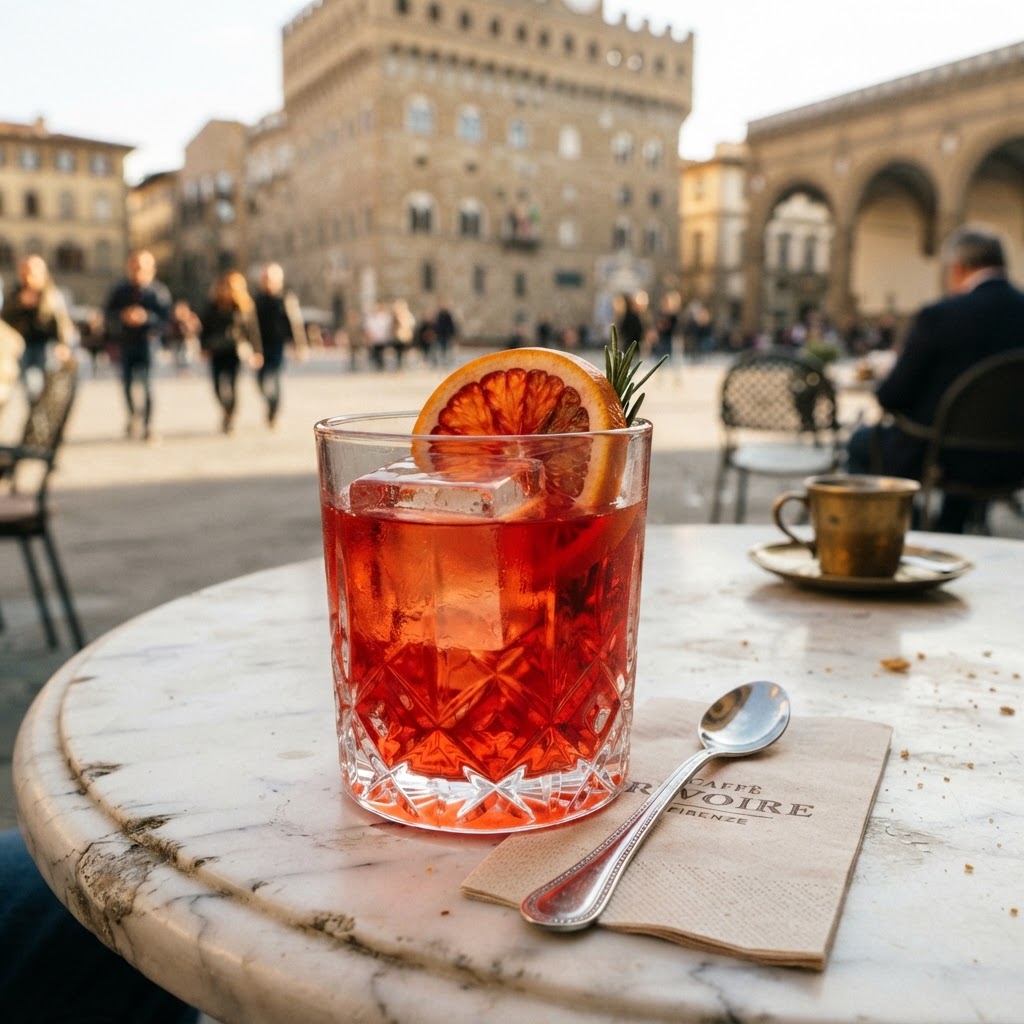
The Negroni is a perfectly balanced cocktail — equal parts gin, sweet vermouth, and Campari, stirred over ice and garnished with a slice of orange, a drink of vivid ruby-red and bracing bittersweet complexity that has become the universal symbol of the Italian aperitivo hour. According to Wikipedia, the Negroni was created in Florence in 1919–20 by Count Camillo Negroni of Fiesole, who frequented the aristocratic Caffè Casoni on Via de' Tornabuoni and, wanting to vary from his usual Americano (Campari, vermouth, and soda), asked the bartender to replace the soda water with gin in honor of his time in New York. The new drink became known as the "Americano in the style of Count Negroni" and later simply took the count's name. The IBA's official recipe is one part gin, one part sweet red vermouth, and one part Campari, built over ice and garnished with an orange peel or slice.
The genius of the Negroni is the equal-parts trinity: the gin's juniper bite, the vermouth's winey sweetness, and the Campari's bitter-orange depth cancel and complete one another so precisely that no single ingredient dominates. It is a drink that is somehow both bracing and soothing, bitter and sweet, strong and light — and at roughly 24% ABV, it is sessionable in a way few spirit-forward cocktails are.
About the Ingredients
Gin — a London Dry (Beefeater, Tanqueray) gives classic juniper backbone; for a more botanical, modern Negroni, a contemporary gin like Hendrick's or Monkey 47 works beautifully. The gin should be assertive enough to stand up to Campari.
Sweet vermouth — a quality red vermouth (Carpano Antica, Cocchi Torino, or Martini & Rossi Riserva) provides winey, vanilla-tinged sweetness and body; keep it refrigerated once opened, as vermouth is a fortified wine that oxidizes.
Campari — the brilliant-red Italian bitter liqueur created by Gaspare Campari in Novara in 1860, made from an infusion of herbs, aromatic plants, and fruit in alcohol and water; its bitter-orange, rhubarb, and gentian character is the soul of the drink and non-negotiable.
Orange — a slice or a wide peel, expressed over the drink; the orange oils brighten the Campari and tie the trio together.
Ingredients (makes 1): - 1 oz gin - 1 oz sweet red vermouth - 1 oz Campari - 1 orange slice or a wide orange peel
Instructions: Fill a rocks glass with a large ice cube (or several smaller cubes). Add the gin, sweet vermouth, and Campari. Stir gently for about 20–30 seconds until well-chilled and properly diluted. Express the orange peel oils over the surface by bending it skin-side-down over the glass, then drop it in (or rest the slice on the rim). Serve.
The Mimosa Pairing Logic: The Negroni's bitter Campari wants a mimosa with parallel complexity and a touch of bitterness to harmonize. A grapefruit rosemary mimosa is the perfect brunch partner — the grapefruit's natural naringin bitterness mirrors Campari, and the rosemary echoes the drink's herbal depth. A classic Champagne mimosa is the lighter foil, its clean citrus cutting the bittersweet weight. This is the brunch equivalent of a Negroni at a Florentine café and a glass of Prosecco at the next table — a toast to Caffè Casoni and Count Negroni.
Reference Links: - Negroni (Count Camillo Negroni, Florence 1919–20, Caffè Casoni, Americano, equal parts): Wikipedia
Make-Ahead: The Negroni is ideal for batching — because it is all spirit (no juice or soda to degrade), it can be pre-mixed in a bottle and kept in the freezer indefinitely; simply pour over ice and garnish to order. For a brunch, pre-bottle a pitcher and let guests pour their own. Keep sweet vermouth refrigerated; it is the only perishable ingredient. Stir, never shake — shaking over-dilutes and clouds the ruby clarity.
Pro Tips: Use quality vermouth, not the dusty bottle from the back of the cabinet — vermouth is a wine, and stale vermouth ruins a Negroni. Keep vermouth refrigerated after opening; it lasts a month, not forever. Use a large single ice cube — small cubes melt fast and over-dilute; a big cube keeps the drink cold and strong. Stir, don't shake — the Negroni's beauty is its clarity and silky texture, and shaking bruises it. Express the orange peel — the oil is a genuine flavor layer, and a peel merely dropped in is decorative. Taste and adjust the gin if Campari overwhelms; a more assertive gin rebalances the drink.
Rate this recipe
Be the first to rate this recipe
to submit your rating.
Recent Posts

Couscous Royale: North Africa's Grand Platter of Lamb, Chicken, and Merguez
October 14, 2026

Seattle Cream Cheese Dog Bites: Hadley Long's 1989 Pioneer Square Invention
October 14, 2026

Khao Soi: Chiang Mai's Northern Thai Coconut Curry Noodles
October 13, 2026

Korean Bibimbap: Jeonju's Joseon Dynasty Mixed Rice
October 11, 2026

Spaghetti alla Carbonara: Rome's World War II Pasta of Eggs, Guanciale, and Pecorino
October 9, 2026