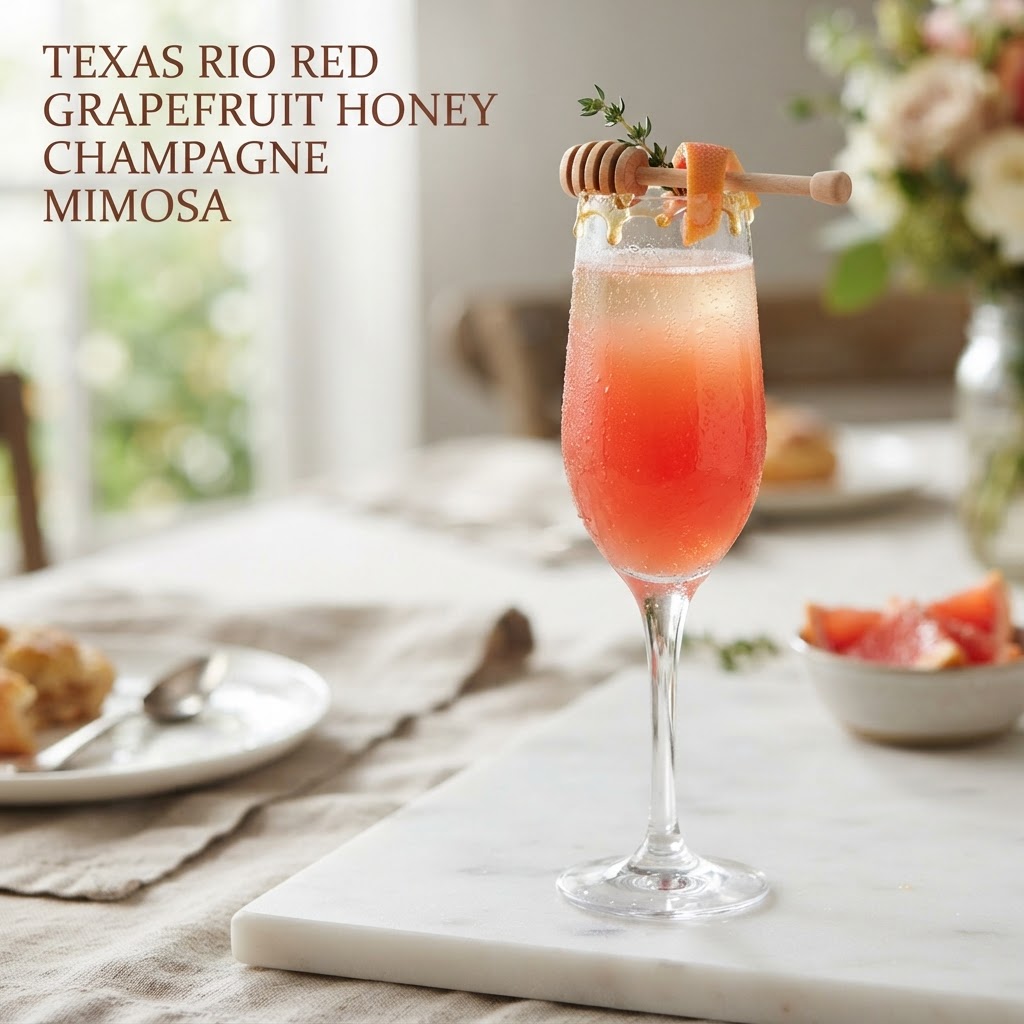
The Texas Rio Red Grapefruit Honey Champagne Mimosa
August 14, 2026
On March 30, 1929, in a grapefruit orchard near McAllen, in the Rio Grande Valley of South Texas, a single limb on a pink Thompson grapefruit tree quit doing what the rest of the tree was doing — its buds had mutated, producing fruit with flesh of an extraordinary, lycopene-rich red. The farmer who found it, A. E. Henninger, propagated the bud, and in 1934 the resulting "Ruby Red" became the first grapefruit ever granted a United States patent. Later, in the 1970s, Dr. Richard Hensz of the Texas A&I Citrus Center irradiated Ruby Red budwood with thermal neutrons to produce the Rio Red, a cultivar with flesh roughly five times as red as the original 1929 mutation. The Texas red grapefruit was designated the official state fruit of Texas in the early 1990s.
The Rio Red's flesh is a flaming crimson, its flavor sweeter and less bitter than the white and pink grapefruits that came before it. That sweetness, balanced by the grapefruit's natural tartness and a whisper of honey, makes it one of the finest brunch juices in the American citrus canon — and a mimosa of remarkable, glowing color.
About Rio Red Grapefruit
The grapefruit (Citrus paradisi) is the youngest member of the citrus family, a hybrid of the pomelo and the sweet orange that first appeared in the West Indies around the 1700s. The red-fleshed Texas varieties (Ruby Red, Rio Star, Rio Red) owe their crimson color to lycopene, the same antioxidant that colors tomatoes and watermelon. The Rio Grande Valley's sandy soils and warm days produce fruit of exceptional sweetness. Reference: Texas Citrus Industry — Our History
For a mimosa, only fresh-squeezed Rio Red juice will do — the bottled juice is paler, thinner, and lacking the fresh, aromatic oils of the peel. If Rio Reds are unavailable, Ruby Red or Rio Star grapefruit from Texas is the equivalent.
Rio Red Grapefruit-Honey Base: - 3 large Rio Red grapefruits, juiced (about 1½ cups juice) - 2 tablespoons mild honey (orange blossom or clover) - 1 tablespoon fresh lemon juice
Juice the grapefruits and strain out the pulp and seeds. Warm the honey briefly in the microwave (5 seconds) so it dissolves easily, then whisk it into the grapefruit juice along with the lemon juice. Taste — it should be sweet-tart, with the honey rounding the grapefruit's natural bitterness without masking it. Chill thoroughly. The juice should be a vivid, translucent ruby-red. Use within 24 hours.
Ingredients (serves 6): - 1 cup Rio Red grapefruit-honey base (above) - 1 bottle (25 oz chilled Champagne Brut NV or Blanc de Blancs (Blanc de Blancs — such as Pierre Peters Cuvée de Réserve — provides the crisp, citrus-mineral character that complements the grapefruit's sweetness; Champagne Brut NV provides more structure) - A thin ruby-red grapefruit twist and a small honey drizzle for garnish - Optional: a pinch of flaky sea salt on the foam
Instructions: Chill Champagne flutes for 5 minutes. Pour 1½ oz of the Rio Red grapefruit-honey base into each flute. Top slowly with chilled Champagne, pouring down the side. The ruby-red juice will bloom through the pale wine in luminous coral-crimson gradients. Garnish with a thin grapefruit twist expressed over the glass and a delicate honey drizzle on the foam. Finish with a pinch of flaky sea salt if using.
For a Mimosa Bar (serves 12): - 2 cups Rio Red grapefruit-honey base - 2 bottles Champagne Brut or Blanc de Blancs, chilled - Ruby-red grapefruit twists and honey for garnish
Variations: - Add ½ oz of tequila (blanco) per serving for a Texas Paloma Mimosa that leans into the grapefruit's regional character. - Replace Champagne with sparkling rosé for a deeper coral-salmon hue. - Add a sprig of rosemary expressed over the glass for an aromatic, savory counterpoint to the honey.
Mimosa Pairing Logic: The Rio Red's sweet-tart depth and the honey's floral warmth call for a Champagne with bright, citrus-mineral acidity that cuts through the sweetness while complementing the grapefruit's bitterness. The wine's toasty notes echo the honey's warmth. For a related pour, the Pink Grapefruit Rosemary Champagne Mimosa is the herb-forward cousin, and the St-Germain Mimosa shares the floral-honey-over-Champagne logic.
Reference Links: - The Glory of the Grapefruit (1929 McAllen mutation, state fruit): Texas Monthly - Texas Citrus Industry history (Ruby Red, first grapefruit US patent 1934): Texas Citrus Mutual
Make-Ahead: Rio Red grapefruit-honey base (24 hours, refrigerated — fresh grapefruit juice loses brightness after a day). Assemble per glass just before serving.
Pro Tips: Fresh-squeezed is non-negotiable: bottled grapefruit juice is pasteurized and flat, lacking the aromatic peel oils that give the drink its lift. Choose grapefruits that feel heavy for their size; they hold more juice. The honey should be a mild variety (orange blossom is ideal), as strong buckwheat or manuka honey overwhelms the grapefruit. The pinch of flaky sea salt is not a gimmick: it suppresses bitterness and amplifies sweetness, making the grapefruit read as sweeter without added sugar. Strain the juice thoroughly, because pulp clouds the clean, luminous gradient that makes this drink so visually striking.
Rate this recipe
Be the first to rate this recipe
to submit your rating.
Perfect Mimosa Pairings
Mimosas that pair perfectly with this dish
Recent Posts

Couscous Royale: North Africa's Grand Platter of Lamb, Chicken, and Merguez
October 14, 2026

Seattle Cream Cheese Dog Bites: Hadley Long's 1989 Pioneer Square Invention
October 14, 2026

Khao Soi: Chiang Mai's Northern Thai Coconut Curry Noodles
October 13, 2026

Korean Bibimbap: Jeonju's Joseon Dynasty Mixed Rice
October 11, 2026

Spaghetti alla Carbonara: Rome's World War II Pasta of Eggs, Guanciale, and Pecorino
October 9, 2026