Sugar Cream Pie: Indiana's Hoosier State Pie
August 16, 2026
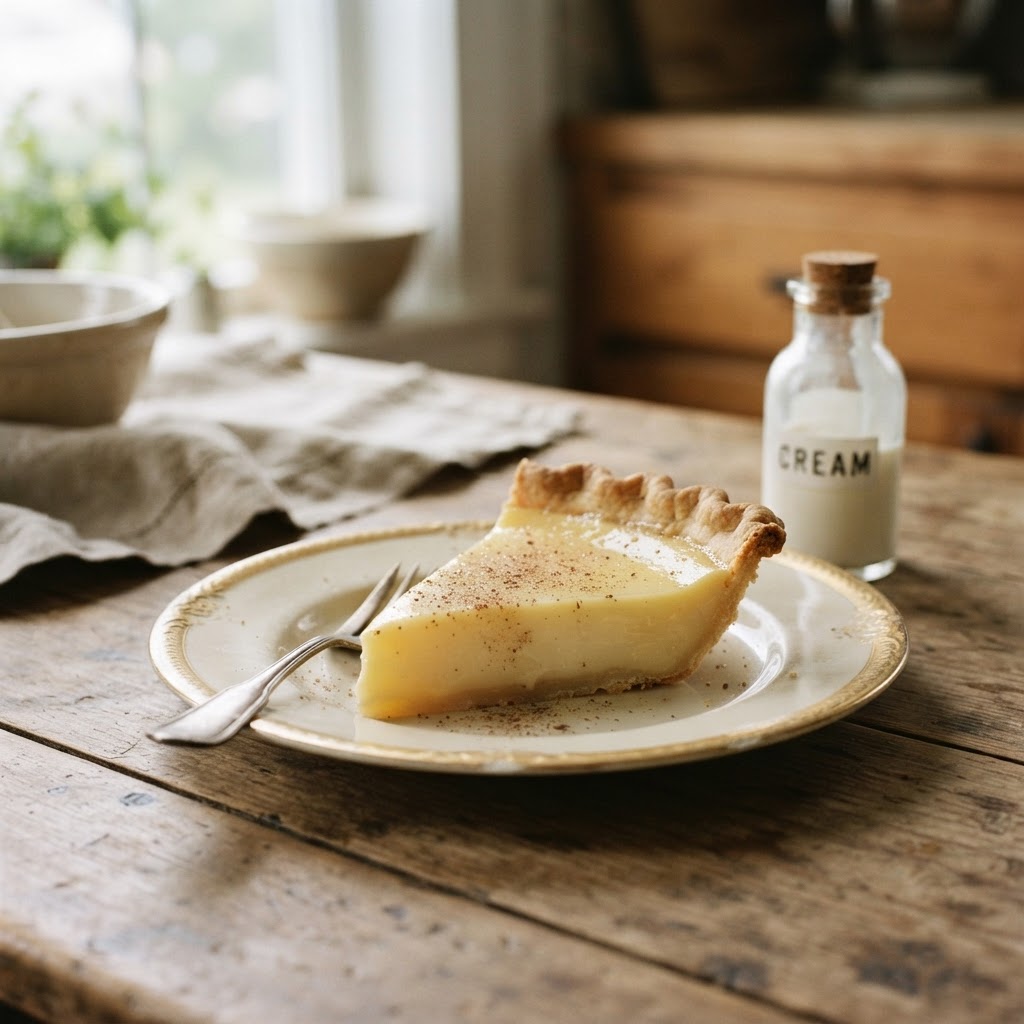
The sugar cream pie is the pie of Indiana — a single-crust pie filled with a simple, silky custard of cream, sugar, and a little flour, baked until golden and just set, dusted with a drift of nutmeg, a dessert so identified with the state that the Indiana legislature named it the official state pie in 2009. It is a "desperation pie," born of the Amish and Shaker kitchens of the early 1800s, when a pie could be made from what every pantry held — sugar, cream, flour, and butter — without eggs, without fruit, without anything fresh, a thrifty, elegant invention of rural plenty. According to Wikipedia, the pie has been made in Indiana since the state's founding in 1816, and there is a general consensus that a "true" sugar cream pie does not include eggs; it is a custard of sugar, cream, and flour in a pie crust, and it became Indiana's official state pie in 2009. The Indiana Historical Society records that the sugar cream pie tradition pre-dates Indiana statehood, beginning with the migration of Shaker communities to eastern Indiana, and that the pie falls under the category of "desperation pie" — a pie that could be made from pantry staples at any time of the year.
The genius of the sugar cream pie is its emptiness. There is no fruit, no eggs, no flavoring but vanilla and nutmeg — only cream, sugar, and a little flour to thicken it, baked in a buttery crust until the top is golden and slightly crinkled and the center is a soft, trembling custard. The simplicity is the sophistication: the pie tastes of pure, sweet cream, and its texture is silky and yielding, like the softest crème caramel, with a faint, golden, caramelized top from the long bake.
About the Ingredients
Cream — heavy cream or a blend of cream and whole milk, the body of the filling; the cream is the flavor, the richness, and the texture of the pie, and there is nothing to hide behind.
Sugar — granulated sugar, dissolved into the cream; the pie is intentionally, unapologetically sweet, and the sugar is the second of only four ingredients.
Flour — a little all-purpose flour (or cornstarch) to thicken the cream into a soft, sliceable custard; the flour is the stabilizer, and without it the pie is a pouring cream.
Butter and vanilla — a little butter, melted, for richness and a glossy top; vanilla for aroma.
Nutmeg — a dusting of freshly grated nutmeg over the top before baking, the traditional Indiana finish; the nutmeg is the single spice and the only thing that interrupts the pure cream-and-sugar flavor.
Pie crust — a single, blind-baked bottom crust of butter or lard pastry; the crust provides the structure and the salt that balances the sweet.
Ingredients (makes one 9-inch pie): - 1 unbaked 9-inch pie crust (homemade or store-bought) - 2 cups heavy cream (or 1 cup cream + 1 cup whole milk) - 1 cup granulated sugar - 1/4 cup all-purpose flour - 1/4 cup (1/2 stick) unsalted butter, melted - 1 tsp vanilla extract - 1/4 tsp salt - Freshly grated nutmeg, for the top
Instructions: Preheat the oven to 350°F. Fit the pie crust into a 9-inch pie dish and crimp the edges; chill 15 minutes. In a bowl, whisk the cream, sugar, flour, melted butter, vanilla, and salt until smooth (the sugar will not fully dissolve). Pour into the crust.
Bake 45–55 minutes until the filling is set around the edges and still trembling slightly in the center, and the top is golden and slightly crinkled. Dust with freshly grated nutmeg in the last 10 minutes of baking, or sprinkle over the hot pie as it comes out of the oven. Cool completely on a rack before slicing; the pie sets as it cools, and a warm slice is a runny slice. Serve at room temperature or chilled.
The Mimosa Pairing Logic: The pure, sweet cream and the faint nutmeg want a bright, aromatic drink that echoes the spice and cuts the richness. A honeyed chamomile lemon prosecco mimosa is the inspired match — the honey mirrors the sweet cream and the chamomile is a soft floral echo of the nutmeg. A classic Champagne mimosa is equally right, the orange a bright, acidic counter to the sweet, creamy custard. This is the brunch equivalent of a slice of sugar cream pie and a cup of strong Hoosier coffee — a sparkling toast to Indiana and the desperation pie that became a state symbol.
Reference Links: - Sugar cream pie (Indiana, 1816, no eggs, official state pie 2009): Wikipedia - Desperate for Pie (Shaker communities, eastern Indiana, desperation pie): Indiana Historical Society
Make-Ahead: The sugar cream pie must be made ahead and cooled completely — it is best the day after it is baked, when fully set and cold, and it cannot be sliced warm without falling apart. It keeps 3 days refrigerated. The crust can be made and chilled a day ahead. Bake in the lower third of the oven for a crisp bottom crust; a soggy bottom is the failure mode of a cream pie, and a hot oven floor sets the crust before the filling saturates it.
Pro Tips: Do not add eggs; a true sugar cream pie is a flour-thickened cream custard, and eggs make it a different, heavier pie (closer to a buttermilk pie or a chess pie). Whisk the flour into the cream until smooth; lumps of flour bake into floury pockets that mar the silky texture. Bake until the center still trembles; an overbaked sugar cream pie is grainy and split, and a properly baked one is soft and just set. Cool completely before slicing; the pie sets as it cools, and a warm slice is a runny soup. Dust with nutmeg; the nutmeg is the single, traditional spice, and it is the only thing that cuts the pure sweetness of the cream. Use a hot oven floor for a crisp crust; a cream pie's worst failure is a soggy bottom, and baking low in the oven with a preheated baking sheet sets the crust first.
Rate this recipe
Be the first to rate this recipe
to submit your rating.
Recent Posts

Couscous Royale: North Africa's Grand Platter of Lamb, Chicken, and Merguez
October 14, 2026

Seattle Cream Cheese Dog Bites: Hadley Long's 1989 Pioneer Square Invention
October 14, 2026

Khao Soi: Chiang Mai's Northern Thai Coconut Curry Noodles
October 13, 2026

Korean Bibimbap: Jeonju's Joseon Dynasty Mixed Rice
October 11, 2026

Spaghetti alla Carbonara: Rome's World War II Pasta of Eggs, Guanciale, and Pecorino
October 9, 2026