Southern Cathead Biscuits with Sawmill Gravy: The Appalachian Lumber Camp Breakfast
August 28, 2026
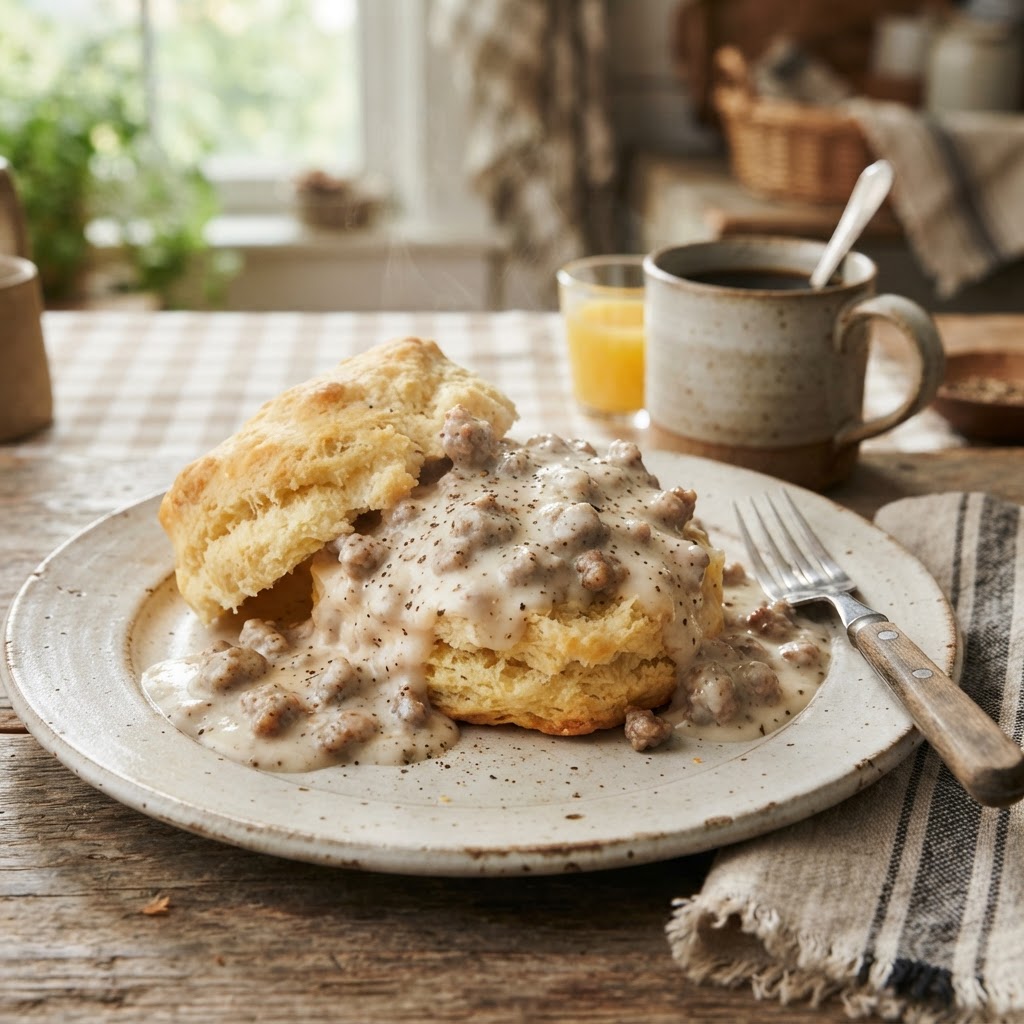
Cathead biscuits with sawmill gravy are the great breakfast of the Southern Appalachian mountains — enormous, rustic, hand-shaped biscuits, so large they are said to be the size of a cat's head, split open and smothered in a creamy white sausage gravy that takes its name from the lumber camps where it was born. According to 1885 Grill, the dish has been found on Southern tables for decades, with some believing it originated during the Revolutionary War while others trace it to the Southern Appalachian lumber mills of the 1800s — hence the name "sawmill gravy," because it was first made by lumber camp cooks who used coarsely ground cornmeal in the gravy before flour became cheap and abundant. Mashed records that sawmill gravy is "named for the Appalachian workers who ate it" and that its popularity "partly stemmed from how cheap it was" — a hearty, high-calorie breakfast for the men who worked the sawmills and needed a meal that would sustain them through a day of physical labor.
The genius of cathead biscuits is their size and their texture: unlike beaten biscuits (which are hard, crisp, and kneaded for an hour) or standard rolled biscuits (which are neat and uniform), cathead biscuits are enormous, rough, drop biscuits — the dough is barely mixed, patted into shape by hand, and baked so that the outside is golden and the interior is impossibly soft and flaky, with layers that pull apart in sheets. Split open and flooded with sawmill gravy — made by browning breakfast sausage in a skillet, whisking in flour to make a roux, and adding milk until the gravy is thick, creamy, and studded with bits of sausage — it is the most complete and most comforting breakfast in the American South.
About the Ingredients
Flour — self-rising flour or all-purpose flour with baking powder and baking soda; soft Southern flour (like White Lily) makes the most tender biscuit.
Buttermilk — tangy buttermilk for a tender crumb and a slight tang; the acid also reacts with the baking soda for lift.
Butter and shortening — a combination of cold butter and shortening (or all butter) cut into the flour for flaky layers; some traditional recipes use lard.
Breakfast sausage — good-quality bulk pork breakfast sausage, browned and crumbled; the rendered fat is the base for the gravy. The sausage should be well-browned for the best flavor.
Milk — whole milk for the gravy; it should be added gradually and the gravy should be stirred constantly to prevent lumps.
Black pepper — a generous amount of freshly cracked black pepper; sawmill gravy should be visibly flecked with pepper and should have a distinct bite.
Ingredients (makes 8 cathead biscuits and gravy, serves 4): - For the biscuits: 2 cups self-rising flour (or 2 cups all-purpose flour + 2 tsp baking powder + 1/2 tsp salt + 1/4 tsp baking soda), 1/4 cup (1/2 stick) cold unsalted butter, cut into small cubes, 3/4 cup buttermilk, plus more for brushing - For the sawmill gravy: 1 lb bulk pork breakfast sausage, 3 tbsp all-purpose flour, 2 cups whole milk, 1/2 tsp salt, 1 tsp freshly cracked black pepper, plus more to taste - Butter, for serving
Instructions: For the biscuits: Preheat the oven to 450°F. In a large bowl, cut the cold butter into the flour using a pastry cutter or your fingers until the mixture resembles coarse crumbs with some pea-sized pieces. Make a well in the center and pour in the buttermilk. Stir with a fork just until the dough comes together in a shaggy mass — do not overmix; the dough should be wet and rough.
Turn the dough out onto a lightly floured surface. Gently pat (do not roll) the dough into a disc about 1 inch thick. Cut biscuits with a large biscuit cutter (3-inch), or simply pull off handfuls of dough and shape them into rough balls the size of a cat's head. Place on a parchment-lined baking sheet, spacing an inch apart. Brush the tops with buttermilk. Bake 12–15 minutes until deep golden on top. Cool slightly.
For the gravy: In a large skillet, brown the sausage over medium-high heat, breaking it up with a wooden spoon, until cooked through and well-browned, 6–8 minutes. Sprinkle the flour over the sausage and cook, stirring, 1–2 minutes to remove the raw flour taste. Gradually whisk in the milk, stirring constantly to prevent lumps. Bring to a simmer and cook, stirring, until the gravy is thick and creamy, 3–5 minutes. Season with salt and a generous amount of black pepper.
Split the warm biscuits and spoon the sausage gravy generously over the bottom halves. Cap with the top halves and serve at once.
The Mimosa Pairing Logic: The rich, peppery sausage gravy and the buttery biscuits want a bright, dry drink that cuts the richness and echoes the Southern morning. A classic Champagne mimosa is the natural choice — the citrus acidity balances the sausage and the bubbles lift the heavy gravy. A pomegranate mimosa is equally lovely, its jewel-toned tartness a beautiful mirror for the peppery gravy and a bright counter to the rich biscuit. This pairing is, in its way, the brunch equivalent of cathead biscuits and sawmill gravy and a glass of sweet Southern tea — a sparkling toast to the Appalachian lumber camps and the breakfast that sustained them.
Reference Links: - Southern Staples: Biscuits and Gravy (Appalachian lumber mills, sawmill gravy name): 1885 Grill - Why The Southern Sauce Is Called 'Sawmill Gravy' (Appalachian workers, cheap ingredients): Mashed
Make-Ahead: The biscuit dough can be mixed, cut, and frozen raw on a tray, then transferred to a bag; bake from frozen, adding 3–4 minutes. The gravy is best made fresh; it thickens as it sits and is never as good reheated. If you must make ahead, hold the gravy gently warm over low heat and add a splash of milk to loosen it before serving. Bake the biscuits while the gravy simmers so they are ready together.
Pro Tips: Keep the butter genuinely cold and work quickly; warm butter melts into the flour and the flaky layers vanish. Do not overmix the dough; a few rough turns are enough, and the less you handle it, the more tender the biscuit. Make the biscuits large and rough — the name "cathead" comes from their size and their irregular, hand-shaped form; a neat, rolled biscuit is not a cathead. Brown the sausage thoroughly; the browning is where the flavor lives, and pale sausage makes bland gravy. Use a generous amount of black pepper; the gravy should be visibly flecked with pepper and should have a real bite.
Rate this recipe
Be the first to rate this recipe
to submit your rating.
Recent Posts

Couscous Royale: North Africa's Grand Platter of Lamb, Chicken, and Merguez
October 14, 2026

Seattle Cream Cheese Dog Bites: Hadley Long's 1989 Pioneer Square Invention
October 14, 2026

Khao Soi: Chiang Mai's Northern Thai Coconut Curry Noodles
October 13, 2026

Korean Bibimbap: Jeonju's Joseon Dynasty Mixed Rice
October 11, 2026

Spaghetti alla Carbonara: Rome's World War II Pasta of Eggs, Guanciale, and Pecorino
October 9, 2026