Smoked Beef Brisket with Bourbon Peach Glaze (Texas BBQ Elevated)
May 10, 2026
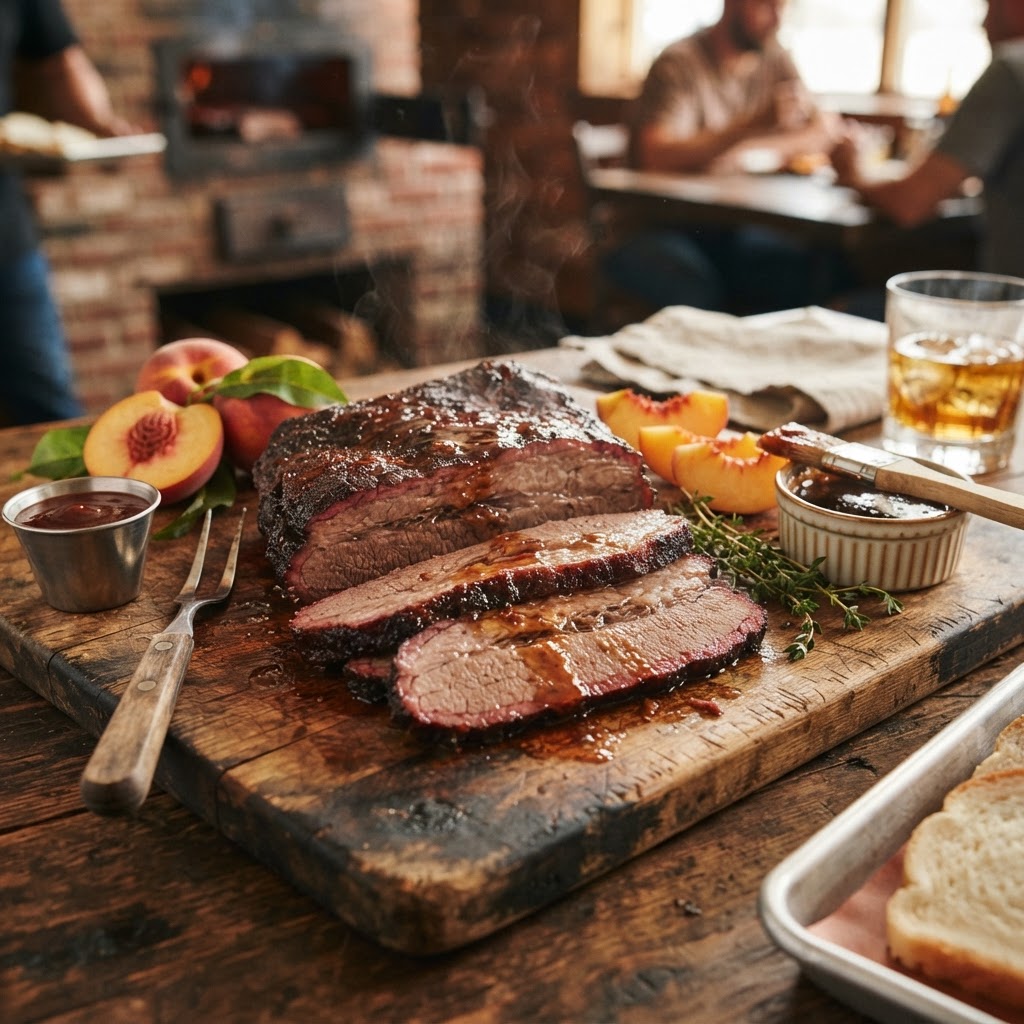
Smoked beef brisket is the centerpiece of Texas barbecue and one of the most famous American cooking traditions. The dish — a whole brisket, seasoned simply with salt and pepper, smoked low and slow over oak wood for 12 to 18 hours until the exterior develops a deep, mahogany bark and the interior is tender, juicy, and deeply infused with smoke — is the test of a pitmaster's skill. In Texas, particularly in the Central Texas tradition of the Hill Country around Austin and Lockhart, brisket is not just food; it is a craft, a culture, and a point of regional pride.
The Central Texas barbecue tradition descends from the German and Czech immigrants who settled the Hill Country in the 19th century and brought their meat-smoking traditions with them. The leading Texas barbecue joints — Louie Mueller Barbecue in Taylor (opened 1949), Kreutz Market in Lockhart (opened 1900), and Snow's BBQ in Lexington (the current champion, voted best in Texas year after year) — cook whole packer briskets over post oak wood for the better part of a day, producing the deeply smoky, peppery bark and meltingly tender interior that define the style. The barbecue boom of the 2010s — led by Aaron Franklin of Franklin Barbecue in Austin, whose brisket became a global phenomenon — elevated Texas brisket from regional specialty to international culinary icon.
The bourbon peach glaze is a Southern complement to the smoked brisket — the sweetness of the peaches (a Southern staple) and the warmth of the bourbon (a Kentucky contribution) create a glaze that caramelizes onto the bark during the final hour of smoking, adding a glossy, sweet-savory layer that bridges the smoky meat and the sweet, fruity glaze. The combination is a celebration of the American South — Texas smoke, Kentucky bourbon, Georgia peaches — in a single dish.
Ingredients (serves 10–12 as a main course):
The Brisket: - 1 whole packer brisket, 12–14 lbs (untrimmed, with the fat cap intact — the packer brisket includes both the flat and the point) - ¼ cup kosher salt (or a classic Texas salt-and-pepper rub — see below) - ¼ cup coarsely ground black pepper - 2 tablespoons granulated garlic (optional — some purists use only salt and pepper)
The Bourbon Peach Glaze: - 4 ripe peaches, pitted and diced (or 2 cups frozen peaches, thawed) - ½ cup bourbon (good-quality, like Maker's Mark or Buffalo Trace) - ½ cup brown sugar, packed - ¼ cup apple cider vinegar - 2 tablespoons Dijon mustard - 1 tablespoon Worcestershire sauce - 1 teaspoon smoked paprika - ½ teaspoon cayenne pepper (optional, for a subtle heat) - 1 tablespoon butter - Salt and black pepper
The Smoke: - Post oak wood (the traditional Texas fuel — available from specialty BBQ suppliers), or hickory or oak chunks as a substitute - A charcoal or wood-fired smoker (or a charcoal grill set up for indirect smoking) - A meat thermometer (essential — guessing is impossible for a cut this size)
Preparing the Brisket: Trim the fat cap to ¼ inch — leave a uniform layer that will render during cooking, but trim the hard, excess fat. The thinner the fat cap, the more smoke penetrates the meat. Pat the brisket dry. Combine the salt, pepper, and granulated garlic (if using). Apply the rub generously to all surfaces — the seasoning should form a visible crust. Let the brisket sit at room temperature for 1 hour before smoking.
Smoking the Brisket (Low and Slow): Preheat the smoker to 225°F (225°F). Add the post oak wood chunks to the fire. Place the brisket fat-side up on the smoker grate, away from the direct heat. Close the lid. Smoke at 225°F for 6–8 hours, maintaining a steady temperature and adding fuel as needed. The brisket is smoked, not grilled — do not open the lid frequently. Every time you open the smoker, you lose heat and extend the cooking time.
The Texas Crutch (Wrapping): After 6–8 hours, when the bark is set (deeply colored and firm to the touch) and the internal temperature reaches 165°F, wrap the brisket tightly in butcher paper (the Texas method — foil steams the meat and softens the bark). Return to the smoker. Continue smoking at 225°F for another 4–6 hours until the internal temperature reaches 200–203°F and a probe slides into the thickest part of the brisket with no resistance, like room-temperature butter.
The Bourbon Peach Glaze (prepare during the final hour): In a saucepan, combine the diced peaches, bourbon, brown sugar, apple cider vinegar, Dijon mustard, Worcestershire sauce, smoked paprika, and cayenne. Bring to a simmer over medium heat and cook 15–20 minutes until the peaches break down and the glaze thickens to a syrupy consistency. Stir in the butter at the end. Season with salt and pepper. (Can be made 2 days ahead; refrigerate.)
Glazing the Brisket: After the brisket reaches 200–203°F, unwrap it carefully. Brush the bourbon peach glaze generously over the top and sides of the brisket. Return to the smoker for 20–30 minutes at 250°F to allow the glaze to set and caramelize onto the bark. The glaze should be glossy, deeply caramelized, and fragrant with bourbon and peach.
Resting: Remove the brisket from the smoker and wrap it loosely in butcher paper, then in a towel. Place it in an empty cooler (insulated) and let it rest 1 hour (up to 4 hours). Resting is non-negotiable — the juices redistribute and the internal temperature equalizes. Slicing before resting causes the juices to run onto the board, leaving the meat dry.
Slicing: Slice the brisket against the grain into ¼-inch thick slices. The grain changes direction between the flat and the point — pay attention and adjust your cutting angle. Each slice should have a visible, deeply colored bark on one side and a pink smoke ring beneath.
Service: Arrange the sliced brisket on a platter with the glazed side up. Serve with additional glaze on the side, plus traditional Texas sides — coleslaw, pinto beans, potato salad, and white bread. Pickles and sliced onions are the classic garnish.
The Mimosa Pairing Logic: The smoky, sweet-savory character of the bourbon peach glazed brisket calls for a mimosa with fruit that echoes the peach glaze and brightness that cuts through the richness. A peach bellini mimosa is the most natural pairing — the peach directly echoes the glaze and the prosecco's fruitiness complements the smoky meat. A mango cardamom mimosa is inspired — the tropical fruit and warm spice create a beautiful resonance with the Southern flavor profile. For a more structured pairing, a peach ginger mimosa provides a warm, spicy counterpoint that complements the bourbon. Avoid very dry or tannic mimosas — they clash with the sweet, smoky character of the dish.
Reference Links: - Texas barbecue history: Texas Monthly - Smoked brisket technique: Serious Eats - Aaron Franklin's brisket method: Franklin Barbecue - Central Texas barbecue tradition: Wikipedia
Make-Ahead: The brisket can be smoked a day ahead, wrapped in butcher paper, refrigerated, and reheated gently in a 250°F oven with a splash of beef broth to keep it moist. The glaze can be made 2 days ahead. The brisket must be rested before slicing — this cannot be rushed.
Pro Tips: The packer brisket — the whole, untrimmed cut including both the flat and the point — is the only brisket to smoke. Trimmed flats from the supermarket lack the fat and connective tissue that produce the tender, juicy result. Post oak wood is the traditional Texas fuel — it produces a clean, intense smoke that is the signature of Central Texas brisket. Hickory is an acceptable substitute, but mesquite is too strong for a long smoke. The Texas crutch (wrapping in butcher paper when the brisket hits 165°F) is the key to a tender, juicy result — unwrapped, the brisket can stall at 165°F for hours as the evaporating moisture cools the meat. The internal temperature of 200–203°F and the probe test (slides in like butter) are the only reliable indicators of doneness — guessing is impossible for a cut this size. Resting in an insulated cooler for at least 1 hour is essential — the brisket continues to cook from residual heat and the juices redistribute.
Rate this recipe
Be the first to rate this recipe
to submit your rating.
Recent Posts

Couscous Royale: North Africa's Grand Platter of Lamb, Chicken, and Merguez
October 14, 2026

Seattle Cream Cheese Dog Bites: Hadley Long's 1989 Pioneer Square Invention
October 14, 2026

Khao Soi: Chiang Mai's Northern Thai Coconut Curry Noodles
October 13, 2026

Korean Bibimbap: Jeonju's Joseon Dynasty Mixed Rice
October 11, 2026

Spaghetti alla Carbonara: Rome's World War II Pasta of Eggs, Guanciale, and Pecorino
October 9, 2026