Scotch Quail Eggs with Herbs and Mustard Aioli
February 23, 2026
In 1738, the London department store Fortnum & Mason, at Piccadilly, created the Scotch egg as a portable, durable meal for travellers heading west out of the city. The store called it a "scotched" egg, after the anchovies mixed into the sausage meat to sharpen its flavor, and it has been sold continuously at Fortnum & Mason for nearly three hundred years. The original had no breadcrumb coating; that came later, and by 1861 Isabella Beeton was suggesting it as an option. The food historian Annette Hope has speculated that the deeper inspiration was the Mughlai *nargisi kofta*, in which a boiled egg is encased in seasoned ground meat and fried, a dish the British encountered in India.
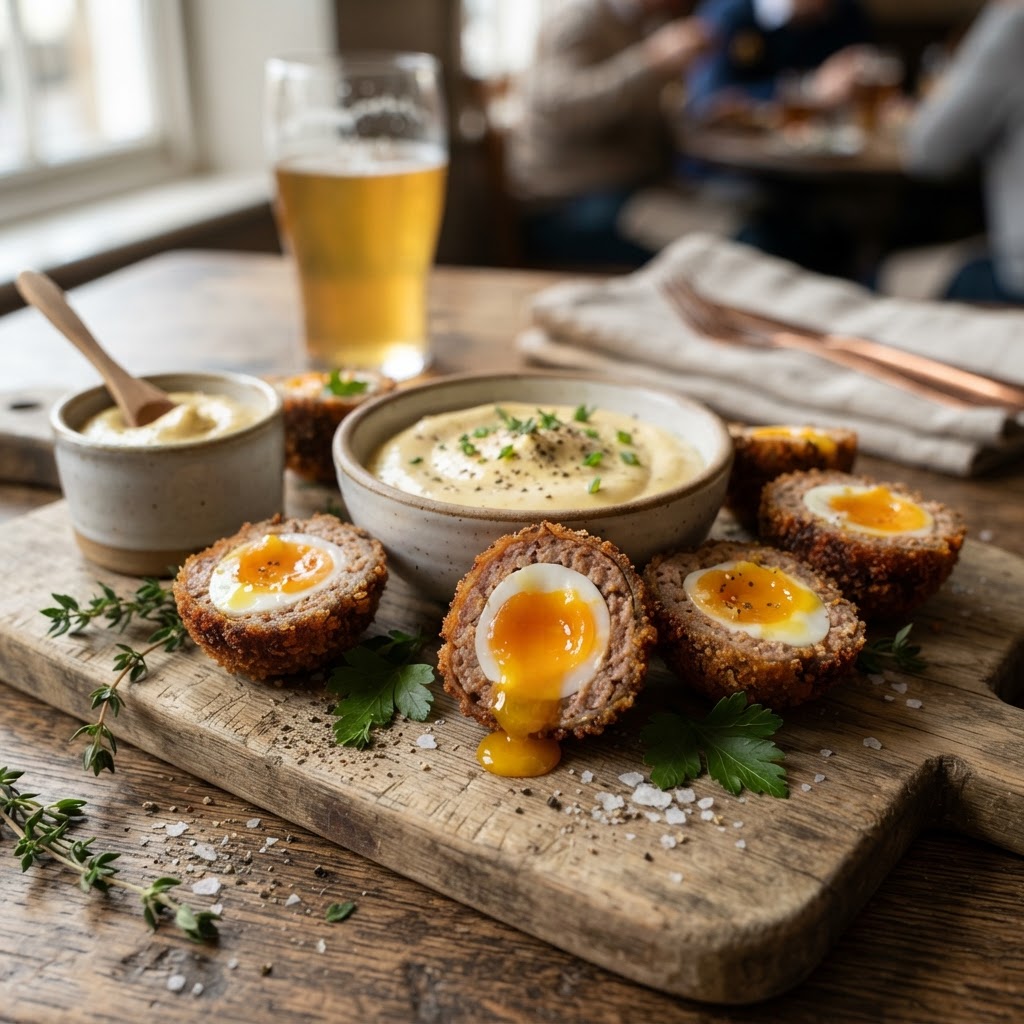
The quail-egg version is a more recent refinement, a bite-sized cocktail-party canapé built on the same principle: a soft- or jammy-set quail egg, the yolk barely set and custard-like at the center, encased in a thin, even layer of seasoned sausage meat, coated in crisp panko, and deep-fried until golden. The mustard aioli, a garlicky mayonnaise sharpened with English mustard, is the bright, pungent counterpoint that makes the bite sing. Each element must be precise: the egg must be perfectly timed (quail eggs go from soft to hard in seconds), the sausage layer must be thin and even (too thick and the egg overcooks before the meat is done), and the oil temperature must be high enough to fry the exterior without overcooking the yolk.
Ingredients (makes 24 Scotch quail eggs): - 24 quail eggs (available at specialty grocers, Asian markets, and online) - 14 ⅛ oz good-quality sausage meat (British-style banger or high-quality pork breakfast sausage, casings removed) - 1 teaspoon fresh thyme leaves, finely chopped - 1 teaspoon fresh parsley, finely chopped - ½ teaspoon mace or freshly grated nutmeg - ½ teaspoon salt - ¼ teaspoon freshly ground black pepper - ½ cup all-purpose flour - 2 large eggs, beaten with 1 tablespoon water - 1½ cups panko breadcrumbs - Neutral frying oil (grapeseed, canola, or peanut) - Flaky sea salt
Mustard Aioli: - 5 ¼ oz good-quality mayonnaise (Duke's or Hellmann's) - 2 garlic cloves, grated to a paste - 1 tablespoon Colman's English mustard (the classic choice — sharp and pungent) - 1 tablespoon whole grain mustard - 1 teaspoon fresh lemon juice - ½ teaspoon Worcestershire sauce - Salt and white pepper
Boiling the Quail Eggs: Bring a small pot of water to a rolling boil. Gently lower quail eggs into the water using a slotted spoon. Boil exactly 2 minutes and 15 seconds for a jammy, custard-like yolk (2 minutes for a softer set, 2 minutes 30 seconds for a firmer but still soft yolk). Immediately transfer to a bowl of ice water and cool completely. Peel very carefully — quail egg shells are delicate and the whites tear easily. Peel under cold running water to help separate the membrane. Pat dry.
Seasoning the Sausage Meat: In a bowl, combine sausage meat, thyme, parsley, mace, salt, and pepper. Mix until just combined — do not overwork or the meat becomes dense. Divide into 24 equal portions (approximately ½ oz each). Flatten each portion into a thin disc in the palm of your hand. Place a peeled quail egg in the center and gently wrap the sausage meat around it, sealing any seams. The sausage layer should be thin and even — no more than 3–4mm thick. Roll gently between your palms to smooth the surface.
Breading: Set up three shallow dishes: flour with a pinch of salt, beaten egg with water, and panko breadcrumbs. Roll each sausage-wrapped egg in flour (shake off excess), dip in egg (let excess drip off), then roll in panko, pressing gently to adhere. Place on a parchment-lined tray. Chill 15 minutes to set the coating.
Mustard Aioli: Whisk together mayonnaise, grated garlic, both mustards, lemon juice, Worcestershire, salt, and white pepper. Taste — it should be sharp, garlicky, and mustardy. (Can be made 3 days ahead; refrigerate.)
Frying: Heat oil in a heavy Dutch oven to 350°F. Working in batches of 6, carefully lower the Scotch eggs into the oil. Fry 4–5 minutes, turning occasionally, until deeply golden and the sausage is cooked through. Remove to a wire rack set over paper towels. Season with flaky salt. Serve warm or at room temperature.
The Mimosa Pairing Logic: The rich, savory sausage coating and the creamy egg yolk call for a mimosa with bright acidity that cuts through the richness. A classic orange mimosa is the most natural pairing — the citrus refreshes the palate and the champagne's toasty notes complement the sausage. A grapefruit rosemary mimosa is exceptional — the grapefruit's gentle bitterness balances the richness of the fried coating, while the rosemary echoes the herbs in the sausage. For a more aromatic pairing, a cardamom orange blossom mimosa creates a beautiful bridge with the mace and thyme in the sausage. Avoid very sweet tropical mimosas — they amplify the richness rather than providing contrast.
Reference Links: - Scotch egg history at Fortnum & Mason: Fortnum & Mason - Scotch egg Wikipedia: Wikipedia - Quail egg cooking guide: The Spruce Eats - Colman's English mustard: Colman's
Make-Ahead: Mustard aioli (3 days, refrigerated). Quail eggs can be boiled, peeled, and wrapped in sausage meat up to 24 hours ahead (refrigerate, covered). Bread and fry just before service. Once fried, Scotch quail eggs are best served within 30 minutes but hold reasonably well at room temperature for up to 1 hour.
Pro Tips: The quail egg timing is the single most critical variable — 2 minutes 15 seconds in boiling water produces the ideal jammy yolk. Test one egg first to calibrate your stove and altitude. Peeling quail eggs is notoriously fiddly — crack them all over before peeling, and peel under a thin stream of cold water, which helps separate the membrane from the white. The sausage layer must be thin and even — if it is too thick, the egg will overcook before the sausage is done, and the Scotch egg becomes dense and leaden. Chilling the breaded eggs before frying is essential — it sets the coating and prevents the sausage from splitting open in the hot oil.
Rate this recipe
Be the first to rate this recipe
to submit your rating.
Recent Posts

Couscous Royale: North Africa's Grand Platter of Lamb, Chicken, and Merguez
October 14, 2026

Seattle Cream Cheese Dog Bites: Hadley Long's 1989 Pioneer Square Invention
October 14, 2026

Khao Soi: Chiang Mai's Northern Thai Coconut Curry Noodles
October 13, 2026

Korean Bibimbap: Jeonju's Joseon Dynasty Mixed Rice
October 11, 2026

Spaghetti alla Carbonara: Rome's World War II Pasta of Eggs, Guanciale, and Pecorino
October 9, 2026