Russian Medovik Honey Cake al Brachetto
August 6, 2026
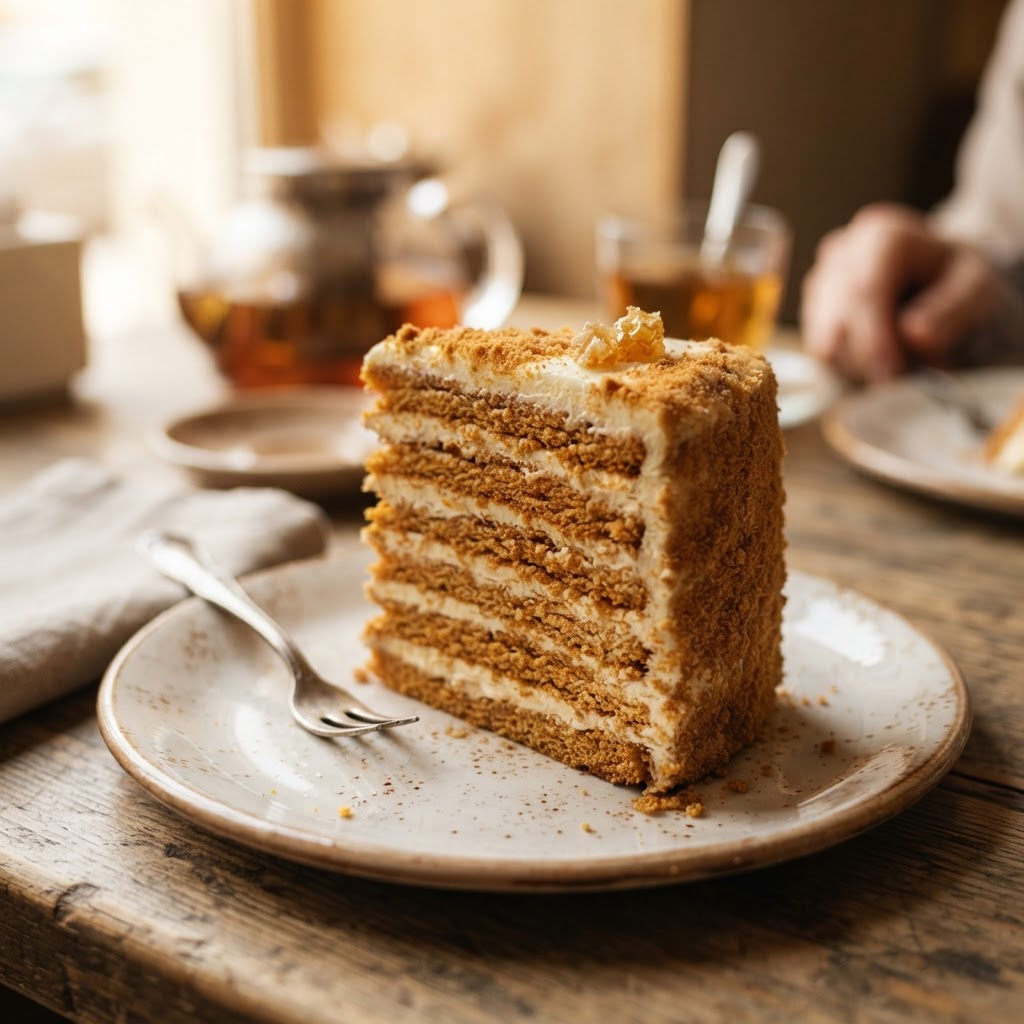
Medovik — the Russian honey cake, with its many thin, caramel-hued honey cake layers and creamy white sour cream frosting — is one of the most famous desserts of Russia and the former Soviet Union. It is a cake of impressive appearance and remarkable flavor: the honey-laced layers are delicate and slightly chewy, and the tangy sour cream frosting softens them over time into a tender, sliceable whole with a distinctive smoky, caramelized honey flavor.
According to Wikipedia, medovik is a layer cake popular in countries of the former Soviet Union, and its identifying ingredients are honey and smetana (sour cream) or condensed milk. Vika Linka describes medovik as eight layers of honey goodness with a creamy filling in between — a stunning layered dessert made with delicate honey-infused cake layers and a light, tangy sour cream frosting.
The most charming origin story of medovik places its invention in the early 19th century in the Imperial Russian court. According to popular tradition, the cake was created in the 1820s by a young confectioner for Empress Elizabeth Alexeievna, the wife of Tsar Alexander I. The Empress was famously displeased with honey, finding it cloying, and court chefs were forbidden from serving it. A new young confectioner, seeking to win her favor, created a multi-layered honey cake with a tangy sour cream frosting — and the Empress, not recognizing the honey beneath the cream, was delighted. Whether or not the story is strictly true, medovik became one of the most popular cakes of the Russian Empire and, later, the Soviet Union, and it remains a popular dessert across Russia, Ukraine, Belarus, and the Baltic states today.
What makes medovik distinctive is the honey cake dough itself. Unlike most layer cakes, the medovik dough is cooked on the stovetop — butter, honey, sugar, and eggs are heated together until melted and smooth, then baking soda is added (the dough foams and lightens dramatically), and flour is stirred in to form a soft, sticky dough. This hot honey dough is then divided and rolled thin, and each layer is baked individually for just a few minutes until golden and fragrant. The layers are slightly chewy, deeply honeyed, and have a subtle bitterness from the caramelized honey. The frosting is a simple mixture of sour cream (smetana) and sugar — its tanginess is the perfect counterpoint to the sweetness of the honey layers. The finished cake must rest for many hours (ideally overnight) so the sour cream frosting softens the layers into a tender, sliceable whole. The sides of the cake are traditionally coated in crumbs made from a reserved layer of the honey cake, giving the cake its characteristic rustic, crumb-dusted appearance.
Our Mimosavated version adds a splash of Brachetto d'Acqui to the sour cream frosting — the sweet, lightly sparkling red wine with strawberry and rose aromas adds a subtle berry note that complements the caramelized honey.
Ingredients (serves 12):
The Honey Cake Layers: - 3 ½ oz unsalted butter - 3 ½ oz honey (a flavorful honey — buckwheat or wildflower is ideal) - 5 ¼ oz granulated sugar - 2 large eggs - 1 teaspoon baking soda - 14 ⅛ oz all-purpose flour (plus extra for rolling) - 1 teaspoon vanilla extract - A pinch of salt
The Brachetto Sour Cream Frosting: - 1 lb 5 oz full-fat sour cream (smetana — use the highest fat you can find) - 5 ¼ oz powdered sugar - ⅓ cup Brachetto d'Acqui - 1 teaspoon vanilla extract
Making the Honey Cake Dough: In a large saucepan over low heat, combine the butter, honey, and sugar. Heat, stirring, until the butter is melted and the sugar is dissolved — do not let it boil. Remove from heat and let cool for 5 minutes.
Whisk in the eggs one at a time, whisking constantly so they don't scramble. Return to low heat. Add the baking soda — the mixture will foam and lighten in color dramatically. Cook, stirring constantly, for 2–3 minutes, until the mixture is a light, foamy caramel color. Remove from heat and stir in the vanilla and salt.
Gradually stir in the flour, mixing until a soft, sticky dough forms. Turn the dough out onto a floured surface and knead briefly until smooth — the dough should be soft but workable, not sticky.
Baking the Layers: Preheat the oven to 392°F (400°F).
Divide the dough into 8 equal portions. Roll each portion into a thin 9 in (9-inch) round on a sheet of parchment paper — the dough is soft, so roll directly on the paper you'll bake it on. Prick each layer all over with a fork. Bake each layer for 4–5 minutes, until golden and slightly puffed — they bake very quickly. Let cool on the parchment.
Reserve one baked layer for the crumbs. Trim the remaining 7 layers into neat rounds using a 7 ⅞ in (8-inch) plate as a guide (save the trimmings).
Making the Brachetto Sour Cream Frosting: In a bowl, whisk together the sour cream, powdered sugar, Brachetto, and vanilla until smooth and spreadable — do not over-whip, or the sour cream will thin out. The frosting should be thick enough to hold its shape.
Assembling: Place the first honey layer on a serving plate. Spread a thin, even layer of frosting over it. Repeat with the remaining 6 layers and frosting, finishing with a layer of frosting on top. Frost the sides of the cake with the remaining frosting.
Crumble the reserved baked layer (and the trimmings) into fine crumbs. Press the crumbs all over the top and sides of the cake, covering the frosting completely.
Resting: Cover the cake loosely and refrigerate for at least 8 hours, ideally overnight — this resting time is essential, as the sour cream frosting softens the honey layers into a tender, sliceable whole. A freshly assembled medovik is hard and crumbly; a rested medovik is soft and melts in the mouth.
Serving: Slice with a serrated knife. Serve chilled or at room temperature — either is traditional.
The Mimosa Pairing Logic: Since the frosting contains Brachetto d'Acqui, pair with a strawberry mimosa — strawberry purée and Prosecco. The strawberry echoes the Brachetto and complements the caramelized honey. A raspberry rose champagne mimosa is also excellent — the raspberry and rose mirror the Brachetto and complement the honey cake's warm, amber flavors. Avoid heavy or dry mimosas — medovik is sweet, honeyed, and tangy, and you need something light and fruity with a touch of berry to complement it.
Reference Links: - Medovik on Wikipedia (honey and smetana, former Soviet Union): Wikipedia - Russian Honey Cake Medovik (eight layers, sour cream frosting): Vika Linka - Brachetto d'Acqui wine guide: Wine Folly
Make-Ahead: The honey cake layers can be baked up to 2 days ahead and stored at room temperature, well-wrapped. The frosting can be made up to 2 days ahead and refrigerated. The assembled cake must rest for at least 8 hours (ideally overnight) before serving — this is not optional; the resting time is what transforms the hard layers into a tender cake. The fully assembled cake keeps for up to 5 days in the refrigerator and actually improves over the first 2–3 days as the frosting continues to soften the layers. The cake can be frozen for up to 2 months — thaw in the refrigerator overnight.
Pro Tips: Use a flavorful, dark honey — buckwheat or wildflower honey gives the cake its signature deep, smoky, caramelized flavor; a mild clover honey will produce a bland cake. The dough is cooked on the stovetop before the flour is added — this cooks the honey and creates the distinctive caramelized flavor; don't skip this step. When the baking soda is added, the dough foams dramatically — this is normal and is what lightens the dense honey dough. Roll the layers thin and even — about 3mm — so they bake quickly and soften properly with the frosting. Bake the layers one at a time and watch carefully — they bake in 4–5 minutes and burn quickly. Reserve one layer for crumbs — the crumb coating on the sides is the signature of a proper medovik and gives the cake its rustic appearance. The sour cream must be full-fat — low-fat sour cream will weep and produce a runny frosting. The resting time is essential — do not skip it; a freshly assembled medovik is hard and crumbly, while a rested medovik is soft and sliceable. The cake improves with age — it is often best on the second or third day, after the frosting has fully soaked into the layers.
Rate this recipe
Be the first to rate this recipe
to submit your rating.
Perfect Mimosa Pairings
Mimosas that pair perfectly with this dish
Recent Posts

Couscous Royale: North Africa's Grand Platter of Lamb, Chicken, and Merguez
October 14, 2026

Seattle Cream Cheese Dog Bites: Hadley Long's 1989 Pioneer Square Invention
October 14, 2026

Khao Soi: Chiang Mai's Northern Thai Coconut Curry Noodles
October 13, 2026

Korean Bibimbap: Jeonju's Joseon Dynasty Mixed Rice
October 11, 2026

Spaghetti alla Carbonara: Rome's World War II Pasta of Eggs, Guanciale, and Pecorino
October 9, 2026