Russian Blini with Smoked Salmon and Crème Fraîche: The Medieval Buckwheat Pancake as an Elegant Party Bite
June 15, 2026
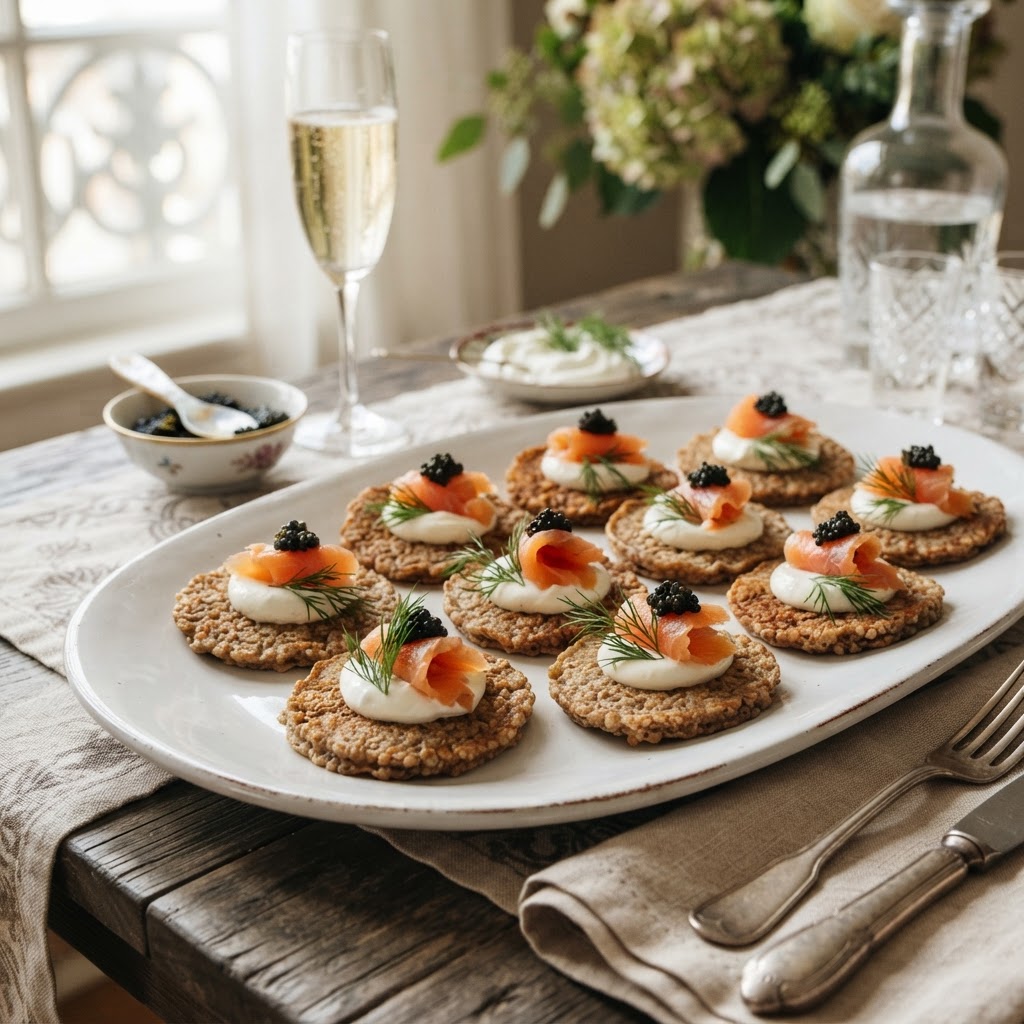
Russian blini with smoked salmon are the medieval buckwheat pancake reimagined as an elegant party bite — small, golden-brown yeast pancakes topped with crème fraîche, a curl of smoked salmon, a sprig of dill, and a small spoonful of caviar. They are the kind of appetizer that feels like a czar's table, the kind that makes the whole room feel more elegant.
The History of Blini
According to Wikipedia, blini have a history dating to the Middle Ages in Russian culture. Blinis are small, thick Russian pancakes traditionally made with buckwheat flour. Wikipedia's buckwheat pancake entry notes that the buckwheat variety of blini is particularly popular in Russia, Ukraine (*hrechanyky*), and Lithuania (*grikių blynai*). The Moscow Times traces the longer history: the idea of pouring liquid batter on a heated stone and baking it has been around for several millennia — they were made in ancient Egypt, Greece, and Rome — but blini as a distinct Russian food have a history rooted in the Middle Ages.
Blini were traditionally made during Maslenitsa, the pre-Lenten festival — the Russian equivalent of Mardi Gras, when dairy and eggs are used up before the fast. The buckwheat flour gives the blini a dark, nutty, slightly earthy flavor that is the perfect foil for the rich toppings. The classic accompaniments — sour cream, smoked salmon, caviar, dill — are the Russian table at its most luxurious.
The party version is the same: small blini, topped with crème fraîche (the French version of sour cream, slightly tangy and thick), smoked salmon, dill, and caviar. It is the appetizer that bridges Russia and France, the medieval and the modern.
About the Ingredients
Buckwheat flour — the traditional flour for blini; it gives the pancakes their dark color and nutty, earthy flavor. A mix of buckwheat and all-purpose flour produces a lighter, more refined blini.
Yeast — the traditional leavening; yeast-risen blini are lighter and airier than pancake-batter blini, with a slightly tangy flavor from the fermentation.
Crème fraîche — the French version of sour cream, thicker and less sour; it is the perfect base for the salmon and the caviar.
Smoked salmon — cold-smoked, sliced thin; the salmon should be silky, not chewy.
Caviar — the smallest spoonful; it doesn't need to be beluga — even good salmon roe or trout roe adds the briny pop that makes the bite.
Dill — fresh, for the herbal note that ties it all to the Russian table.
Ingredients (makes 24 blini): - 1/2 cup buckwheat flour - 1/2 cup all-purpose flour - 1 tsp active dry yeast - 1 cup warm milk - 1 large egg, separated - 1 tbsp melted butter - 1/2 tsp salt - 1/2 cup crème fraîche - 4 oz smoked salmon, cut into small pieces - 2 tbsp caviar (salmon roe or trout roe) - Fresh dill sprigs for garnish
Instructions: Make the blini batter: in a bowl, combine the buckwheat flour, all-purpose flour, yeast, warm milk, and salt. Whisk until smooth. Cover and let rise in a warm place 1 hour, until bubbly. Whisk the egg yolk and melted butter into the batter. Beat the egg white until stiff, then fold gently into the batter. Heat a non-stick skillet over medium heat and brush with butter. Drop tablespoons of batter to make small pancakes, 2–3 inches in diameter. Cook 1–2 minutes per side, until golden and puffed. Transfer to a plate. To assemble: place a small dollop of crème fraîche on each blini, top with a piece of smoked salmon, a small spoonful of caviar, and a sprig of dill. Serve immediately, while the blini are warm.
The Mimosa Pairing Logic: Smoked salmon, caviar, and sparkling wine is the most classic brunch pairing in the world. A classic champagne mimosa is the purist's pick — the orange juice's citrus echoes the crème fraîche's tang. A pomegranate mimosa is the jewel alternative — the pomegranate seeds mirror the caviar and the tartness is the Baltic. Either way, eat the blini while it is warm and the salmon is cold, and raise the glass to Moscow.
Reference Links: - Blini (Middle Ages history, buckwheat flour): Wikipedia - Buckwheat pancake (Eastern European varieties): Wikipedia - The Long Lost History of Russian Blinis: The Moscow Times
Make-Ahead: The blini batter can be made a day ahead and kept in the refrigerator after the first rise — let it come to room temperature before folding in the egg white. The blini can be cooked a few hours ahead and kept at room temperature, covered. But assemble just before serving — a blini with crème fraîche and salmon that sits has a soggy base. Warm the blini briefly if needed, top, and pass.
Pro Tips: Use a mix of buckwheat and all-purpose flour — 100% buckwheat is too dense for a delicate party blini. Let the batter rise — the yeast needs time to create the light, airy texture. Fold the egg white gently — this is what makes the blini fluffy. Cook the blini small, 2–3 inches, for a single bite. And don't overload the toppings — a small dollop of crème fraîche, a piece of salmon, a spoonful of caviar, a sprig of dill. The blini should be the star, not buried.
Rate this recipe
Be the first to rate this recipe
to submit your rating.
Recent Posts

Couscous Royale: North Africa's Grand Platter of Lamb, Chicken, and Merguez
October 14, 2026

Seattle Cream Cheese Dog Bites: Hadley Long's 1989 Pioneer Square Invention
October 14, 2026

Khao Soi: Chiang Mai's Northern Thai Coconut Curry Noodles
October 13, 2026

Korean Bibimbap: Jeonju's Joseon Dynasty Mixed Rice
October 11, 2026

Spaghetti alla Carbonara: Rome's World War II Pasta of Eggs, Guanciale, and Pecorino
October 9, 2026