Portuguese Pastel de Nata: The Lisbon Custard Tart of the Jerónimos Monastery
July 8, 2026
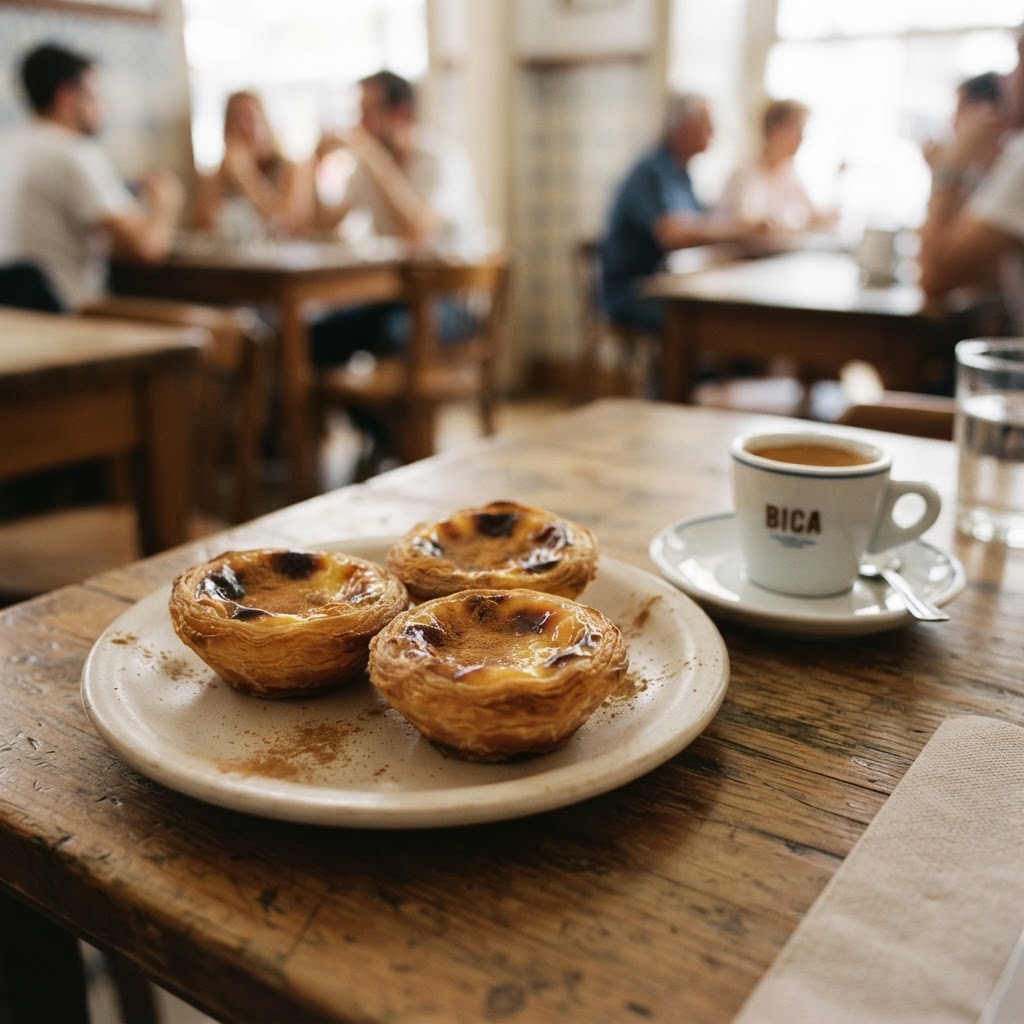
The *pastel de nata* is the great pastry of Portugal — a small, round egg-custard tart in a flaky, multilayered pastry shell, blistered and charred on top from the blistering oven, dusted with cinnamon and powdered sugar, eaten warm in two bites with a *bica* espresso, a confection created before the 18th century by Catholic monks at the Jerónimos Monastery in Belém, Lisbon, and sold from a single bakery — the *Fábrica de Pastéis de Belém* — since 1837, where the original recipe is kept in a secret room to this day. According to Wikipedia, the *pastel de nata* is a Portuguese egg custard tart pastry, optionally dusted with cinnamon; the pastries are inspired by an original recipe called *pastéis de Belém*, created before the 18th century by Catholic monks at the Jerónimos Monastery in Belém, Lisbon. At the time, convents and monasteries used large quantities of egg whites for starching clothes (the habits of friars and nuns), and it was common to use the leftover egg yolks to make cakes and pastries, resulting in a proliferation of sweet pastry recipes throughout Portugal. After the Liberal Revolution of 1820 and the closure of the monasteries, the monks began selling the tarts at a nearby sugar refinery; in 1834 the monastery closed and the recipe was sold to the refinery's owners, who opened the *Fábrica de Pastéis de Belém* in 1837. The Lisbon Guru records that since the bakery's opening the original recipe has been kept in a secret room accessible only to the master pastry chefs, and that the shop sells over 20,000 pastries a day.
The genius of the *pastel de nata* is the contrast: the pastry is a puff pastry with hundreds of flaky, shattering layers, made by rolling the dough into a cylinder and slicing it into discs that are pressed into the tart molds, and the custard is a simple, intensely eggy cream, baked in a very hot oven so that the top blisters and blackens in spots — the mark of a true pastel de nata. Eaten warm, dusted with cinnamon, the combination of the crisp, flaky shell and the soft, barely sweet, burnt-topped custard is one of the great pastries of the world.
About the Ingredients
Puff pastry — the pastry is made from a flour-and-water dough laminated with butter (or margarine), rolled into a tight cylinder, rested, and sliced into discs; the discs are pressed into the muffin cups with a spiral motion that creates the characteristic flaky, cup-shaped shell. Homemade puff pastry is the traditional method; high-quality store-bought puff pastry is an acceptable shortcut.
Egg yolks — the custard is rich with egg yolks, the legacy of the convents that had egg yolks to spare; the yolks give the custard its intense yellow color and its silky, custardy richness.
Milk and cream — whole milk (and sometimes a little cream) for the custard base.
Sugar, water, and a cinnamon stick — the custard is sweetened with a sugar syrup (boiled with a cinnamon stick and sometimes lemon peel) that is poured over the yolks and milk; the syrup method gives the smoothest custard and the characteristic slight caramelization on top.
Flour or cornstarch — a little flour or cornstarch to thicken the custard so it sets in the very short, hot bake.
Vanilla, lemon peel, and cinnamon — a strip of lemon peel and a cinnamon stick perfumed the syrup, and a whisper of vanilla; the cinnamon is also the traditional dusting on top.
Ingredients (makes 12 tarts): For the pastry: - 1 lb (about 15 ⅞ oz) puff pastry (homemade or store-bought), thawed if frozen - A little flour for rolling
For the custard: - 1 cup granulated sugar - 1/2 cup water - 1 cinnamon stick - A strip of lemon peel - 1/2 cup whole milk - 1/3 cup heavy cream - 3 tbsp all-purpose flour (or cornstarch) - 6 large egg yolks - Cinnamon and powdered sugar, for dusting
Instructions: For the pastry: roll the puff pastry into a tight log, about 1 inch in diameter. Cut into 12 equal discs. Turn each disc cut-side up and press it into a muffin cup with your thumb, spreading it thin and pushing it up the sides to form a cup. Chill 20 minutes.
For the custard: in a saucepan, bring the sugar, water, cinnamon stick, and lemon peel to a boil, stirring until the sugar dissolves; boil 2–3 minutes, then remove from the heat and discard the cinnamon and peel. In another saucepan, whisk the flour into the milk and cream until smooth; cook over medium heat, whisking, until thickened, 2–3 minutes. Remove from the heat. Whisk the egg yolks in a bowl. Slowly whisk the hot sugar syrup into the yolks, then whisk the yolk-syrup mixture into the warm milk mixture until smooth. Strain through a fine sieve. Let cool to lukewarm.
Preheat the oven to 500°F (or as hot as your oven goes). Pour the lukewarm custard into the chilled pastry shells, filling nearly to the top. Bake 10–12 minutes until the pastry is deep golden and the custard is blistered and blackened in spots on top. Cool 5 minutes in the pan, then unmold. Dust with cinnamon and powdered sugar. Eat warm.
The Mimosa Pairing Logic: The crisp, flaky pastry and the eggy, caramelized custard want a bright, clean drink that cuts the richness and echoes the Lisbon café morning. A classic Champagne mimosa is the natural choice — the citrus acidity balances the rich custard and the bubbles lift the pastry, the way a *bica* espresso does. A sparkling-southside is equally lovely, its mint and lime a bright, herbal counter to the burnt-sugar custard. This is the brunch equivalent of a warm *pastel de nata* and a *bica* at a Lisbon café counter — a sparkling toast to Belém and the monks who invented a pastry that the world cannot stop eating.
Reference Links: - Pastel de nata (Portuguese egg custard tart, Jerónimos Monastery, Belém, Fábrica de Pastéis de Belém 1837): Wikipedia - Pastéis de Belém: A Taste of History (secret recipe, 20,000 pastries a day): Lisbon Guru
Make-Ahead: The pastry shells can be prepared a day ahead and chilled. The custard can be made a day ahead and held refrigerated; bring to lukewarm before pouring (cold custard does not blister). The tarts are best the day they are baked, eaten warm, when the pastry is shatteringly crisp and the custard is at its most delicate; they soften within hours. Reheat briefly in a 400°F oven to re-crisp. The blistered, charred top is the mark of a true pastel de nata; it requires a very hot oven and a fearless bake.
Pro Tips: Roll the puff pastry into a tight log and slice into discs; this is the traditional method, and the spiral of layers is what gives the characteristic flaky cup. Press the discs thin in the muffin cups; a thick pastry shell is doughy, and a thin one shatters beautifully. Bake as hot as your oven will go; the blistered, blackened top is the mark of a true pastel de nata, and a timid, pale bake is a lesser thing. Cool the sugar syrup before adding it to the yolks; hot syrup scrambles the eggs. Strain the custard; the smoothest custard is the mark of a good pastel de nata. Fill the shells nearly full; the custard puffs dramatically and then sinks, and the blistered top forms in the hottest part of the oven. Eat warm, dusted with cinnamon; a cold pastel de nata is a shadow of a warm one, and the cinnamon is the traditional finish.
Rate this recipe
Be the first to rate this recipe
to submit your rating.
Recent Posts

Couscous Royale: North Africa's Grand Platter of Lamb, Chicken, and Merguez
October 14, 2026

Seattle Cream Cheese Dog Bites: Hadley Long's 1989 Pioneer Square Invention
October 14, 2026

Khao Soi: Chiang Mai's Northern Thai Coconut Curry Noodles
October 13, 2026

Korean Bibimbap: Jeonju's Joseon Dynasty Mixed Rice
October 11, 2026

Spaghetti alla Carbonara: Rome's World War II Pasta of Eggs, Guanciale, and Pecorino
October 9, 2026