Portuguese Pastéis de Nata allo Spumante
June 2, 2026
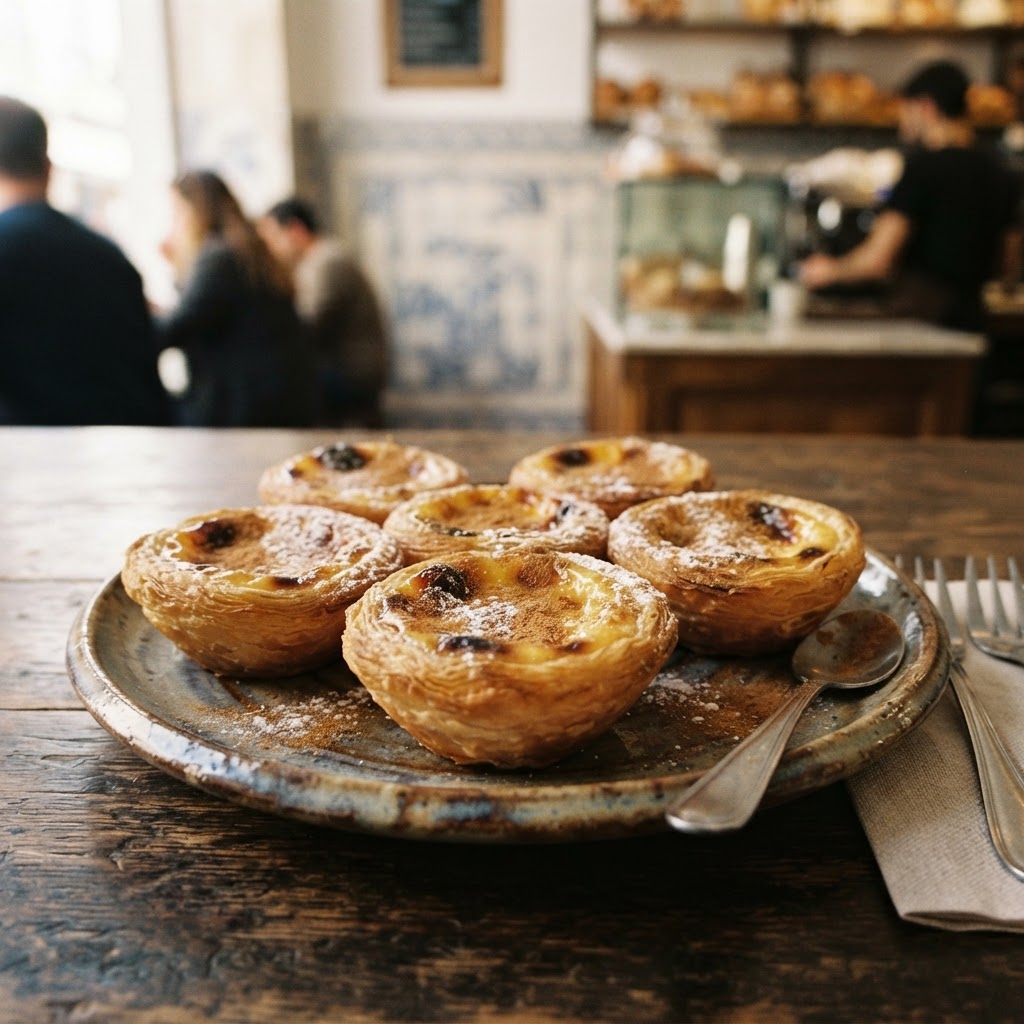
Pastéis de nata — small Portuguese custard tarts with blistered, flaky pastry shells and creamy, caramelized egg custard tops — are one of the most popular pastries in the world, and the pride of Lisbon. Their origin is a story of monks, egg whites, and a 19th-century revolution.
According to Santa Nata, the origin of the pastel de nata dates back to before the 18th century, where they were created by monks at the Jerónimos Monastery in the parish of Santa Maria de Belém in Lisbon. At that time, convents and monasteries used large quantities of egg whites for starching clothes. It was quite common for monasteries and convents to use the leftover egg yolks to make cakes and pastries, resulting in the proliferation of sweet pastry recipes throughout Portugal. In the aftermath of the Liberal Revolution of 1820, following the dissolution of religious orders and the impending closure of many convents and monasteries, the monks started selling pastéis de nata at a nearby sugar refinery to bring in revenue. In 1834, the monastery was closed and the recipe was sold to the sugar refinery. The owners of the sugar refinery then opened Fábrica de Pastéis de Belém, which still sells the original pastéis de Belém today, made from the closely guarded secret recipe.
As ET Food Voyage explains, pastel de nata features crispy, flaky pastry with a creamy egg-custard filling, topped with a dusting of cinnamon and icing sugar. The original recipe was a closely guarded secret, passed down through generations of monks. Nomad Women recounts that the famous pastéis de Belém egg tart was created in the Jerónimos Monastery, just 100 meters from the bakery where it has been sold since 1837.
What makes a great pastel de nata is the contrast between the shatteringly crisp, blistered pastry — achieved by laminating a dough (not puff pastry, but a specifically made mass of dough and butter) — and the creamy, barely set custard, which is baked at a very high temperature so that the top caramelizes and blisters while the interior remains soft. The tarts are traditionally served warm, dusted with cinnamon and powdered sugar, and eaten in two or three bites. In 2009, The Guardian listed pastéis de nata as one of the 50 best things to eat in the world, and in 2019 Bloomberg predicted the pastry was on its way to becoming as ubiquitous as the croissant.
Our Mimosavated version adds a splash of Spumante (Italian sparkling wine) to the custard — the bright, slightly acidic wine lifts the rich egg yolks and adds a subtle fruity note that complements the caramelized top.
Ingredients (makes 12 tarts):
The Puff Pastry Shells: - 1 lb 2 oz all-butter puff pastry (store-bought all-butter puff is fine; or make your own) - 1 tablespoon melted butter, for greasing the muffin tin
The Spumante Custard: - 2 ⅛ cups whole milk - 1 ¾ oz all-purpose flour - 14 ⅛ oz granulated sugar - 1 cup water - 1 cinnamon stick - 1 strip lemon peel - 6 large egg yolks - 3 ⅓ tbsp Spumante (Italian sparkling wine, brut) - 1 teaspoon vanilla extract - A pinch of salt
Preparing the Pastry: Preheat the oven to 482°F (480°F) or as high as your oven will go. Generously grease a 12-cup muffin tin with melted butter.
Roll the puff pastry into a log about 1 in (1 inch) in diameter. Cut the log into 12 equal rounds, each about ¾ in thick. Place each round cut-side up and use your thumb to press it into a thin circle, starting from the center and working outward, until it is large enough to line a muffin cup. Press each circle into a muffin cup, pressing it up the sides so it comes just above the rim. Chill the lined muffin tin while you make the custard.
Making the Spumante Custard: In a saucepan, warm the milk with the cinnamon stick and lemon peel over low heat until just below simmering. Remove from heat and let infuse for 10 minutes. Strain out the cinnamon and peel.
In a small bowl, whisk the flour with a few tablespoons of the warm milk to form a smooth paste. Whisk this paste back into the warm milk.
In another saucepan, combine the sugar and water. Bring to a boil and cook until the syrup reaches 212°F (just simmering, about 3–4 minutes) — this is a light syrup, not caramel. Pour the hot syrup in a thin stream into the warm milk, whisking constantly. Return the mixture to low heat and cook, whisking, until it thickens slightly, about 2 minutes. Remove from heat.
In a bowl, whisk the egg yolks with the Spumante and vanilla. Gradually whisk a few ladles of the hot milk mixture into the yolks to temper them, then pour the yolk mixture back into the saucepan, whisking constantly. Do not let the custard boil — it should be pourable and slightly warm. Strain the custard through a fine sieve into a jug.
Baking: Pour the warm custard into the chilled pastry shells, filling each about three-quarters full. Bake in the very hot oven for 12–15 minutes, until the pastry is deep golden brown and the custard tops are blistered and darkly caramelized in spots — the blistered, caramelized top is the hallmark of a proper pastel de nata.
Remove from the oven and let cool in the tin for 5 minutes. Use a small knife to gently loosen each tart, then transfer to a wire rack to cool slightly.
Serving: Serve warm, dusted with cinnamon and powdered sugar. Pastéis de nata are at their absolute best within an hour of baking, while the pastry is still crisp and the custard is still warm.
The Mimosa Pairing Logic: Since the custard contains Spumante, pair with a classic Prosecco mimosa — orange juice and Prosecco. The bright citrus complements the caramelized custard and the cinnamon. A lemon mimosa is also excellent — the lemon echoes the lemon peel in the custard and cuts the richness. Avoid heavy or sweet mimosas — pastéis de nata are rich with egg and caramel, and you need something bright and citrusy to balance them.
Reference Links: - The History of the Pastel de Nata (Jerónimos Monastery, Belém, 1834): Santa Nata - Pastel de Nata (Jerónimos Monastery, Fábrica de Pastéis de Belém): ET Food Voyage - Lisbon's Pastéis de Belém (1837 bakery, secret recipe): Nomad Women - Spumante Italian sparkling wine guide: Wine Folly
Make-Ahead: The pastry-lined muffin tin can be chilled for up to 2 hours before filling. The custard can be made up to 1 day ahead and refrigerated — gently re-warm to a pourable, lukewarm consistency before baking (do not let it boil). Once baked, pastéis de nata are best eaten within a few hours — the pastry loses its crispness over time. They can be gently reheated in a 356°F (350°F) oven for 3–4 minutes the next day to partially restore the crispness. They can be frozen baked for up to 1 month — reheat from frozen in a 356°F oven for 8–10 minutes.
Pro Tips: The oven must be very hot — 482°F (480°F) or higher. The high heat is what creates the blistered, caramelized custard top and the crisp, flaky pastry; a cooler oven will produce a pale, soft tart that is not a proper pastel de nata. Use all-butter puff pastry — margarine-based pastry doesn't blister and flake the same way. Press the pastry thin in the muffin cups — thick pastry will not bake through and crisp properly. The custard should be lukewarm when poured into the shells — if it's too hot, it will start to cook the pastry; if too cold, it won't caramelize. Fill the shells only three-quarters full — the custard puffs and then settles, and overfilling causes overflow. Don't be afraid of the dark, blistered top — the caramelization is the entire point and provides the complex, bittersweet flavor that distinguishes a great pastel de nata. Serve warm, dusted with cinnamon — the cinnamon is traditional and essential, adding a warm spice note that complements the caramelized custard. Eat them fresh — pastéis de nata are at their absolute best within an hour of baking.
Rate this recipe
Be the first to rate this recipe
to submit your rating.
Perfect Mimosa Pairings
Mimosas that pair perfectly with this dish
Recent Posts

Couscous Royale: North Africa's Grand Platter of Lamb, Chicken, and Merguez
October 14, 2026

Seattle Cream Cheese Dog Bites: Hadley Long's 1989 Pioneer Square Invention
October 14, 2026

Khao Soi: Chiang Mai's Northern Thai Coconut Curry Noodles
October 13, 2026

Korean Bibimbap: Jeonju's Joseon Dynasty Mixed Rice
October 11, 2026

Spaghetti alla Carbonara: Rome's World War II Pasta of Eggs, Guanciale, and Pecorino
October 9, 2026